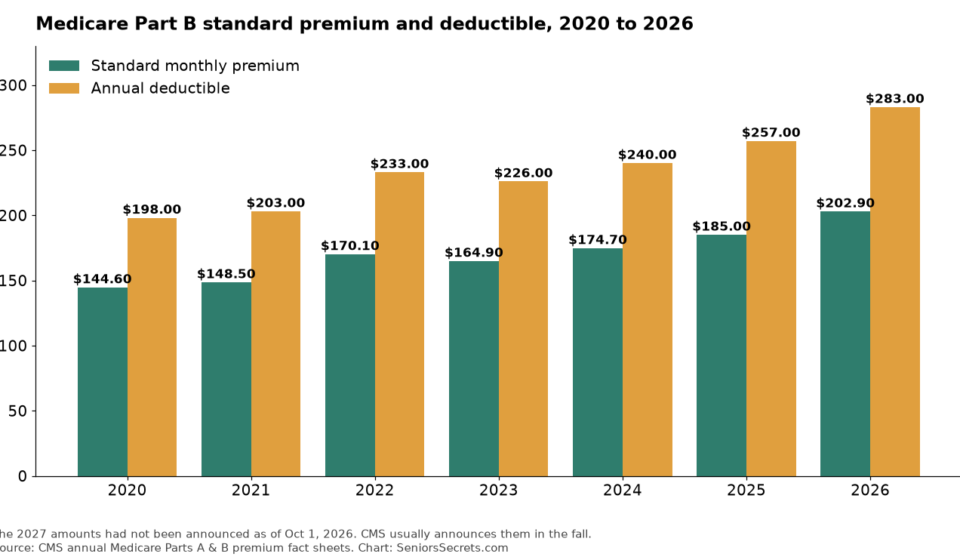

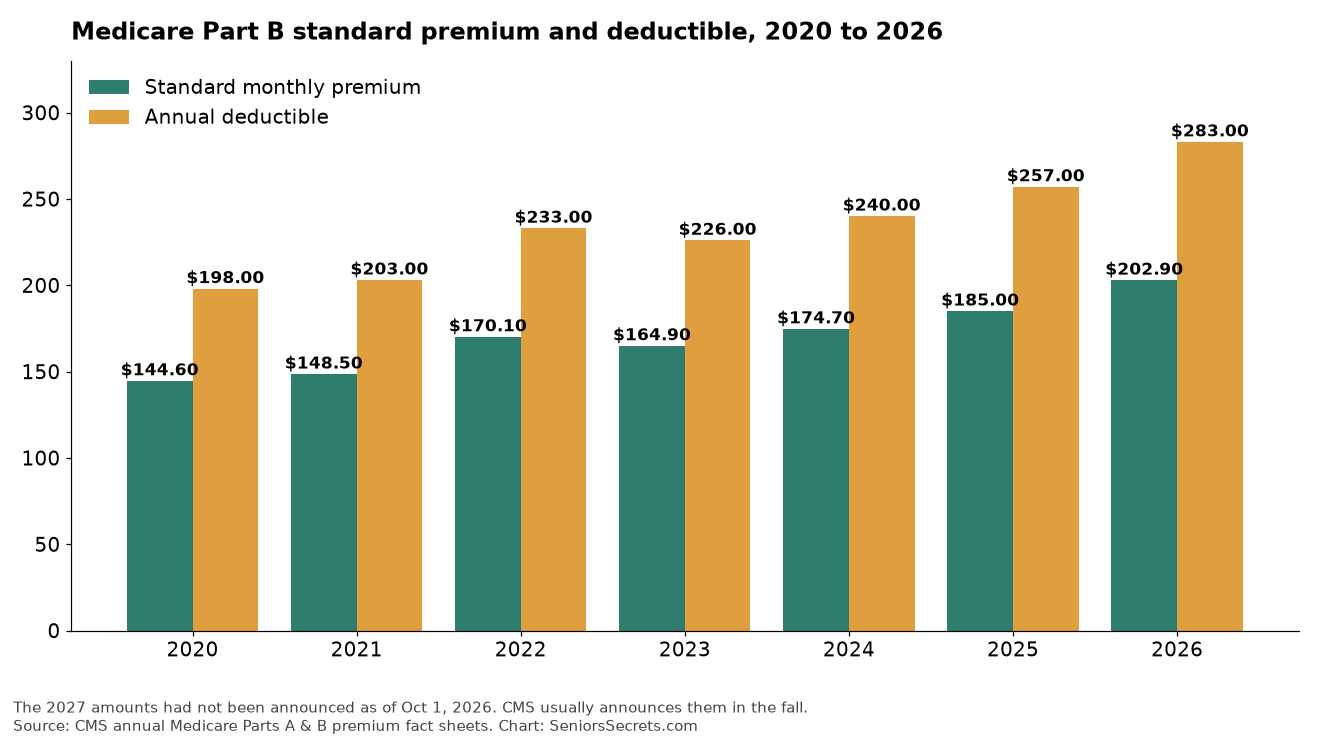
The standard Medicare Part B premium for 2026 is $202.90 a month, up $17.90 from $185 in 2025. It’s the first time the standard premium has topped $200. The annual Part B deductible rose to $283, up from $257. Most people with Medicare pay the standard amount. About 8% pay more because of their income, which is a separate charge called IRMAA.
This guide covers the premium itself: what it pays for, why it went up, how it comes out of your Social Security check, the rule that protects some people from increases, the late-enrollment penalty, and the programs that can pay the premium for you. For the income surcharges, see my separate guide to Medicare IRMAA brackets and how to lower them.
I’m a researcher who reads Medicare’s rules closely, not a licensed agent. The numbers come from the CMS 2026 premiums fact sheet and Medicare.gov, checked October 1, 2026.
While you wait for the official 2027 figure, see when the 2027 Part B premium will be announced and what to do during Open Enrollment.
2026 Part B costs at a glance
| Cost | 2025 | 2026 |
|---|---|---|
| Standard monthly premium | $185.00 | $202.90 |
| Annual deductible | $257 | $283 |
| Coinsurance after the deductible | 20% | 20% |
| Immunosuppressive drug-only premium | $110.40 | $121.60 |
Over a full year, the standard premium comes to $2,434.80 per person. A married couple who both have Part B pays it twice: $4,869.60.
What the Part B premium pays for
Part B is the outpatient half of Original Medicare. Your premium buys coverage for:
- Doctor and specialist visits, including telehealth
- Outpatient surgery, hospital outpatient care and emergency room visits
- Lab tests, X-rays, MRIs and other imaging
- Durable medical equipment such as walkers, wheelchairs, CPAP machines and oxygen
- Preventive services and screenings, most at no cost to you
- Outpatient mental health care, physical therapy and some home health care
- Drugs given in a doctor’s office, like chemotherapy infusions and some injections
After you meet the $283 deductible, you generally pay 20% of the Medicare-approved amount. There’s no annual cap on that 20% in Original Medicare, which is why many people add a Medigap policy or choose a Medicare Advantage plan.
Why the premium rose so much in 2026
By law, the standard Part B premium is set to cover about 25% of Part B spending for people 65 and older. Taxpayers cover the rest. So when outpatient spending goes up, the premium follows.
CMS said the 2026 increase was mainly due to projected price changes and more use of services, in line with past trends. It also said the increase would have been about $11 a month higher if Medicare hadn’t changed how it pays for skin substitutes, a wound-care product whose spending had shot up.
The 2027 premium hadn’t been announced when I checked on October 1, 2026. CMS usually releases it in October or November, and I’ll update this post when it does.
How the premium is paid
If you get Social Security or Railroad Retirement benefits, the premium is taken out of your monthly payment automatically. Your Social Security statement shows the gross benefit, the Part B deduction and the net deposit.
If you don’t get benefits yet, for example because you’re delaying Social Security to 70, Medicare sends you a bill, usually every three months. You can pay online through your Medicare account, sign up for Medicare Easy Pay to have it drafted from your bank, or mail a check. Don’t let bills slide: if you stop paying, your Part B coverage can end.
If you have a Medicare Advantage plan, you still pay the Part B premium, plus any premium your plan charges. Some plans include a “giveback” that reduces your Part B premium. See how the Medicare giveback benefit works before you pick a plan just for that.
The hold harmless rule and your Social Security check
For 2026, Social Security benefits rose 2.8%. For the average retired worker, that’s a raise of about $56 a month. The Part B increase took $17.90 of it, leaving a net increase of roughly $38.
The “hold harmless” rule stops your net Social Security payment from going down because of a Part B increase. If your COLA in dollars is smaller than the premium increase, your premium rises only by the amount of your COLA.
In 2026, that matters only if your benefit is about $639 a month or less, because a 2.8% raise on $639 is $17.90. Most retirees get more than that, so they paid the full increase.
You’re not protected by hold harmless if:
- You’re new to Medicare or to Social Security this year
- You pay IRMAA
- You don’t have the premium taken from your Social Security payment
- Your state pays your premium through Medicaid or a Medicare Savings Program (in that case the state absorbs the increase, not you)
The Part B late enrollment penalty
If you don’t sign up for Part B when you’re first eligible and you don’t have qualifying coverage from current employment, your premium goes up 10% for each full 12-month period you could have had Part B but didn’t. The penalty usually lasts as long as you have Part B.
For example, if you waited two full years without job-based coverage, you’d pay 20% more than the standard premium. In 2026 that’s about $243.48 a month instead of $202.90. If you missed your window, the General Enrollment Period guide explains when you can sign up, and the Special Enrollment Period guide covers people who had work coverage.
Who can get help paying the Part B premium
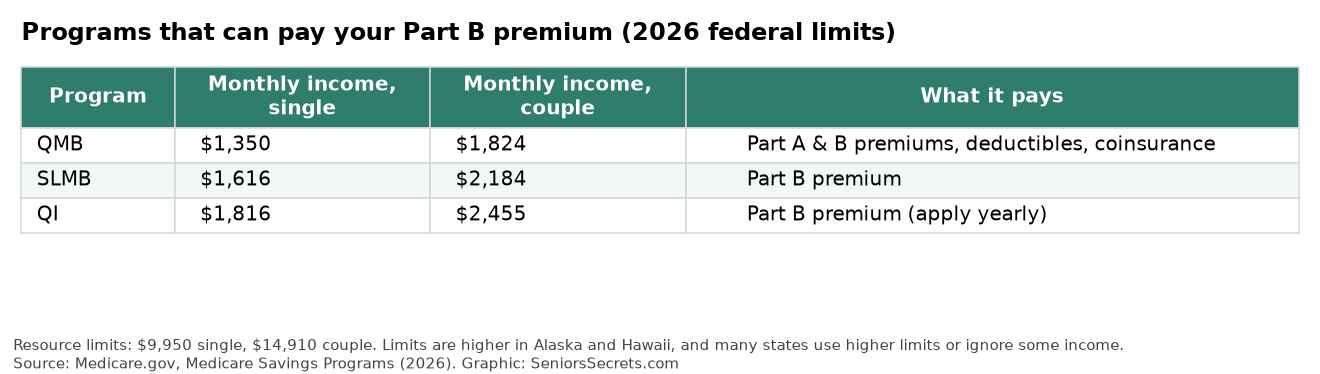
Medicare Savings Programs are run by states and can pay your Part B premium, and in some cases your deductibles and coinsurance too. The 2026 federal limits are:
| Program | Monthly income, single | Monthly income, couple | What it pays |
|---|---|---|---|
| QMB | $1,350 | $1,824 | Part A and B premiums, deductibles, coinsurance |
| SLMB | $1,616 | $2,184 | Part B premium |
| QI | $1,816 | $2,455 | Part B premium (apply each year) |
The resource limit is $9,950 for one person and $14,910 for a couple. Your home, one car and household goods don’t count. Many states use higher limits or ignore some income, so apply even if you’re a little over. Qualifying for any of these programs also gets you Extra Help with drug costs automatically.
To apply, contact your state Medicaid office. A free SHIP counselor can help you with the forms. For more on these programs, including what’s expected for 2027, see my Medicare Savings Program guide.
Medicaid. If you have full Medicaid along with Medicare, your state pays your Part B premium.
Some employer and union retiree plans reimburse part of the Part B premium. Check your retiree benefits booklet.
Steps to take before Open Enrollment
Medicare Open Enrollment runs October 15 to December 7, 2026. You can’t change the Part B premium itself during it, but you can change the rest of your coverage.
- Check what’s coming out of your check. Log into your my Social Security account and confirm the deduction is $202.90, unless you pay IRMAA or a penalty.
- Apply for a Medicare Savings Program if your income is anywhere near the limits above.
- Review your drug plan. The Part D out-of-pocket cap is $2,100 in 2026 and rises to $2,400 in 2027. My Part D 2027 guide covers the changes.
- Compare Medicare Advantage and Original Medicare with your actual doctors and drugs. See Medicare Advantage vs. Original Medicare.
- If your income dropped after retirement and you pay IRMAA, you may be able to lower it with form SSA-44. See the IRMAA guide.
For everything else that changes next year, read Medicare changes for 2027.

FAQ
How much is the Medicare Part B premium in 2026?
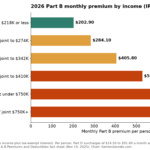
The standard premium is $202.90 a month. People with higher incomes pay between $284.10 and $689.90 a month because of IRMAA.
What is the Part B deductible in 2026?
$283 for the year. After that you usually pay 20% of the Medicare-approved amount.
Is the Part B premium the same for everyone?
No. Most people pay the standard $202.90. People with income above $109,000 (single) or $218,000 (joint) pay more, people who enrolled late may owe a penalty, and a small group protected by hold harmless pay less.
When will the 2027 Part B premium be announced?
CMS usually announces it in October or November. It hadn’t been released as of October 1, 2026.
Do I still pay the Part B premium with Medicare Advantage?
Yes. You keep paying it, plus any plan premium. Some plans reduce it through a giveback benefit.
Can I get my Part B premium paid for me?
Yes, if your income and savings are limited. A Medicare Savings Program or Medicaid can pay it. Contact your state Medicaid office or a SHIP counselor.