If you have a stand-alone Part D drug plan, this is not a year to let it renew on autopilot. The headline numbers for 2027 are calm: the yearly cap on what you pay for covered drugs rises to $2,400, and the average stand-alone plan premium is projected to go up by about a dollar. Underneath that average, though, some popular plans are raising premiums by $50 to $100 a month, and $0-premium plans are disappearing for people without Extra Help.
Open Enrollment for 2027 coverage runs October 15 to December 7, 2026. Whatever you pick starts January 1, 2027.
I’m a researcher who reads Medicare.gov, CMS documents and plan data so readers don’t have to. I’m not a licensed insurance agent, and I don’t sell plans. For one-on-one help, call your free State Health Insurance Assistance Program (SHIP). Everything below was checked against official sources on October 6, 2026.

Got a colored letter about your drug plan? See what the tan, blue and orange Medicare notices mean before you decide.
The 2027 numbers at a glance
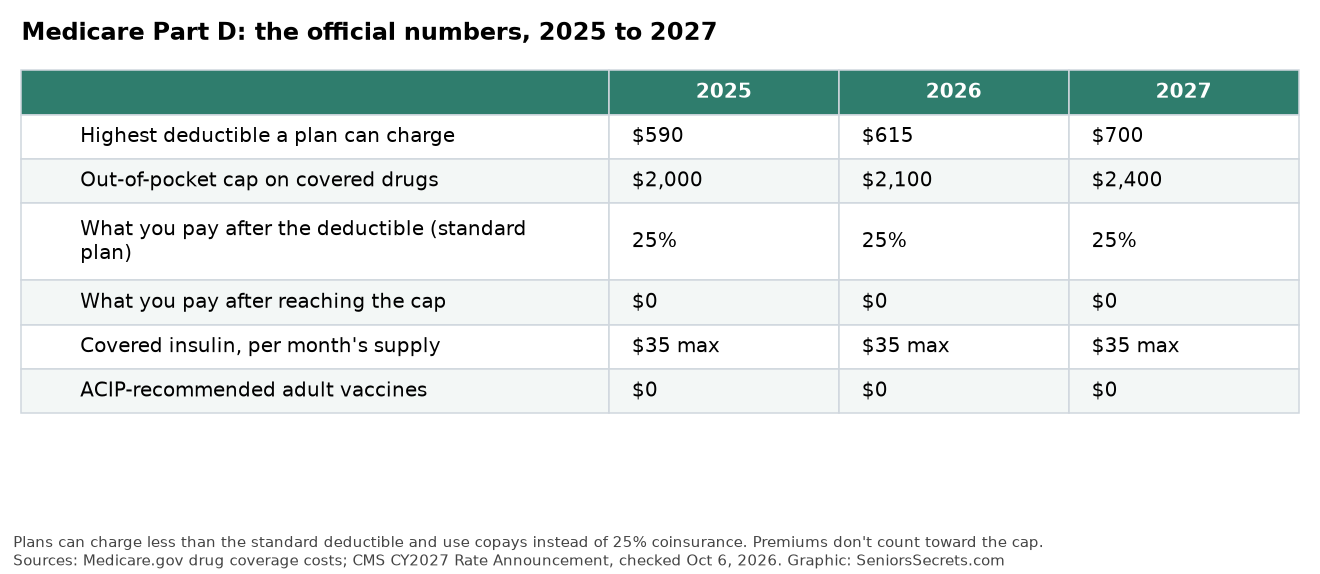
These are the official figures, not projections. They’re on Medicare’s drug coverage costs page and in CMS’s 2027 rate announcement.
| 2025 | 2026 | 2027 | |
|---|---|---|---|
| Highest deductible a plan can charge | $590 | $615 | $700 |
| Yearly cap on what you pay for covered drugs | $2,000 | $2,100 | $2,400 |
| What you pay after the deductible (standard design) | 25% | 25% | 25% |
| What you pay after you reach the cap | $0 | $0 | $0 |
| Covered insulin, one month’s supply | $35 max | $35 max | $35 max |
| ACIP-recommended adult vaccines | $0 | $0 | $0 |
Your own plan may charge a lower deductible, or none, and many plans use flat copays instead of 25% coinsurance. The cap is the same for everyone, including people whose drug coverage comes through a Medicare Advantage plan.
How the $2,400 cap actually works
Part D has three stages, and the plan tracks them for you:
- Deductible. You pay full price for covered drugs until you meet your plan’s deductible (no more than $700 in 2027).
- Initial coverage. You pay your share, 25% in a standard plan, until your out-of-pocket spending hits $2,400.
- Catastrophic coverage. You pay $0 for covered Part D drugs for the rest of the calendar year.
Here’s the math most articles skip. In a standard plan, you reach the cap once the total cost of your covered drugs (your share plus the plan’s) reaches about $7,500 for the year: the $700 deductible plus 25% of the next $6,800. Someone on one brand-name specialty drug can get there by spring. Someone on three generics never will.
What counts toward the cap: your deductible, copays and coinsurance for drugs on your plan’s formulary, plus certain payments made for you, such as through Extra Help.
What doesn’t count:
- Your monthly premium.
- Drugs that aren’t on your plan’s drug list, unless the plan approves an exception.
- Drugs you buy with a discount card or coupon instead of your plan. Medicare’s 2027 “What’s new” fact sheet spells this out for TrumpRx coupons too: a cash price can be cheaper at the counter, but it won’t move you toward the $2,400 cap.
That last point matters if you take an expensive drug. Paying cash with a coupon in January can feel like a win and still leave you further from the cap in June.
What’s happening to premiums for 2027
CMS’s September 28 announcement projects the average stand-alone Part D premium at $36 a month in 2027, up from $35.09. For drug coverage inside Medicare Advantage plans, the average is projected to drop from $11.32 to $7. CMS also ended the temporary Part D premium stabilization program that held down stand-alone premiums in 2025 and 2026.
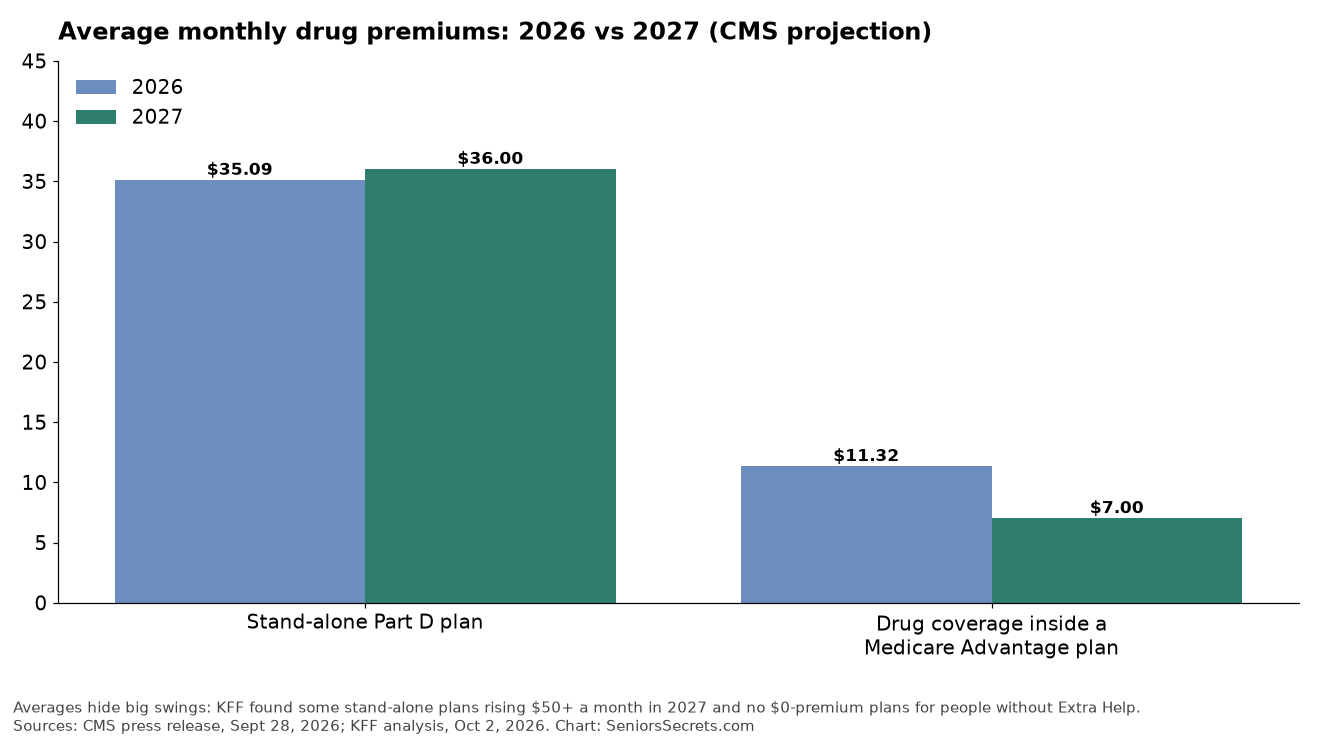
KFF went plan by plan through the same CMS data, and its October 2 analysis is the one I’d read before you do anything:
- The average beneficiary will have 9 stand-alone plans to choose from, down from 11. It’s the fourth straight year of fewer choices.
- There will be no $0-premium stand-alone plans for people without Extra Help. About 4 million people who paid nothing in 2026 will pay something in 2027, whether they stay or switch.
- People in AARP Medicare Rx Preferred face increases of $50 or more a month in every state if they keep the plan, and more than $75 in 37 states. AARP Medicare Rx Saver rises $50 or more in 33 states.
- The lowest-premium national option is still Wellcare Value Script, at $5.30 a month in 45 states.
My take: if your plan is one of the big risers, the premium alone could cost you $600 to $1,200 more next year for the same coverage. That’s real money, and fixing it takes one Plan Finder session. But don’t jump to the cheapest premium either. A $5 plan that doesn’t cover your drugs well can cost far more over the year.

15 more negotiated drug prices start January 1
Medicare’s second round of negotiated prices takes effect on January 1, 2027, covering 15 drugs, including Ozempic, Rybelsus and Wegovy, Trelegy Ellipta, Xtandi, Ibrance, Linzess, Janumet and Tradjenta. The CMS fact sheet estimates Part D enrollees will save about $685 million in out-of-pocket costs. What you personally pay still depends on your plan’s tier and copay, so ask the plan. Our 2027 Medicare changes guide lists all 15 with their negotiated prices. The third round, the first to include Part B drugs like Botox and Entyvio, wraps up this fall; my guide to the 2028 negotiation list covers those 15 drugs and the November 30 deadline.
Two programs worth knowing before you choose
Extra Help. If your income and savings are limited, Extra Help is the biggest money-saver in Part D. In 2027 people who qualify pay a $0 premium on a qualifying plan, a $0 deductible, and no more than $5.80 for a generic and $14.40 for a brand-name drug, according to Medicare. See our Extra Help guide for the limits and how to apply.
The Medicare Prescription Payment Plan. Every plan offers this free option. Instead of paying a big bill at the pharmacy, you get a monthly bill that spreads your drug costs across the year. Medicare is clear that it doesn’t lower your costs; it just evens them out. It mostly helps people who’d otherwise hit the $2,400 cap in the first few months. Our payment plan guide shows how the monthly amount is calculated.
Six steps before December 7
- Read your Annual Notice of Change. It lists your plan’s 2027 premium, deductible, drug list and pharmacy network. Our ANOC walkthrough shows what to look for line by line.
- Write down every drug, dose and how often you take it. Pull the list from your pharmacy if you can.
- Run it through Plan Finder at Medicare.gov and sort by total yearly cost (premium plus drug costs), not premium.
- Check your pharmacy. Preferred pharmacies can mean lower copays in the same plan.
- Look for restrictions on your drugs: prior authorization, step therapy or quantity limits.
- Don’t drop drug coverage to save a premium. If you go 63 days or more without Part D or other creditable coverage, Medicare adds a permanent late enrollment penalty to your premium.
If you’re also deciding between Original Medicare and Medicare Advantage, start with our side-by-side comparison, then use our two-week Open Enrollment checklist to stay on schedule.
Ways to pay less beyond picking the right plan
Choosing the plan that covers your drugs best is the biggest lever, but a few habits keep saving money all year:
- Ask about generics and lower-tier options. If a drug sits on a high tier, ask your doctor whether a generic or a similar drug on a lower tier would work. If nothing else works for you, you can ask your plan for a tier exception.
- Compare 90-day and mail-order prices. Many plans charge less for a 90-day supply of maintenance drugs, especially through their preferred mail-order pharmacy. Check your plan’s cost for both before refilling.
- Use preferred pharmacies. The same drug can cost noticeably more at a standard network pharmacy than at a preferred one. Plan Finder shows the difference when you enter your pharmacy.
- Check manufacturer assistance programs. Drug makers run patient assistance programs for people with limited income; rules vary by company and drug.
- Don’t let coverage lapse. The late enrollment penalty is 1% of the national base premium for each full month you went without Part D or other creditable coverage, and it lasts as long as you have Part D. Medicare.gov’s example: 14 months without coverage adds about $5.50 a month in 2026, based on the $38.99 base premium (Medicare.gov, avoid penalties).
The first 10 negotiated drug prices (including Eliquis, Jardiance, Xarelto, Januvia and Farxiga) have applied since January 1, 2026, and the 15 drugs listed earlier join them in 2027. You don’t need to sign up for those. The lower price is built into what your plan pays, though your own copay still depends on your plan’s tier and deductible.
FAQ
What is the Part D out-of-pocket cap for 2027?
$2,400. Once your out-of-pocket spending on covered drugs reaches that amount, you pay $0 for covered Part D drugs for the rest of 2027. It was $2,100 in 2026 and $2,000 in 2025.
What is the maximum Part D deductible in 2027?
$700, up from $615 in 2026. Some plans charge less or have no deductible.
Do premiums count toward the $2,400 cap?
No. Only what you pay for covered drugs counts. Premiums, drugs not on your plan’s formulary, and drugs bought with a discount card instead of your plan don’t count.
What happens if I do nothing during Open Enrollment?
If your plan is still offered, you’ll usually be renewed into it for 2027 at its new premium and with its new drug list. That’s exactly the situation KFF warns about for plans with big increases.
Does the cap apply if my drug coverage is through Medicare Advantage?
Yes. The $2,400 cap applies to Part D coverage in stand-alone plans and in Medicare Advantage plans that include drug coverage.
Facts checked against Medicare.gov, CMS and KFF on October 6, 2026. CMS hasn’t announced the 2027 Part B premium yet; it doesn’t change any Part D figure on this page. This article is for education, not personal insurance advice.