Every fall I sit down with Medicare’s own fact sheet, the CMS announcements and the fine print, and sort out what’s truly changing from what’s just noise. This year the official “Your Medicare in 2027” fact sheet came out in September, and CMS published its premium projections for Medicare Advantage and Part D at the end of the month. So we finally have real numbers.
A quick word on who’s writing. I’m a researcher, not a licensed insurance agent or a medical professional. I read the source documents so you don’t have to, and I link every one of them. For advice about your own plan, your free State Health Insurance Assistance Program (SHIP) is the place to go.
Here’s what changes on January 1, 2027, plus a couple of numbers we’re still waiting on.
The big drug-coverage changes
1. The Part D out-of-pocket cap rises to $2,400
Since 2025, Medicare drug plans have had a yearly cap on what you pay for covered drugs. It was $2,000 in 2025 and $2,100 in 2026. For 2027 it’s $2,400. Once your out-of-pocket spending on covered Part D drugs reaches that amount, you pay $0 for covered drugs for the rest of the year. Medicare.gov confirms the 2027 figure, and it matches the table in CMS’s 2027 Rate Announcement.
2. The maximum Part D deductible goes to $700
No drug plan can charge a deductible above $615 in 2026. In 2027 the ceiling is $700. Plenty of plans charge less, and some charge nothing, so this is a “check your plan” item rather than a guaranteed increase.
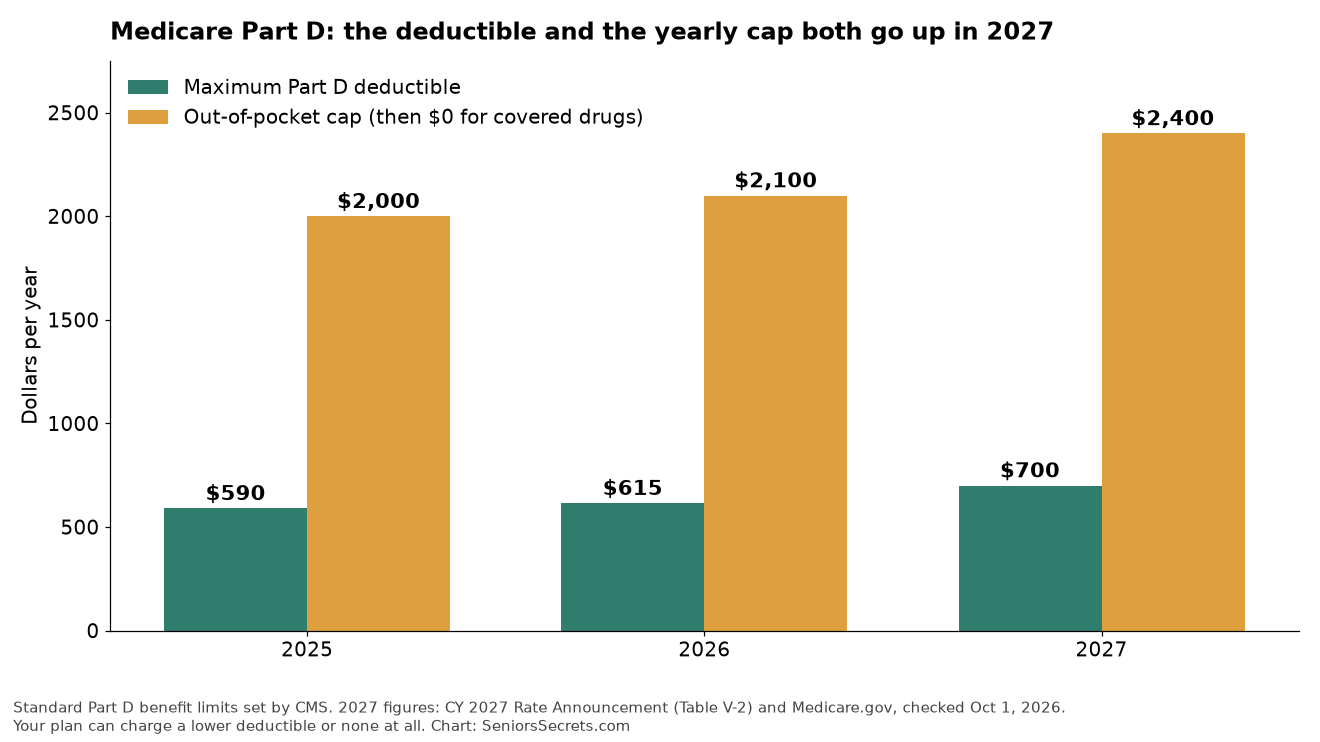
These amounts aren’t anyone’s whim, by the way. The law ties them to growth in Part D spending, and CMS said in its Rate Announcement that it has no flexibility to change the calculation. If you take expensive drugs, plan on reaching a cap that’s $300 higher than this year’s. If you want the full Part D picture, I’ve covered it in Medicare Part D 2027: the new cap, costs and enrollment.
3. Fifteen more drugs get negotiated Medicare prices
The second round of Medicare drug price negotiation takes effect January 1, 2027. According to the CMS fact sheet on negotiated prices for 2027, the 15 drugs include Ozempic, Rybelsus and Wegovy (negotiated at $274 for a 30-day supply against a 2024 list price of $959), Trelegy Ellipta, Xtandi, Pomalyst, Ofev, Ibrance, Linzess, Calquence, Austedo, Breo Ellipta, Xifaxan, Vraylar, Tradjenta, Janumet and Otezla.
CMS estimates people with Part D would save about $685 million in out-of-pocket costs under the standard benefit once these prices apply. That’s spread across millions of people, though, so your own savings depend entirely on your plan’s copay or coinsurance for the drug.

The first 10 negotiated drugs, the ones that started in 2026, are covered in my guide to Medicare’s negotiated drug prices. One detail from CMS worth knowing: a few drugs from that first round (Stelara, Entresto, Xarelto, and NovoLog/Fiasp) are scheduled to come off the negotiated list on January 1, 2027, because generic or biosimilar competition arrived. A third round, the first to include Part B drugs given in a doctor’s office, is under way now, with prices due by November 30, 2026 and starting in 2028. See the 2028 Part B and Part D negotiation list.
4. The GLP-1 Bridge: $50 a month for certain weight-loss drugs
Medicare’s fact sheet lists a new Medicare GLP-1 Bridge. If you have Part D, aren’t already getting these drugs covered by your plan, and meet the other requirements, you’d pay a $50 copayment for a one-month supply of certain GLP-1 drugs for weight loss. Details and eligibility are on Medicare.gov/glp1bridge, and I’ve broken it down in the GLP-1 Bridge guide.
Premiums and plan costs
5. Medicare Advantage premiums are projected to fall, on average
On September 28, CMS projected the weighted average Medicare Advantage premium will drop from $14.37 a month in 2026 to $12.00 in 2027. For Advantage plans that include drug coverage, the average drug portion is projected to fall from $11.32 to $7. CMS’s press release also says more than 99% of people with Medicare will have at least one Advantage plan available.
Averages hide a lot, though. Analysts reviewing the same CMS plan data told the trade publication Healthcare Dive that many Advantage plans are raising Part D deductibles and out-of-pocket maximums, and that there are fewer $0-premium plans. A lower premium with a higher deductible isn’t automatically a better deal.
6. Stand-alone drug plan premiums: up less than $1, on average
The average total premium for a stand-alone Part D plan is projected to go from $35.09 to $36 a month. CMS says 88% of people who don’t get Extra Help will have access to a basic Part D plan at $10.30 a month or less.
7. The Medicare Advantage out-of-pocket ceiling for 2027
Every Medicare Advantage plan has to cap what you pay for covered medical care in a year. CMS’s 2027 limit, in its April 2026 bid review memo to plans, is $9,850 for in-network services. For plans that cover out-of-network care, like PPOs, the combined ceiling is $14,800. Many plans set their limit lower, so look up your plan’s number.
8. Still waiting: the 2027 Part B premium and deductible
As of October 14, 2026, CMS hasn’t announced the 2027 Part B premium or deductible. For 2026 they’re $202.90 a month and $283 a year. CMS usually releases the new figures in the fall, and I’ll update this post when they do. Social Security’s 2027 cost-of-living adjustment is out: 3.6%, announced October 14, 2026 (SSA). The raise and the new Part B premium together decide what lands in your bank account. Here’s what the 3.6% COLA means for your check.
Coverage and rule changes
9. Telehealth from home continues through 2027
Through December 31, 2027, you can get Medicare telehealth services anywhere in the U.S., including at home. Medicare’s telehealth page lists examples like depression screenings and speech therapy. More in my telehealth guide.
10. Electronic prior authorization in Medicare Advantage
Starting January 1, 2027, your Medicare Advantage plan may be able to process prior authorization requests electronically, and you may be able to see the decisions in your patient portal. Ask your doctor’s office whether they’re set up for it. It could shorten the wait on approvals.
11. Who’s eligible for Medicare is now spelled out more narrowly
To get Part A and Part B or join a Medicare plan, Medicare’s fact sheet says you must be a U.S. citizen or national, a lawful permanent resident (green card holder), a Cuban-Haitian entrant, or lawfully living in the U.S. as a Compact of Free Association (COFA) migrant. If you or a family member are a noncitizen with another immigration status, call Social Security or your SHIP now rather than in December.
12. New programs and smaller changes
- ACCESS model. A new care model for people in Original Medicare with chronic conditions like high blood pressure, diabetes or depression, offering at-home support such as virtual visits and wearable devices, possibly at low or no cost.
- Diabetes Prevention Program. You can now attend sessions in person or virtually, live or self-paced.
- New ways to log in. Your Medicare.gov account now works with ID.me, CLEAR and Login.gov.
- TrumpRx discounts don’t count toward your cap. Medicare’s fact sheet points to TrumpRx.gov for discount coupons, but warns that when you pay with a discount card instead of your plan, the cost doesn’t count toward your Part D deductible or $2,400 cap.

What to do this month
- Read your Annual Notice of Change. Your plan should have sent it in September. My ANOC guide walks through it line by line.
- Enter your drugs into Plan Finder. It’s the only way to see what the $700 deductible and $2,400 cap mean for you.
- Mark October 15 to December 7. That’s Open Enrollment, and I’ve laid out the dates and choices in the Open Enrollment guide.
The full official list is in Medicare’s Your Medicare in 2027: What’s New & Changing fact sheet.
The 2026 numbers you’ll be comparing against
When CMS posts the 2027 Part A and Part B amounts (usually in the fall), this is the baseline to compare them to. These are the official 2026 figures from the CMS 2026 premiums and deductibles fact sheet and Medicare.gov’s Part D cost page:
| Cost | 2026 | 2027 |
|---|---|---|
| Part B standard premium | $202.90 a month | Not announced yet |
| Part B deductible | $283 | Not announced yet |
| Part A hospital deductible (per benefit period) | $1,736 | Not announced yet |
| Hospital coinsurance, days 61–90 | $434 a day | Not announced yet |
| Lifetime reserve days | $868 a day | Not announced yet |
| Skilled nursing, days 21–100 | $217 a day | Not announced yet |
| Part D maximum deductible | $615 | $700 |
| Part D out-of-pocket cap | $2,100 | $2,400 |
If those increases strain your budget, two programs are worth checking before you assume you have to pay full price. Extra Help lowers Part D premiums, deductibles and copays. Medicare Savings Programs, run by each state’s Medicaid office, can pay your Part B premium and sometimes your deductibles and coinsurance. Income limits are higher than many people expect, and some states set them above the federal minimum, so apply even if you think you’re borderline. I’ll update this table the day CMS publishes the 2027 Part A and B amounts.
FAQ
What is the Medicare Part D out-of-pocket maximum for 2027?
$2,400. After you’ve spent that much on covered Part D drugs in 2027, you pay nothing more for covered drugs that year.
Is the Part B premium going up in 2027?
CMS hasn’t said yet. The 2026 premium is $202.90 a month. The 2027 amount is usually announced in the fall, and I’ll update this post as soon as it’s out.
Is Ozempic cheaper on Medicare in 2027?
Ozempic, Rybelsus and Wegovy have a negotiated Medicare price of $274 for a 30-day supply starting January 1, 2027. Your copay depends on your plan’s tier and cost sharing. Part D plans generally still can’t cover drugs used only for weight loss, which is why Medicare set up the separate GLP-1 Bridge.
Do I need to do anything if I like my plan?
If your plan is continuing, you’ll be renewed automatically. Still check your Annual Notice of Change. Drug lists, pharmacy networks and deductibles change every year, even when the premium doesn’t.
Is Medicare telehealth ending?
Not in 2027. Medicare says you can get telehealth services at home anywhere in the U.S. through December 31, 2027.