Medicare IRMAA in 2026: The Income Brackets, How the Surcharge Works and Legal Ways to Lower It

IRMAA, the income-related monthly adjustment amount, is an extra charge added to your Medicare Part B and Part D premiums when your income is above a set level. In 2026 it starts when your modified adjusted gross income (MAGI) is above $109,000 for a single filer or $218,000 for a married couple filing jointly. At the top bracket, a single person pays $689.90 a month for Part B instead of the standard $202.90, plus up to $91 a month extra for Part D.
CMS says these surcharges affect roughly 8% of people with Part B. If you’re in that group, or close to it, the details below can save you real money, because IRMAA works in cliffs: going $1 over a threshold costs you the whole next tier.
I’m a researcher who reads Medicare’s rules closely. I’m not a tax adviser, financial planner or licensed agent. Talk to a tax professional before you change how you take income. The brackets come from the CMS 2026 premiums fact sheet.
The 2026 IRMAA brackets
Your 2026 surcharge is based on the MAGI on your 2024 tax return.
| Single filer MAGI | Joint filer MAGI | Part B total monthly premium | Part D surcharge (added to your plan premium) |
|---|---|---|---|
| $109,000 or less | $218,000 or less | $202.90 | $0 |
| $109,001 to $137,000 | $218,001 to $274,000 | $284.10 | $14.50 |
| $137,001 to $171,000 | $274,001 to $342,000 | $405.80 | $37.50 |
| $171,001 to $205,000 | $342,001 to $410,000 | $527.50 | $60.40 |
| $205,001 to $499,999 | $410,001 to $749,999 | $649.20 | $83.30 |
| $500,000 or more | $750,000 or more | $689.90 | $91.00 |
If you’re married, lived with your spouse at any time during the year, and file separately, the brackets are much harsher: above $109,000 you jump straight to $649.20 for Part B, and at $391,000 or more you pay $689.90.
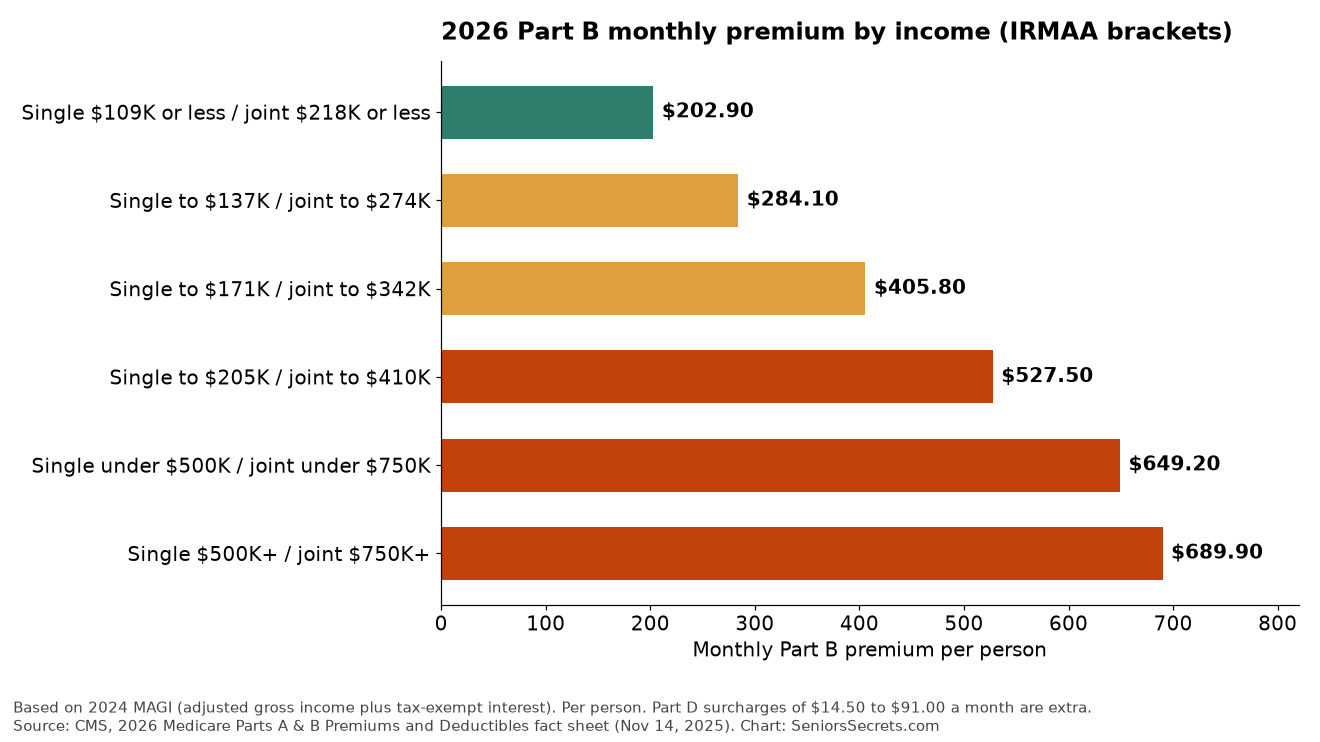
Remember that these are per person. A married couple with $280,000 of joint MAGI pays $405.80 each for Part B, $811.60 a month together, plus $37.50 each in Part D surcharges. Compared with the standard premium, that’s about $5,770 a year extra for the couple.
How the two-year lookback works
Social Security decides whether you owe IRMAA using the most recent tax return the IRS gives it, usually from two years earlier:
- 2026 premiums use your 2024 return.
- 2027 premiums will use your 2025 return.
The lookback causes two common surprises:
- Your last working year can follow you into retirement. If you retired in 2025, your 2025 salary can raise your 2027 premiums even though your income has dropped.
- One-time income counts. Selling a house with a gain above the exclusion, a large Roth conversion, or selling investments can push you into a higher bracket for one year, two years later.
The 2027 brackets will be adjusted for inflation and announced with the 2027 Part B premium. Neither had been released when I checked on October 1, 2026. I’ll update this post when they are.
What counts as MAGI for IRMAA
For IRMAA, MAGI is your adjusted gross income plus any tax-exempt interest, such as municipal bond interest. That means:
- Counts: wages, taxable pension and IRA withdrawals, required minimum distributions, Roth conversions, capital gains, dividends, taxable Social Security, and tax-exempt interest.
- Doesn’t count: qualified Roth IRA withdrawals, qualified HSA withdrawals for medical costs, and money you take out of savings that isn’t taxable income.
When you can get IRMAA lowered: the life-changing event appeal
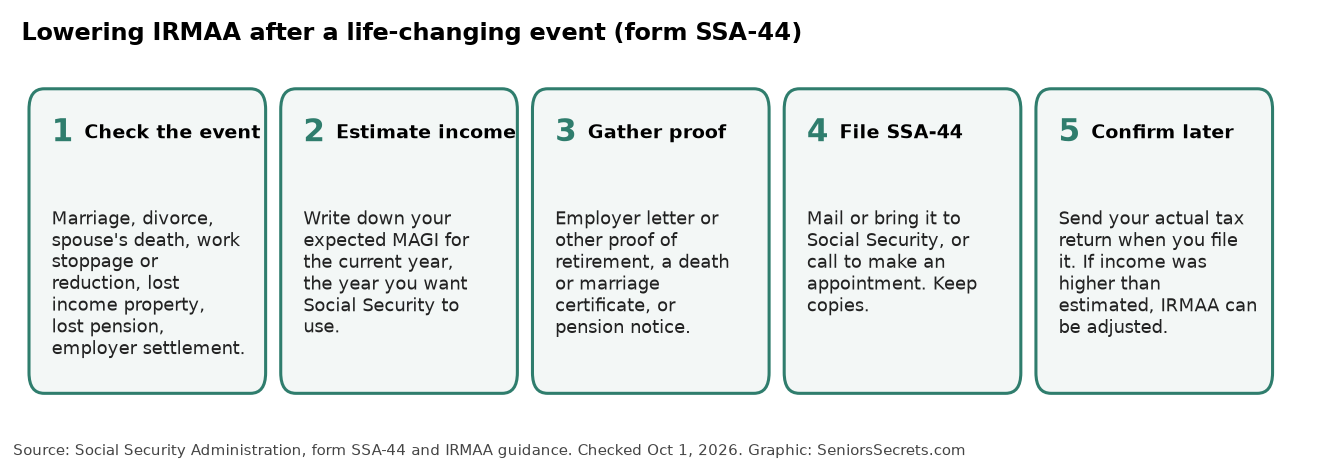
If your income has dropped because of certain life events, you can ask Social Security to use a more recent year’s income instead. You file form SSA-44, “Medicare Income-Related Monthly Adjustment Amount – Life-Changing Event,” with proof.
Qualifying events are:
- Marriage
- Divorce or annulment
- Death of your spouse
- Work stoppage (you retired or stopped working)
- Work reduction
- Loss of income-producing property, such as from a disaster
- Loss or reduction of pension income
- An employer settlement payment
The most common case is retirement. If you stopped working in 2025, your 2024 salary probably set your 2026 IRMAA. File the SSA-44 with an estimate of your 2026 income and proof that you stopped working, like a letter from your employer.
Things that don’t qualify include a big one-time capital gain, selling a home, or a Roth conversion you chose to do. For those, the planning steps below matter more.
You can also appeal if you think Social Security used the wrong information, for example an amended return or a tax return with an error. The letter that tells you about IRMAA explains how.
Legal ways to plan around IRMAA
None of these are loopholes. They’re timing and account choices. Run them past a tax professional, because they interact with income tax, too.
1. Watch the threshold, not just your tax bracket. Because IRMAA is a cliff, $1 over a threshold can cost the whole next tier, more than $970 a year per person for Part B at the first step in 2026. If you’re close, small moves like deferring a sale to January can keep you under.
2. Plan Roth conversions around the brackets. Conversions add to MAGI in the year you do them. Some people convert before age 63, since income at 63 sets premiums at 65, or size conversions to stay inside a bracket. Qualified Roth withdrawals later don’t count toward MAGI.
3. Give to charity from your IRA. If you’re 70½ or older, a qualified charitable distribution (QCD) sends money directly from your IRA to a charity. It doesn’t count as income and can count toward your required minimum distribution. The IRS limit is $111,000 per person in 2026.
4. Time capital gains. Spreading large sales over two tax years, or harvesting losses to offset gains, can keep a single year from spiking.
5. Think about tax-exempt interest carefully. Municipal bond interest is free of federal income tax, but it still counts for IRMAA.
6. Use the SSA-44 when you qualify. Many retirees pay a year or two of IRMAA they didn’t have to, because no one told them about the life-changing event form.
A worked example
Linda and Tom file jointly. In 2024, Tom’s last full year of work, their MAGI was $260,000. In 2026 they each pay $284.10 for Part B and an extra $14.50 for Part D, about $2,300 a year more than the standard premiums for the two of them.
Tom retired in March 2025. Their 2026 income will be about $150,000 from pensions, Social Security and IRA withdrawals. Because a work stoppage is a qualifying event, they can file form SSA-44 with Tom’s retirement letter and their 2026 estimate. If Social Security accepts it, both go back to $202.90 for 2026.
Now suppose they also plan a $100,000 Roth conversion in 2026. That would push their MAGI to about $250,000, back into the first IRMAA tier for 2028. Splitting the conversion over two years could keep them under $218,000 each year, assuming the threshold doesn’t fall.
How IRMAA is paid
If you get Social Security, both surcharges are usually taken from your monthly payment. The Part D surcharge goes to Medicare, not to your drug plan, even if you pay your plan premium directly. If you don’t get Social Security yet, Medicare bills you. Don’t ignore those bills: missing payments can end your coverage.
What’s changing for 2027
Part D itself changes in 2027: the out-of-pocket cap rises to $2,400 and the maximum deductible to $700. IRMAA surcharges still apply on top of your plan premium. For the full list, see Medicare changes for 2027 and my Part D 2027 guide.
If you’re still working past 65, my guide to working after retirement and Social Security covers how earnings affect your benefits. For the Part B premium on its own, see Medicare Part B premium 2026.

FAQ
What income is used for 2026 IRMAA?
Your modified adjusted gross income from your 2024 federal tax return: adjusted gross income plus tax-exempt interest.
Does IRMAA apply to Medicare Advantage?
Yes. If you’re in a Medicare Advantage plan, you still pay the Part B premium, including any IRMAA. If your plan includes drug coverage, the Part D surcharge applies too.
Is IRMAA permanent?
No. It’s recalculated every year from your income two years earlier. If your income drops, your surcharge drops with it, or sooner if you file an SSA-44 for a qualifying event.
Can I appeal IRMAA?
Yes. Use form SSA-44 for a qualifying life-changing event, or request a reconsideration if Social Security used wrong or outdated tax information.
Does a one-time capital gain qualify for an SSA-44?
No. Selling an investment or a home isn’t a qualifying event. The surcharge for that year will drop off when your income goes back down.