Medicare Giveback Benefit: How the Part B Premium Reduction Works, Who Gets It and When It’s Worth It

The “Medicare giveback benefit” is the marketing name for a Part B premium reduction. Some Medicare Advantage plans use part of the money Medicare pays them to lower the Part B premium you’d otherwise pay, which is $202.90 a month in 2026. If your premium comes out of Social Security, your monthly deposit goes up by the reduction amount.
It’s a real benefit, not a scam. But it’s smaller and less common than the TV ads suggest: in 2026, about a third of individual Medicare Advantage plans offered one, and more than a quarter of those took off $10 a month or less. And it’s only one piece of what a plan costs you.
I’m a researcher who reads Medicare’s rules closely, not a licensed agent, and I don’t sell plans. Figures come from KFF’s 2026 Medicare Advantage analysis and Medicare.gov, checked October 1, 2026.
How the giveback works
Medicare pays each Medicare Advantage plan a set amount per member. When a plan bids below the local benchmark, it gets a “rebate” it must spend on members: extra benefits like dental or hearing, lower drug premiums, or a reduction in the Part B premium. The giveback is that last option.
The rules:
- It can be any amount, in 10-cent steps, up to the full standard premium.
- It can’t reduce your Part B premium below $0 or turn into a cash payment.
- It applies only while you’re enrolled in that plan.
- It’s set plan by plan and county by county, so neighbors can see different offers.
Original Medicare doesn’t have a giveback. If you keep Original Medicare, with or without a Medigap policy, you pay the full Part B premium.
How much plans give back
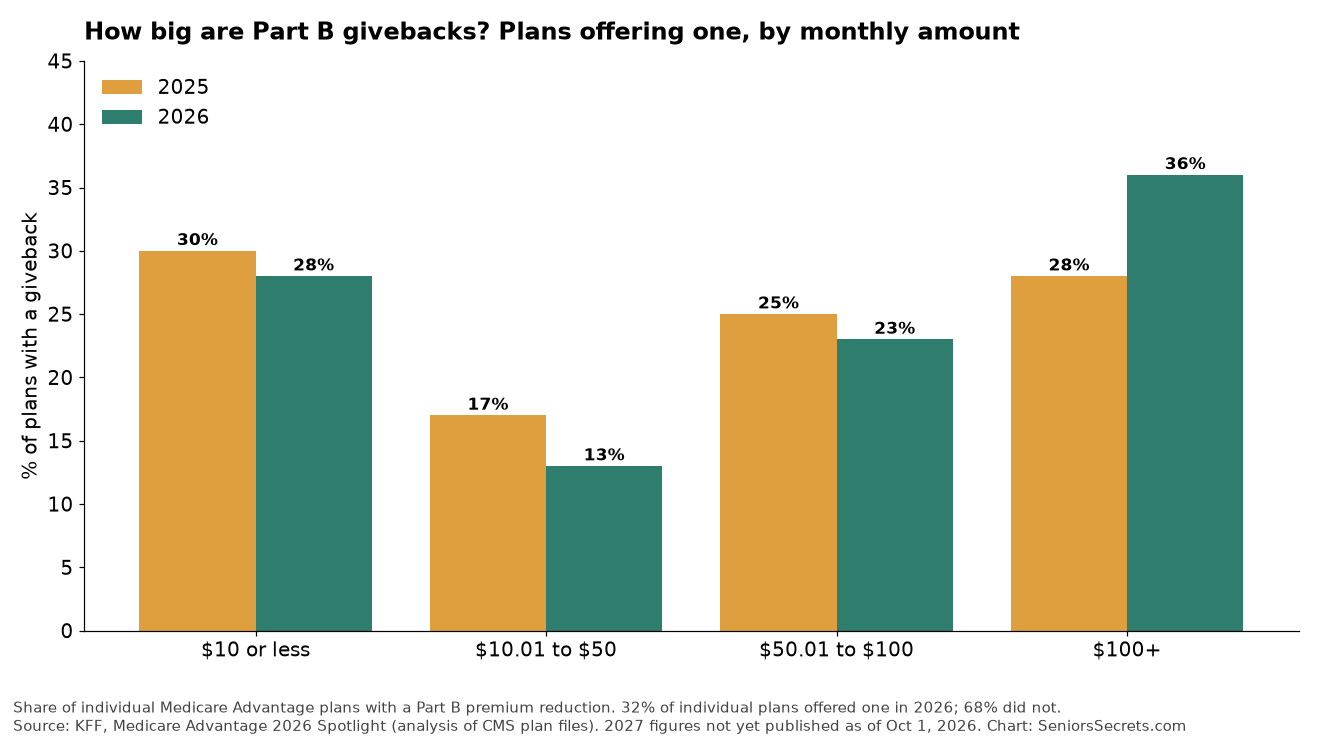
KFF’s analysis of 2026 plans found:
- 32% of individual Medicare Advantage plans offered a Part B reduction, the same as 2025. 68% didn’t.
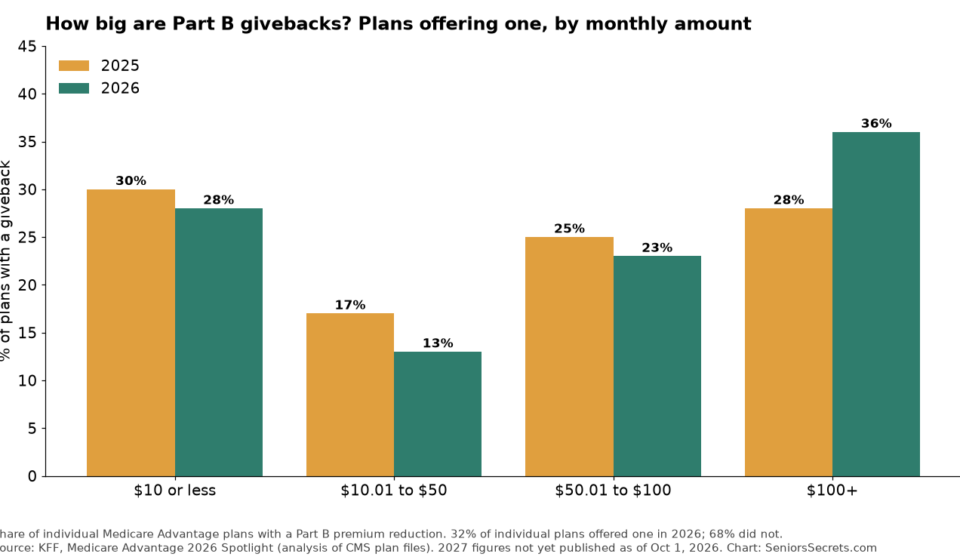
- Among those that did, 36% offered $100 or more a month, 23% offered $50.01 to $100, 13% offered $10.01 to $50, and 28% offered $10 or less.
- By enrollment, 39% of people in giveback plans got less than $10 a month, and 32% got $100 or more.
- Special Needs Plans offered it less often (19%).
A full giveback of $202.90 is worth $2,434.80 a year. A $5 giveback is worth $60.
CMS released its first 2027 plan data in September 2026. Givebacks for 2027 are listed plan by plan in Medicare Plan Finder, but no national breakdown had been published when I checked on October 1, 2026. I’ll update this section when one is.
Who qualifies
You can get a giveback if you:
- Have Medicare Part A and Part B
- Pay your own Part B premium
- Live in the service area of a plan that offers one, and enroll in it
There’s no income test. The catch is number 2. If Medicaid or a Medicare Savings Program already pays your Part B premium, the reduction goes to your state, not to you. For people with limited income, those programs are worth far more than a giveback, because they can cover the full premium and sometimes deductibles and copays as well.
How the money reaches you
If your Part B premium comes out of Social Security, Social Security deducts less, so your deposit goes up. A plan with a $75 giveback means $75 more a month.
If Medicare bills you directly, the reduction lowers your bill.
It can take one to three months for Social Security and Medicare to process the change after your plan starts. When it catches up, you get the missed amount. If you’re switching plans in January, don’t panic if February’s check still looks the same.
The trade-offs to weigh
Plans with large givebacks often save money elsewhere. Research published in JAMA Health Forum in 2025 found that giveback plans tended to have higher cost-sharing than plans without them. Before you choose a plan for its giveback, check:
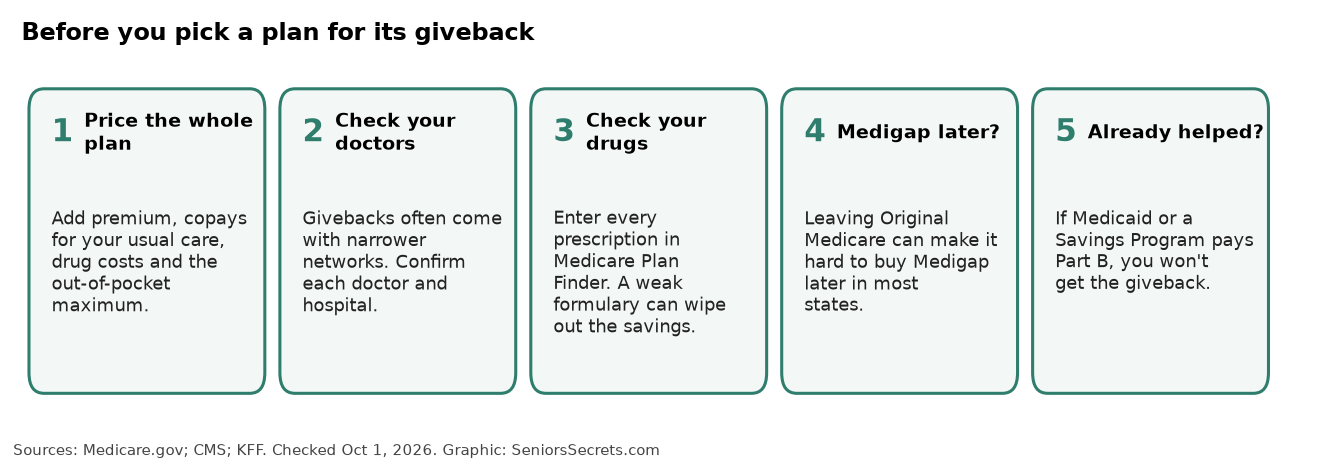
- Total yearly cost. Add the plan premium, your expected copays, and drug costs, then compare the out-of-pocket maximum. A $100 giveback can vanish quickly with a $400-a-day hospital copay.
- Your doctors and hospitals. Many giveback plans are PPOs with no drug coverage aimed at veterans, or HMOs with smaller networks.
- Your drugs. Many giveback plans don’t include Part D. If you take prescriptions, you may need a plan that does, or a separate drug plan if the giveback plan allows it. The Part D cap is $2,100 in 2026 and $2,400 in 2027. See Part D 2027 changes.
- Medigap later. If you leave Original Medicare for a plan and want to go back after the first year, most states let Medigap insurers turn you down or charge more because of your health.
- Other help you already get. If your state pays Part B, skip the giveback as a deciding factor.
Giveback plans can make a lot of sense for veterans who get most of their care and drugs through the VA, and for people with employer or union drug coverage they can keep. For others, compare carefully. My guide to Medicare Advantage vs. Original Medicare covers the bigger choice, and how to choose a 2027 Medicare Advantage plan walks through comparing plans.
How to find giveback plans
- Go to Medicare Plan Finder, enter your ZIP code, and add your drugs and pharmacies.
- Look at Medicare Advantage plans and check the “Part B premium reduction” line in plan details.
- Compare total estimated yearly costs, not just premiums.
- Call 1-800-MEDICARE or a free SHIP counselor for unbiased help.
When you can enroll
- Open Enrollment: October 15 to December 7, 2026, for coverage starting January 1, 2027.
- Medicare Advantage Open Enrollment: January 1 to March 31, if you’re already in a Medicare Advantage plan and want to switch plans or return to Original Medicare.
- Special Enrollment Periods: for moves and other qualifying events. See the Special Enrollment Period guide.
Watch for giveback scams
The giveback is a favorite hook for scam calls and misleading ads. Red flags:
- Calls or texts saying you’re “owed” a giveback check or a “$2,000 card”
- Anyone asking for your Medicare number, Social Security number or bank details to “release” money
- Ads promising a giveback without naming a plan
Medicare and real plans don’t call out of the blue to hand out money. Hang up and call 1-800-MEDICARE. A giveback is also different from a flex card or grocery allowance. See what the Medicare flex card really is.

FAQ
Is the Medicare giveback real?
Yes. It’s an optional Part B premium reduction offered by some Medicare Advantage plans. It’s not available with Original Medicare.
How much is the giveback in 2026?
It ranges from 10 cents to the full $202.90 a month, depending on the plan. Among plans that offer one, 36% gave $100 or more and 28% gave $10 or less.
Do I qualify if I have Medicaid?
You can join a plan with a giveback, but if Medicaid or a Medicare Savings Program pays your Part B premium, the reduction goes to the state.
Does the giveback lower IRMAA?
The giveback reduces the amount you pay toward Part B, but IRMAA is still charged based on your income. See the IRMAA guide.
How do I see the giveback on my statement?
Your Social Security benefit statement shows a smaller Medicare deduction. If Medicare bills you, the bill is lower. It can take one to three months to appear.
Where can I learn more about the Part B premium?
See my guide to the Medicare Part B premium in 2026.
Related guides