
Medicare Flex Card for 2027: What It Really Is, Who Gets One, and the Ads to Ignore

If you watch daytime TV, you’ve seen the ads: a smiling announcer, a card on the screen, and a promise of hundreds or even thousands of dollars “for groceries, rent and bills.” Then a phone number, flashing.
Here’s the honest version. A Medicare flex card is real, but Medicare doesn’t issue it. It’s a prepaid card some private Medicare Advantage plans use to deliver extra benefits to their own members. Original Medicare doesn’t offer one, there’s no government card mailed to everyone on Medicare, and nobody can sign you up for “just the card.” You get it only by joining the plan that offers it, and the money comes with rules.
I’m a researcher who reads Medicare.gov, CMS rules and plan data for readers. I’m not a licensed insurance agent, I don’t sell plans, and no insurer pays this site. For free, unbiased one-on-one help, contact your State Health Insurance Assistance Program (SHIP). Everything here was checked against official sources on October 7, 2026, ahead of Open Enrollment (October 15 to December 7).

What a flex card actually is
Medicare Advantage plans can offer “supplemental” benefits that Original Medicare doesn’t cover, like dental, vision, hearing aids and over-the-counter (OTC) health items. Plans have to deliver those benefits somehow, and a prepaid debit card is an easy way to do it. “Flex card” isn’t an official term. Insurers and marketers use it for several different things:
- An OTC allowance. A set amount each month or quarter for items like pain relievers, vitamins, bandages and allergy medicine at approved stores. Our Medicare OTC card guide covers this one in detail.
- A dental, vision or hearing allowance. Money toward glasses, hearing aids or dental work, on top of whatever the plan already covers.
- Benefits for members with chronic conditions. Some plans can pay for groceries and produce, utility bills, rent help or pest control, but only for members with qualifying chronic conditions who meet the plan’s criteria. CMS calls these Special Supplemental Benefits for the Chronically Ill (SSBCI).
- A combined card. Some plans load several of these “wallets” onto one card. Each wallet keeps its own limits.
What a flex card is not: cash, a Medicare benefit, or the same thing as the Part B giveback. The giveback lowers your Part B premium and doesn’t come on a card; our giveback guide explains it.
Who actually gets the big amounts
This is the part the ads skip. KFF’s 2026 review of Medicare Advantage benefits shows a sharp split between regular plans and special needs plans (SNPs), which are for people with Medicaid, certain chronic conditions, or who live in a nursing home:
- OTC benefits: 68% of people in regular individual plans are in a plan that offers one, down from 79% in 2025. In SNPs it’s 98%.
- Food and produce: only 8% of regular-plan enrollees are in a plan offering it (about 1.8 million people), against 93% of SNP enrollees (7.6 million).
- Utilities and housing help (KFF’s “general supports for living”): 6% in regular plans, 79% in SNPs.
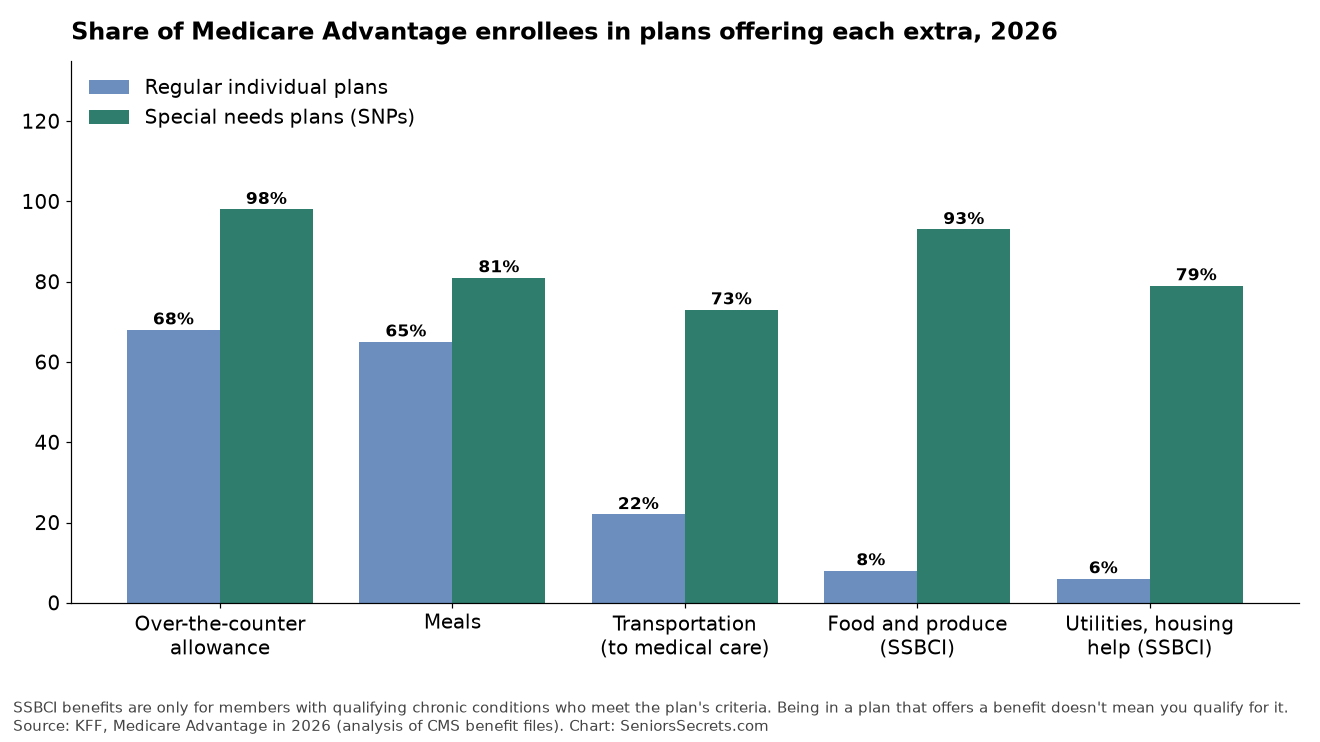
Two cautions make those numbers smaller in real life. Being in a plan that offers a chronic-condition benefit doesn’t mean you qualify for it; the plan decides based on your health conditions. And KFF notes that it’s not known how many people actually use these benefits.
So when an ad says “seniors are getting $2,000 a year for groceries,” the honest reading is that a small number of people in specific plans, often people with both Medicare and Medicaid, may get some grocery money. If you’re dual eligible, our D-SNP guide explains those plans.
The rules that change in 2027
CMS’s 2027 Medicare Advantage final rule tightens how these cards work:
- Cards must be tied to covered items. A plan’s debit card has to be electronically linked to the items and services the plan covers, so eligibility is checked at the register in real time. If an item isn’t covered, expect it to be declined at checkout.
- Money is limited to the plan year. Don’t count on a balance carrying into the next year. KFF notes that, depending on the plan, unused money may expire monthly or roll over until December.
- Plans must publish who qualifies for chronic-condition benefits. That makes it easier to check before you enroll whether you’d actually get the grocery or utility money.
- The mid-year reminder is gone. CMS dropped the requirement for plans to send a mid-year notice about supplemental benefits you haven’t used. Check your own balance.
- Agents have fewer timing limits. The rule also removed restrictions on when and how you can talk with licensed agents and brokers, so expect more calls and mailers this fall.
None of this makes a flex card bad. It just means the card is a benefit with fine print, not free money.
How to check a plan’s flex card before you switch
Every September, plans mail current members an Annual Notice of Change (ANOC) with next year’s benefits. If you’re shopping, use Medicare Plan Finder on Medicare.gov to compare plans in your ZIP code, then read each plan’s Summary of Benefits. Look for answers to these questions:
- How much, and how often? A “$600 benefit” might be $50 a month that doesn’t roll over.
- What can it buy, and where? Approved product lists and stores vary by plan.
- Do I qualify? For grocery, utility and rent benefits, read the plan’s published eligibility criteria. Some require a specific chronic condition.
- What else changes if I switch? This is the question that matters most. A card worth a few hundred dollars won’t make up for losing your doctors, a worse drug list or higher hospital copays.

My honest take: a flex card belongs near the bottom of the list when you’re choosing a plan. Check the network, drug costs and out-of-pocket limit first. Our 2027 Medicare Advantage comparison guide walks through those checks, and the benefit cuts checklist shows where plans are trimming extras for 2027.
How the flex card scams work
The legitimate benefit isn’t the problem. The marketing built around it is. The usual pattern is a TV ad, text or phone call that suggests the government is giving out cards, names a big dollar figure, and asks you to “confirm” your Medicare number to qualify. Sometimes the goal is to steal your Medicare number. Sometimes it’s to switch you into a plan you didn’t need.
The FTC’s Medicare Open Enrollment scam alert is blunt about it: real Medicare representatives won’t call, text or email you out of the blue to ask for your Medicare number or a payment, and caller ID showing “Medicare” can be faked. A few red flags:
- The caller says Medicare is sending you a card. It isn’t.
- There’s a big round number (“$2,000 a year,” “$180 a month back”).
- You’re told to act today, or the offer disappears.
- The caller can’t name the specific plan, its star rating or its network.
If you get a call like this, hang up. If you’re unsure, call 1-800-MEDICARE (1-800-633-4227) yourself. Report it to 1-800-MEDICARE or at ReportFraud.ftc.gov, and call your local Senior Medicare Patrol if you think your Medicare number was shared.
Frequently asked questions
Does Original Medicare give you a flex card?
No. Only some Medicare Advantage plans offer flex or benefit cards, and only to their own members.
How do I get a Medicare flex card?
Join a Medicare Advantage plan that includes one, during a valid enrollment period such as Open Enrollment (October 15 to December 7). The plan sends the card and instructions to members. You can’t get the card on its own.
Can I use a flex card for groceries or rent?
Only if your plan offers those benefits and you meet its criteria, usually a qualifying chronic condition. Most regular plans don’t offer them.
Is a flex card the same as an OTC card?
Not always. An OTC card pays only for approved over-the-counter health items. “Flex card” is a looser marketing term that can mean an OTC allowance, a dental or vision allowance, chronic-condition benefits, or a mix.
Does unused money roll over?
It depends on the plan. Some allowances expire each month or quarter; others roll over until the end of the year. Under the 2027 rule, card benefits are limited to the plan year.
The bottom line
A flex card can be a nice extra in the right plan, but it’s not a reason to switch on its own. Confirm the benefit in the plan’s own documents, make sure your doctors and drugs are covered, and never give your Medicare number to someone who called you first. If you’d like a second opinion on a plan, a free SHIP counselor can help.
Related guides