
Medicare Chronic Care Management in 2026: Who Qualifies, What It Costs, and Whether It Is Worth It
Medicare Chronic Care Management (CCM) pays your doctor’s practice to coordinate your care between visits when you have two or more chronic conditions expected to last at least 12 months (or until death) and that put you at significant risk of death, flare-ups, or functional decline (CMS CCM overview). Services are usually phone or portal check-ins, medication reviews, and specialist coordination, not a spare office visit every week.
If that sounds like unpaid work your clinic already tries to do, CCM is the billing pathway that funds staff time. You must give consent, and you usually owe Part B cost sharing.
This rewrite folds in practical enrollment detail from our older CCM explainer so one guide covers codes, costs and how to start. I research Medicare benefits for readers. I am not a clinician or licensed agent.
Starting in 2027, Medicare also pays for group visits and health coaching for people with chronic conditions. See what the 2027 doctor payment rule changes.
Who qualifies
CMS examples of chronic conditions include diabetes, hypertension, heart disease, COPD, heart failure, arthritis, depression, atrial fibrillation, cancer, asthma, and many others. There is no single closed list. What matters is two or more lasting conditions with real risk.
You also need:
- A comprehensive care plan accessible to you
- 24/7 access to a clinician or clinical staff for urgent care-management needs
- Enhanced non-face-to-face communication
- Management of care transitions
- Coordination with home- and community-based providers as needed
- Written or verbal consent documented in the record (you should understand possible cost sharing)
Only one practitioner can bill CCM for you in a given month.
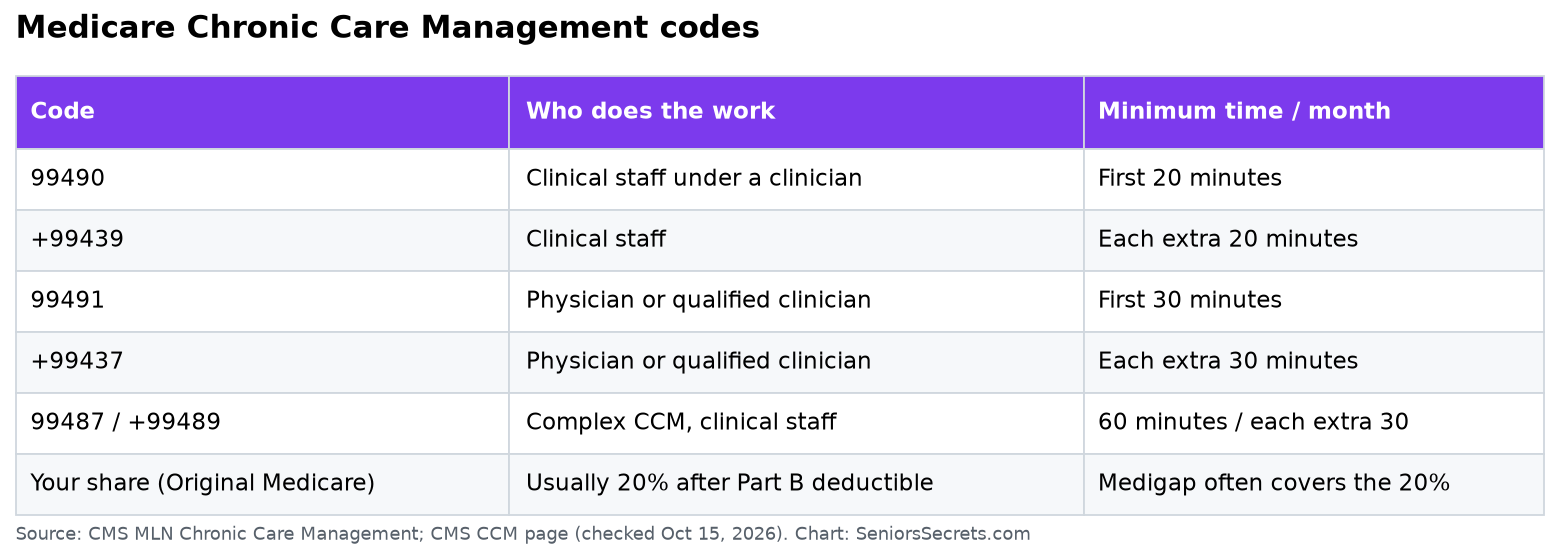
The main billing codes (plain English)
From the CMS MLN Chronic Care Management booklet:
| Code | Meaning |
|---|---|
| 99490 | First 20 minutes of clinical staff time in a month |
| +99439 | Each additional 20 minutes of clinical staff time |
| 99491 | First 30 minutes by the physician/qualified clinician personally |
| +99437 | Each additional 30 minutes by that clinician |
| 99487 / +99489 | Complex CCM (more time, moderate/high complexity decision making) |
National payment amounts change slightly by year and locality. Published 2026 non-facility rates for 99490 are in the ballpark of the mid-$60s before adjustments; your claim uses your area’s fee schedule. What you care about is the 20% coinsurance after the Part B deductible ($283 in 2026, $292 in 2027).
Example: if the approved amount for a month’s 99490 is about $66, your 20% is roughly $13 that month (plus any unmet deductible). Medigap often covers that 20%. Some Advantage plans reduce or waive CCM cost sharing; read your Evidence of Coverage. Dual-eligible beneficiaries may have Medicaid pay the share.

What you should actually receive
A serious CCM program typically includes:
- A living care plan with diagnoses, meds, goals and contacts
- Scheduled check-ins about symptoms, refills and barriers
- Help booking specialists and sharing records
- Review after ER or hospital stays
- Pointers to community resources (transport, food, pharmacy sync)
If “CCM” means only a surprise line on your Medicare Summary Notice with no outreach, call the clinic and ask who your care manager is. You can revoke consent.
Is it worth it?
Consider saying yes if you juggle several specialists, have had recent hospital stays, struggle with refills, or live alone with complex meds.
Consider saying no if you already have a tight care team, hate phone follow-ups, or would pay the coinsurance without Medigap and feel the clinic offers nothing extra.
CCM is not a substitute for seeing your doctor when you are acutely ill. It also is not the same as remote physiologic monitoring (separate codes) or the chronic pain management codes (G3002/G3003) listed in the same MLN booklet.
For diabetes-focused benefits that pair well with CCM, see Medicare diabetic supplies and diabetes management for seniors. For plan shopping, use the 2027 Open Enrollment guide.
How to enroll
- Ask your primary care clinic: “Do you offer Medicare Chronic Care Management?”
- Review the care plan and cost-sharing explanation
- Give consent and confirm the best phone number and time to reach you
- Keep a one-page list of your conditions, meds and specialists for the care manager
- Watch your Medicare Summary Notice for 99490 or related codes
What a good monthly CCM call sounds like
A useful check-in is not a robocall. Expect someone who knows your diagnoses to ask about new symptoms, blood-pressure or sugar readings you track, refill timing, specialist visits, and barriers such as transportation or cost. They should update the care plan when something changes and leave a way to reach the clinic for urgent concerns.
If months pass with only a billing line and no contact, revoke consent or switch to a clinic that staffs CCM properly. You are paying coinsurance for a service, not a billing code.
CCM vs other “management” benefits
Do not confuse CCM with:
- Annual wellness visits (separate Part B benefit)
- Transitional care management after a hospital discharge (time-limited)
- Remote physiologic monitoring of devices (different codes)
- Chronic pain management codes G3002/G3003 (separate MLN instructions)
Each has its own rules. Ask which one your clinic is billing if the name on your statement is unclear.
Common questions
Is CCM free?
Not usually under Original Medicare. Expect 20% coinsurance after the Part B deductible unless Medigap, Medicaid or your Advantage plan covers it.
Can two clinics bill CCM at once?
No. Only one practitioner bills CCM in a month.
Do I have to come to the office every month?
No. CCM minutes are mostly non-face-to-face. You still need usual visits when clinically required.
What is complex CCM?
99487 is for patients needing more time and moderate or high complexity medical decision making, including a comprehensive care plan change.
Can I stop?
Yes. Tell the clinic you revoke consent. They should stop billing future months.
2027 amounts added Nov 18, 2026 from the CMS 2027 Parts A and B fact sheet.
Written by Khasim Basha Shaik. I research and compare Medicare benefits for readers. I am not a licensed insurance agent or medical professional. This article summarizes CMS CCM materials and is not billing advice. Last reviewed October 15, 2026.
Related guides