
Medicare Advantage Changes Proposed for 2028: ER Copays, Ambulance Caps, Flex Cards and More
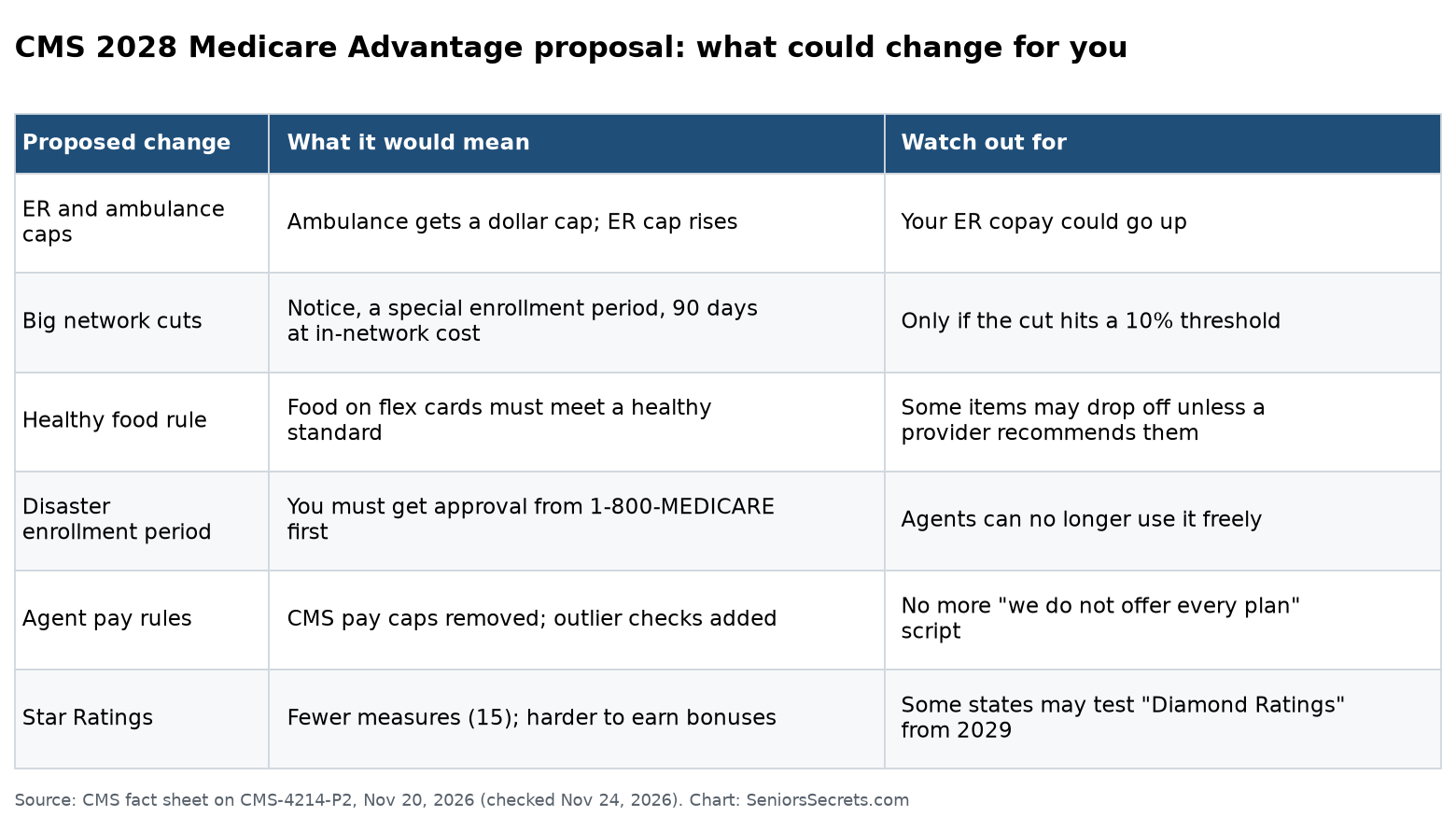
On Nov 20, 2026, CMS proposed a long list of new rules for Medicare Advantage and Part D plans in 2028. The biggest ones for your wallet: a dollar cap on ambulance copays, a higher limit on ER copays, 90 days of in-network care when a big group of doctors leaves your plan, and a “healthy food” rule for flex cards. None of this touches your 2027 plan. It is a proposal, so it can still change before CMS makes it final (CMS fact sheet).

I read the CMS fact sheet and the full 868-page rule (file code CMS-4214-P2) on the Federal Register. Here are the parts that change what you pay or how you pick a plan, plus the catches in the fine print.
What this does not change
Open Enrollment for 2027 still ends on Dec 7, 2026. Your 2027 plan, premiums and copays are already set. The 2027 Part B premium is $209.40 a month with a $292 deductible, and those numbers are final (CMS 2027 fact sheet).
This rule is about 2028 plans. Comments are open for 60 days after the Nov 20 filing, which is Jan 19, 2027. Then CMS writes a final rule.
ER and ambulance copays: one goes down, one could go up
Today, Medicare Advantage plans can charge up to 50% coinsurance for a ground ambulance ride. CMS has never set a dollar cap for it. The rule shows plans charged about $275 on average for a ground ambulance ride. That is $155 more than the about $120 you would pay in Original Medicare (CMS-4214-P2).
CMS wants a dollar cap of $180 to $300 per ambulance ride. The cap depends on your plan’s yearly out-of-pocket limit. Plans with the highest yearly limit get the lowest cap. Those plans charged about $301 on average in 2026, so their cap of $180 would be a real cut.
The ER limit goes the other way. Today, plans can charge $115 to $150 for an ER visit. CMS would raise the cap to $180 to $240. CMS says the old caps were based on 2021 costs. Original Medicare users pay about $240 on average for the same care. So the new cap is still lower than Original Medicare, but your plan would be allowed to charge more than now.

My take: if you use the ER more than ambulances, this could cost you a bit more. Plans do not have to charge the full cap. Check the “Emergency care” line in your plan’s 2028 Annual Notice of Change next fall. CMS says it would update both caps every year after 2028. To see how ambulance coverage works now, read our guide to Medicare ambulance coverage.
When a big group of doctors leaves your plan
Right now, CMS decides case by case if a cut is big enough to give members a way out. The new rule would set a clear test. A cut is “significant” if it affects at least 10% of the plan’s members, or if the doctor or group makes up at least 10% of the plan’s network for one specialty.
If a cut meets that test, three things would happen:
- Your plan must tell you once the cut is final.
- If you saw that doctor in the past year, you get a special enrollment period (a window to switch plans outside the usual dates).
- Your plan must keep covering care from that doctor at in-network prices for at least 90 days.
The catch is the 10% line. If one doctor you love leaves, but it is a small share of the network, you get none of this. Keep checking your plan’s provider directory and call your doctor’s office before you renew.
Flex cards and the new “healthy food” rule
CMS wants all food on flex cards and grocery benefits to meet a “healthy food” standard. It would follow the 2025-2030 Dietary Guidelines for Americans, released in January 2026. A food that does not meet it could still be covered if a doctor or other provider recommends it for your health. CMS gives high-calorie nutrition drinks as an example.
What this means for you: the list of items your card can buy may get shorter in 2028. If you rely on a special drink or food, ask your provider to write down why you need it. Our Medicare flex card guide explains who gets these cards and how to check the rules.
CMS also wants to test letting plans give food, rides and caregiver help to people who get Extra Help, not just people with certain chronic illnesses. This would apply only in the test states described below.
The disaster enrollment period gets a gatekeeper
There is a special enrollment period for people hurt by a declared disaster or emergency. CMS says some plans and agents used it to sign up people who were not really affected. Under the proposal, you would need approval from 1-800-MEDICARE (1-800-633-4227) before you can use it.
My take: this is a good change. If an agent says a storm or emergency “opens” a chance to switch, treat it as a red flag. Our guide to Medicare enrollment scams covers more warning signs.
Agents and brokers: fewer rules on how they are paid
CMS proposes to drop its caps on what plans pay agents and brokers, and the caps on referral fees. In their place, CMS would collect more pay data and flag “outlier” payments. CMS says this cuts red tape while keeping guardrails.
CMS also wants to drop the required script that marketing companies read on sales calls. Today it starts with “We do not offer every plan available in your area.”
My take: without that script, you have to ask yourself. Ask every agent: “How many companies and plans do you sell in my county?” Then compare their pick with Medicare Plan Finder on Medicare.gov. For free advice from someone who does not sell plans, call your State Health Insurance Assistance Program.
Star Ratings and a new test model in some states
CMS wants to cut Star Ratings to 15 measures. The focus would be on health results and member experience. It would also drop the “reward factor,” a bonus for plans with high and steady scores. These changes would start with care in 2028 and show up in the 2030 ratings. CMS says this would raise the bar for high ratings. For how ratings work today, see our guide to Medicare Star Ratings for 2027.
The bigger news is a new required test called ADVaNCE MA. If it is made final, it would run for 10 years starting in 2029, in states picked at random. In those states, Star Ratings would be replaced by a local “Diamond Ratings” system.
Smaller changes worth knowing
- Prior authorization: in-network providers would have to send prior authorization requests (asking the plan to approve care first) through the plan’s electronic system.
- Auto-enrollment idea: CMS is thinking about letting people turning 65 be placed in an Advantage plan from the same company as their current insurance. This is only an idea for now, not a proposal.
What to do now
- Finish your 2027 choice by Dec 7, 2026. This rule does not change it.
- Note your plan’s 2027 ER and ambulance copays from your Evidence of Coverage. You will want them to compare next fall.
- If you want CMS to hear from you, comment at Regulations.gov using file code CMS-4214-P2 by Jan 19, 2027.
- Watch for the final rule later in 2027. I will update this page when CMS makes it final.
Common questions
Will my Medicare Advantage ER copay go up in 2027?
No. The proposal would only apply to 2028 plans. Your 2027 ER copay is in your plan’s Evidence of Coverage and is already set.
What is the proposed ambulance copay cap for 2028?
CMS proposed a cap of $180 to $300 per ground ambulance ride, based on your plan’s yearly out-of-pocket limit. Today plans can charge up to 50% coinsurance with no dollar cap.
Will my flex card stop covering groceries?
Not by itself. The proposal says food on these benefits must meet a healthy food standard, or be recommended by a provider.
What happens if my doctor leaves my Medicare Advantage plan?
Under the proposal, if the cut is big enough to meet CMS’s 10% test, you would get a notice, a chance to switch plans, and at least 90 days of in-network costs with that doctor.
When is the deadline to comment on the 2028 Medicare Advantage rule?
Comments are due 60 days after the Nov 20, 2026 filing, which is Jan 19, 2027. Use file code CMS-4214-P2 at Regulations.gov.
Is this rule final?
No. It is a proposed rule. CMS must review comments before it issues a final version, and it can change or drop any part.
Khasim Basha Shaik researches and compares Medicare plans and rules for readers of SeniorsSecrets.com. He is not a licensed insurance agent or broker. This article is general information, not personal advice. Facts checked against the CMS fact sheet, the CMS-4214-P2 proposed rule and Medicare.gov on Nov 24, 2026. For your own case, call 1-800-MEDICARE or your local SHIP.