
If you want one floor exercise that protects you from falls, eases lower-back ache, and makes it easier to get off the couch, it is hard to beat the move physical therapists quietly rely on. Glute bridges for seniors rebuild the large muscles of the hips and buttocks — the very muscles that fade fastest with age and sitting, and the ones that catch you when you start to stumble. Best of all, you do the whole exercise lying on your back, which keeps it joint-friendly even for people who find standing exercises hard. As a senior fitness writer, this is one of the first moves I suggest to anyone worried about balance.
Your glutes are not just for sitting. The three gluteal muscles — maximus, medius, and minimus — extend your hip, steady your pelvis, and power every step, stair, and stand. When they weaken, your body loses the ability to take a quick compensatory step or stop your center of gravity from drifting — the split-second reactions that prevent a fall.
Table of Contents
- Why Glute Strength Prevents Falls
- How to Do a Glute Bridge Correctly
- A Safe Weekly Progression
- Modifications and Common Mistakes
- Who Should Be Careful
- Frequently Asked Questions
Why Glute Strength Prevents Falls
The case for glute bridges for seniors starts with the biomechanics of staying upright. Strong glutes support the hips and pelvis, which sit at the center of balance and mobility. Research on fall prevention notes that weakness in key muscle groups such as the gluteals reduces your capacity to execute a compensatory step or to stop your center of mass from shifting during an unexpected wobble — the moment a trip becomes a fall. Falls are the leading cause of injury for adults over 65, with about one in four falling each year, so any exercise that shores up the hips is worth your time.
The bridge has a second payoff most people do not expect: it eases lower-back pain. Weak glutes force the lower back and hamstrings to overwork; waking up the glutes shares the load and improves posture. And the bridge directly trains the strength you use to roll over in bed and to rise from low chairs, the toilet, or the car. Pair it with standing work like sit-to-stands and step-ups and you cover the hips from every angle.
How to Do a Glute Bridge Correctly
Form is simple, but the details make the difference between training your glutes and straining your back.
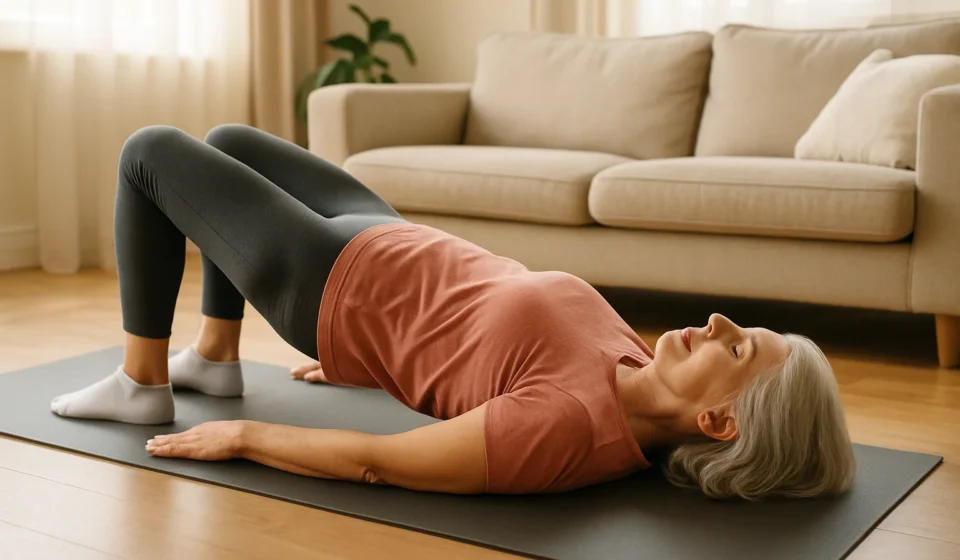
- Lie on your back on a firm surface or exercise mat, knees bent, feet flat and hip-width apart, heels a few inches from your buttocks.
- Rest your arms at your sides, palms down, for stability.
- Tighten your stomach and squeeze your buttocks before you move.
- Press through your heels and lift your hips until your knees, hips, and shoulders form a straight line. Do not arch your lower back past that line.
- Squeeze your glutes at the top and hold for 1 to 3 seconds.
- Lower slowly and with control — the slow lowering is where much of the strength is built.
Breathe out as you lift and in as you lower; never hold your breath, which can spike blood pressure. The movement should be felt in your buttocks and the backs of your thighs, not in your lower back.
A Safe Weekly Progression
| Level | Sets x reps | Frequency | Variation |
|---|---|---|---|
| Beginner | 1–2 x 8, partial “mini-bridge” | 2–3 days/week | Lift only partway, short hold |
| Intermediate | 2–3 x 10–12, full range | 3 days/week | 3-second hold at the top |
| Advanced | 3 x 12–15 | 3–4 days/week | Marching bridge or single-leg bridge |
To advance, try a “marching bridge”: hold the bridge at the top and slowly lift one foot a couple of inches, then the other, as if marching in place. This challenges the gluteus medius — the side-stabilizing muscle most responsible for keeping your pelvis level when you walk. Only progress to a single-leg bridge once the marching version feels easy and steady.
Modifications and Common Mistakes
If getting down to the floor is difficult, you can perform a similar movement on a firm bed, though the floor gives better feedback. If your neck or back is sensitive, a folded towel under the head helps. The two most common mistakes are pushing through the toes instead of the heels (which shifts work to the thighs and can cramp the hamstrings) and over-arching the lower back at the top (which causes the very back pain you are trying to avoid). Keep the rib cage down, the stomach gently braced, and stop the lift the moment your body forms a straight line. Quality beats height every time.
The bridge fits naturally into a broader routine. Combine it with balance exercises and our full fall-prevention strategy, and you build the kind of resilient strength described in our overview of senior fitness and exercise.
Who Should Be Careful
The glute bridge is gentle, but check with your doctor or physical therapist first if you have had a recent hip or back surgery, a hip replacement (some precautions limit certain positions early on), severe osteoporosis, or uncontrolled high blood pressure. Stop if you feel sharp pain, pinching in the hip, or pain that travels down the leg, and have it evaluated. Used sensibly, the bridge is one of the safest strength moves available because your spine stays supported by the floor throughout.
Frequently Asked Questions
How often should seniors do glute bridges?
Two to four sessions a week is plenty, with at least a day of rest between harder sessions so the muscles can recover and strengthen. Beginners can start with just one or two short sets and build gradually.
Will glute bridges help my lower-back pain?
Often, yes. Weak glutes make the lower back overwork; strengthening them shares the load and improves posture. Be sure to lift only to a straight line and avoid arching, since over-arching can aggravate the back rather than help it.
What if I can’t get down to the floor?
You can do the movement on a firm bed, or substitute standing hip exercises like sit-to-stands and heel raises that train similar muscles. A physical therapist can suggest floor-free alternatives tailored to your mobility.
Which muscles does the glute bridge actually work?
Mainly the gluteus maximus, the largest buttock muscle, along with the gluteus medius and minimus, the hamstrings, and the core. The marching and single-leg versions add extra demand on the side-stabilizing gluteus medius.
Related Articles You May Find Helpful
- Sit-to-Stand for Seniors 2026: Build Legs, Stop Falls
- Step-Ups for Seniors 2026: Leg Strength & Fall Defense
- Balance Exercises for Seniors Over 70: 8 Proven Moves
- Fall Prevention for Seniors 2026: 10 Proven Strategies
- Sarcopenia Warning: Why Every Senior Needs Strength Training
Sources
- National Institutes of Health (PMC) — Effectiveness of Balance- and Strength-Based Exercise Interventions for Fall Prevention in Community-Dwelling Older Adults.
- Centers for Disease Control and Prevention (CDC) — Older Adult Falls Data (STEADI).
- National Institute on Aging — Exercise and Physical Activity: Strength training for older adults.
This article is for general education and is not medical advice. Check with your doctor or physical therapist before starting a new exercise, especially after surgery or injury. See our medical disclaimer.
Related guides