Medicare’s 2027 Doctor Rule: 8 Changes Patients Will Notice
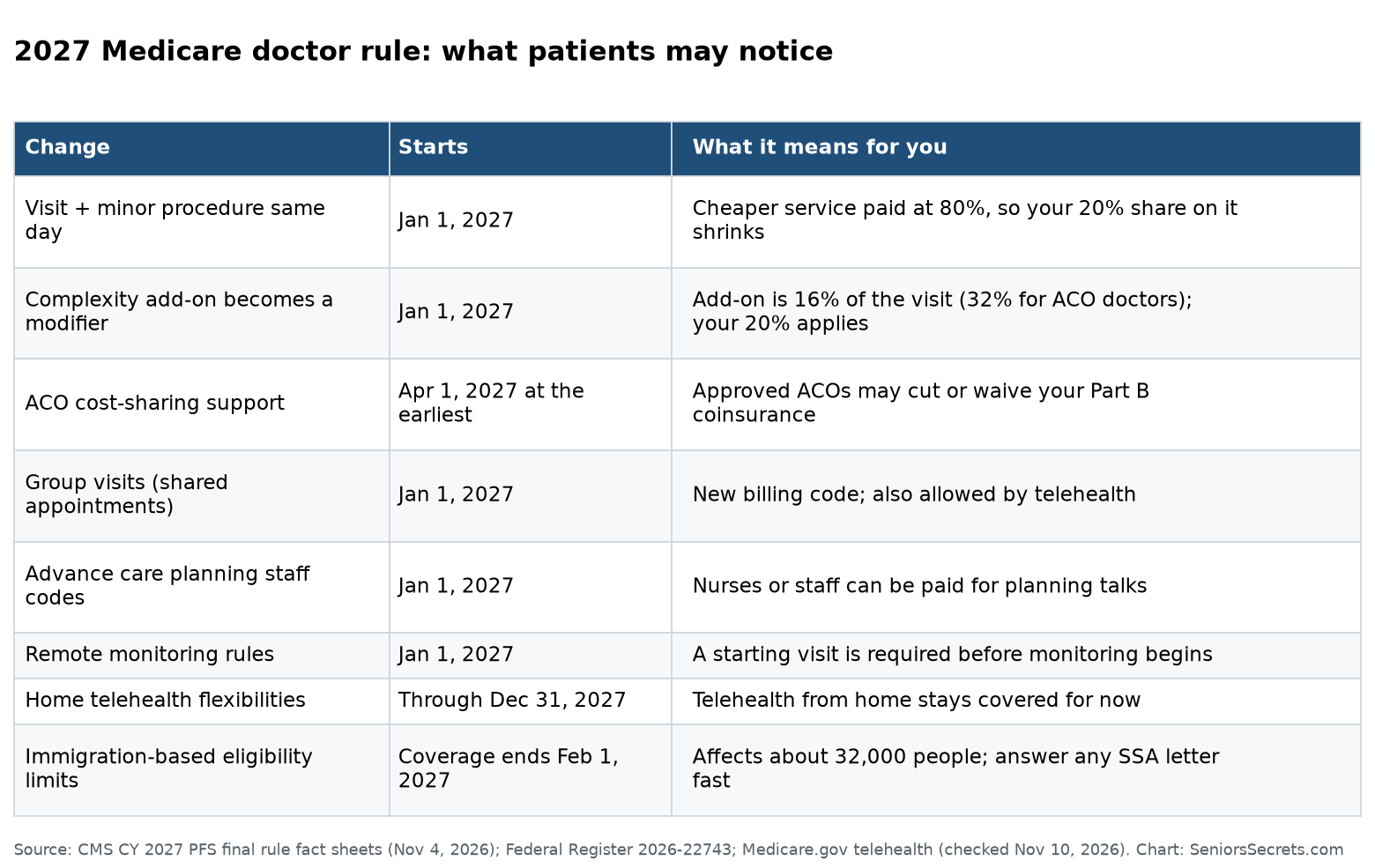
On Nov 4, 2026, CMS finalized the 2027 Medicare Physician Fee Schedule. That is the yearly rule that sets what Original Medicare pays doctors and what your 20% share is based on. It takes effect Jan 1, 2027. For most people the changes are small but real: a lower bill when a visit and a minor procedure happen the same day, a new way for some doctor groups to waive your Part B coinsurance starting April 2027, and home telehealth that stays covered through Dec 31, 2027 (CMS press release; CMS fact sheet; Federal Register, Nov 9, 2026).

Below is what each change means for your bills, who is affected, and what to ask your doctor’s office. I read the CMS fact sheets and the final rule itself, not summaries.
If you or a parent gets a letter from Social Security asking for proof of citizenship or immigration status, answer by the deadline in the letter. See what to do if you get a Medicare eligibility letter.
First, what this rule does and does not touch
The fee schedule sets the Medicare-approved amount (the price Medicare agrees to pay) for each doctor service. In Original Medicare, you pay 20% of that amount after the Part B deductible. So when the approved amount moves, your share moves too (Medicare.gov costs).
What it does not set:
- Your Part B premium and deductible. Those come in a separate CMS notice. CMS announced the 2027 amounts on Nov 17, 2026: $209.40 a month and a $292 deductible, up from $202.90 and $283 in 2026. See our 2027 Part B premium update.
- Medicare Advantage copays. Your plan sets those. Check your 2027 Annual Notice of Change.
- Medigap. If you have Plan G or a similar plan, it pays your 20% coinsurance. Most coinsurance changes below will not reach your wallet. Our Medigap guide explains which plans cover what.
1. A visit and a small procedure on the same day cost a bit less
Today, if your doctor sees you for an office visit and then does a small procedure in the same trip, both are usually paid in full. Think of quick in-office procedures, like many joint injections and skin biopsies. CMS calls these “0-day global” procedures (procedures with no follow-up days built into the price).
Starting Jan 1, 2027, the more expensive service is paid at 100%. The other one is paid at 80%. CMS first proposed 50% and dropped it after comments. It also limited the rule to 0-day procedures, not bigger surgeries with 10 or 90 follow-up days (CMS fact sheet).
Because your 20% is based on the approved amount, your share of the cheaper service drops by a fifth. Here is a made-up example to show the math:
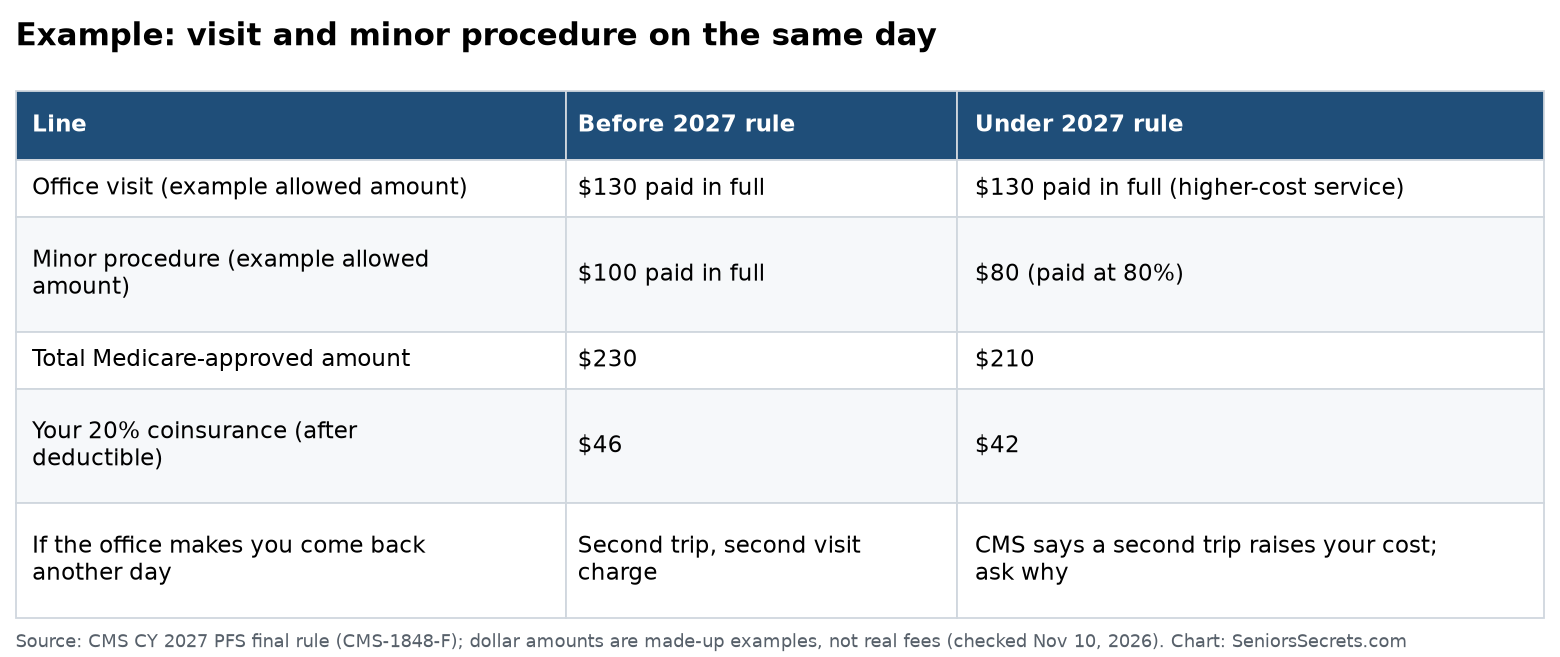
The gotcha. Some offices may be tempted to have you come back another day so both services are paid in full. CMS wrote in the final rule that this would “increase beneficiary cost-sharing” and said it will watch for that billing pattern. If you are told to return for a quick procedure that could be done now, ask why. A second trip means a second visit charge, more travel and more time.
2. The “complexity add-on” becomes a percentage
Since 2025, doctors could add a small extra charge (code G2211) for visits where they manage your care over time. In 2027 that becomes a modifier that raises the visit payment by 16%. For doctors in certain ACOs (doctor groups explained below), a separate modifier raises it by 32%.
Your 20% applies to that higher amount. MedPAC and other commenters warned this could raise patient cost-sharing on bigger visits. CMS kept it anyway. If you have Medigap, you likely will not notice. If you pay coinsurance yourself, read your Medicare Summary Notice for “B1” or “B2” style charges and ask the office if something looks off.
3. Some ACOs can waive your Part B coinsurance from April 2027
This is the change with the most upside. An ACO (Accountable Care Organization) is a group of doctors and hospitals in Original Medicare that agree to coordinate your care. ACOs are not Medicare Advantage plans. You keep the freedom to see any Medicare doctor (Medicare.gov ACOs).
Under the 2027 rule, an ACO in the Shared Savings Program can apply to CMS to reduce or eliminate Part B cost-sharing for patients it chooses. Key limits from the CMS Shared Savings fact sheet:
- It starts April 1, 2027 at the earliest. CMS takes applications in early 2027.
- It can cover most Part B items and services.
- It cannot cover durable medical equipment, prosthetics, orthotics, supplies or prescription drugs.
- Each ACO decides whether to join and which patients and services qualify. It is not automatic.
My take: if you have Original Medicare without Medigap and see the doctor often, this is worth a question at your next visit. Ask, “Is this practice in an ACO, and will it offer Part B cost-sharing support in 2027?” Your primary care office must give you a written ACO notice. You can also call 1-800-MEDICARE (1-800-633-4227). Do not drop a Medigap plan because of this. It is optional for ACOs, may cover only some services, and Medigap can be hard to get back later.
4. Home telehealth stays covered through 2027
Medicare.gov now says that through Dec 31, 2027, Medicare covers telehealth you get from anywhere in the U.S., including your home. You pay the same 20% you would pay in person for most services (Medicare.gov telehealth).
The 2027 rule also adds group visits, advance care planning by clinical staff and a few other services to the telehealth list. Our telehealth guide covers what happens if the home rules lapse after 2027.
5. Group visits and health coaching get paid
Medicare will pay for shared medical appointments starting in 2027. These are group visits where a clinician meets with several patients who share a condition, like diabetes. CMS also noted they may help with loneliness. They can be done by telehealth too.
The rule also creates payment for health and well-being coaching done by trained coaches under a doctor’s supervision. It also raises payment for quit-smoking help and for short alcohol and drug screening talks. If you have a chronic condition, ask whether your practice will offer group sessions or coaching in 2027. Normal Part B cost-sharing applies unless an ACO waives it. Our chronic care management guide shows other ongoing help Medicare already covers.
6. Advance care planning gets new staff codes
Advance care planning means talking through the care you would want if you could not speak for yourself, and filling out forms like a health care proxy. Two new codes, G0572 and G0573, pay for that time when nurses or other clinical staff lead the talk under a doctor’s direction.
Your cost does not change much. It is still free when done during your “Welcome to Medicare” or yearly Wellness visit with a doctor who accepts assignment. If it happens during another visit, the deductible and 20% apply (Medicare.gov advance care planning). The cheapest move is to ask for it at your Annual Wellness Visit.
7. Remote monitoring needs a starting visit
If you use a home blood pressure cuff or glucose meter that sends readings to your doctor, that is remote monitoring. In 2027, the practice must do a separate starting visit before monitoring begins. One type, remote therapeutic monitoring, will only be for patients the practice already knows. A plan to bar outside contractors from doing the monitoring was pushed to 2029.
Watch for that extra starting visit on your statement. It carries normal Part B cost-sharing.
8. New Medicare eligibility limits for some noncitizens
A 2025 law limits Medicare to four groups: U.S. citizens and nationals, green card holders (lawful permanent residents), Cuban and Haitian entrants, and people living here under a Compact of Free Association. The 2027 rule puts that law into Medicare’s regulations.
For people who were enrolled as of July 4, 2025 and are not in those groups, coverage ends Feb 1, 2027. Social Security sends a preliminary notice and then a termination notice in December 2026, with appeal rights. CMS’s actuaries estimate about 32,000 people will lose Medicare starting in 2027 (Federal Register final rule).
If you or a parent gets one of these letters and believe your status qualifies, contact Social Security right away with proof. Green card holders and citizens are not affected, but record errors happen.
What about doctor pay cuts?
The main payment rate (the conversion factor) drops about 2.3% for most doctors in 2027, to $32.63. That is mostly because a one-year 2.5% boost for 2026 ends. This does not change your benefits. It can slightly lower the approved amount your 20% is based on.
Some groups worry that cuts push offices to limit new Medicare patients. That is each practice’s choice. If you are switching plans or doctors for 2027, call and ask, “Are you taking new Medicare patients?” Our guide to our Medicare enrollment guide walks through it.
What to do before Jan 1, 2027
- Finish Open Enrollment by Dec 7, 2026 if you want a different Medicare Advantage or drug plan. This rule mainly affects Original Medicare.
- Ask your primary care office if it is in an ACO and whether it will offer coinsurance help in 2027.
- Book your Annual Wellness Visit and ask for advance care planning during it, when it is free.
- Read your Medicare Summary Notices in early 2027 for same-day procedure lines and new modifier charges.
- Open any Social Security letter about Medicare eligibility the day it arrives.
For the full list of other 2027 changes, see our Medicare 2027 changes guide.
Common questions
When does the 2027 Medicare doctor payment rule take effect?
It takes effect Jan 1, 2027. CMS released it Nov 4, 2026, and it was published in the Federal Register on Nov 9, 2026.
Will I pay less for a visit and a minor procedure on the same day?
Usually a little less. Starting in 2027, Medicare pays the cheaper of the two at 80%, so your 20% coinsurance on that service also drops. This applies to 0-day procedures only.
Can my doctor waive my Medicare coinsurance in 2027?
Only if the doctor is in a Shared Savings Program ACO that CMS approves for cost-sharing support. That can start April 1, 2027 at the earliest. It does not cover equipment, supplies or drugs.
Is Medicare telehealth from home still covered in 2027?
Yes. Medicare.gov says home telehealth is covered anywhere in the U.S. through Dec 31, 2027. You generally pay the same 20% as an in-person visit.
Does this rule change my Part B premium?
No. The 2027 Part B premium and deductible come from a separate CMS notice, released Nov 17, 2026. The 2027 premium is $209.40 a month and the deductible is $292.
Who loses Medicare under the new eligibility rule?
People who are not citizens, nationals, green card holders, Cuban or Haitian entrants, or COFA residents. For those enrolled as of July 4, 2025, coverage ends Feb 1, 2027, after Social Security notices with appeal rights.
Khasim Basha Shaik researches and compares Medicare plan rules and official cost figures for SeniorsSecrets.com. He is not a licensed insurance agent or financial adviser. This article is for education only. Confirm every number on Medicare.gov, SSA.gov or CMS.gov before you enroll or change a plan.