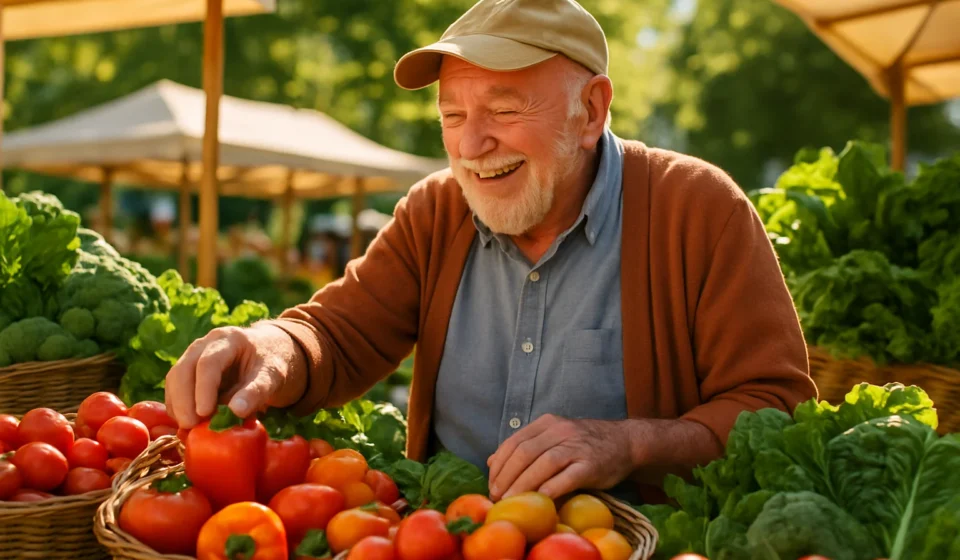

The Senior Farmers Market Nutrition Program (SFMNP) is one of the most overlooked benefits in America: a federally funded program that gives lower-income seniors free coupons or a benefit card to spend on fresh, locally grown fruits, vegetables, herbs, and honey. Yet each year older Americans leave an estimated $30 billion in benefits unclaimed, and SFMNP is a prime example. With farmers markets in full swing this summer and 2026 applications now open in many states, here is exactly who qualifies, how much you can receive, and how to sign up before the money runs out.
Table of Contents
- What Is the SFMNP?
- How Much You Receive in 2026
- Who Qualifies
- What You Can (and Can’t) Buy
- How to Apply Step by Step
- Stack It With Other Food Benefits
- Frequently Asked Questions
What Is the Senior Farmers Market Nutrition Program?
SFMNP is a U.S. Department of Agriculture (USDA) program administered by state agencies, U.S. territories, and federally recognized Tribal organizations — 57 in all. It provides eligible seniors with benefits redeemable at authorized farmers markets, roadside stands, and community-supported agriculture (CSA) programs. The goal is twofold: improve the diets of older adults by putting fresh produce within reach, and support local farmers. It is entirely separate from SNAP (food stamps), so receiving it does not reduce any other benefit.
How Much You Receive in 2026
The benefit amount is set by each state within federal guidelines, so it varies. Historically the federal minimum has been $20 to $50 per season, and many states land around $50. A few examples show the range:
| State (example) | Typical 2026 Benefit | Format |
|---|---|---|
| Alabama | $50 | Benefit card |
| South Carolina | $50 (5 checks of $10) | Paper checks |
| Many states | $35–$50 | Checks or eWIC-style card |
Benefits are typically issued once per season and must be used before an expiration date (often the fall). Because funding is limited and first-come, first-served in most areas, applying early in the season matters.
Who Qualifies for SFMNP
Three basic requirements apply nationwide, though states may add details:
- Age 60 or older (some Tribal programs use 55).
- Household income at or below 185% of the federal poverty level. For 2025–26 that is roughly $2,413 per month for a single person and about $3,261 per month for a household of two (guidelines adjust annually and by state).
- Residency in the state or service area running the program.
Here is a money-saving tip: in many states, if you already receive SNAP, Medicaid, SSI, or a Medicare Savings Program, you are automatically income-eligible and can skip the income paperwork. Most programs use self-declaration of income rather than requiring pay stubs.
What You Can (and Can’t) Buy
SFMNP benefits are limited to fresh, unprocessed, locally grown foods:
- Eligible: fresh fruits, fresh vegetables, fresh-cut herbs, and honey grown by the vendor.
- Not eligible: dried or canned produce, baked goods, jams, cider, potted plants, eggs, meat, cheese, or anything processed.
That fresh-produce focus is exactly what makes the program valuable beyond the dollars. Diets rich in fruits and vegetables are central to an anti-inflammatory eating pattern that supports heart, brain, and joint health in later life.
How to Apply Step by Step
- Find your state’s program. Search “[your state] Senior Farmers Market Nutrition Program” or start at your local Area Agency on Aging (call 1-800-677-1116, the Eldercare Locator).
- Check the application window. Many states open applications in spring or early summer; several now offer online portals, while others distribute through senior centers and food banks.
- Confirm eligibility. Have your age, address, and income (or proof of SNAP/Medicaid/SSI) ready. Most programs use simple self-declaration.
- Collect your benefits. You will receive checks or a benefit card, plus a list of authorized markets and vendors.
- Shop early and spend it all. Benefits expire, so plan trips through the summer and fall harvest before the deadline.
Remember you generally must re-apply each year — last season’s approval does not carry over.
Stack It With Other Food Benefits
SFMNP is designed to work alongside other assistance, not replace it. Many markets let you use SFMNP checks and SNAP/EBT on the same trip, and some double SNAP dollars for produce through “market match” programs. To build a full food safety net, pair SFMNP with:
- SNAP benefits for monthly groceries.
- Local food banks and senior congregate or home-delivered meal programs.
- The Commodity Supplemental Food Program (CSFP) monthly food box for seniors, where available.
For a broader look at money you may be missing, see our roundup of government benefits seniors overlook in 2026.
Why Fresh Produce Matters More After 60
The value of SFMNP is not just financial — it targets a real nutritional gap. National surveys consistently show that most older adults fall short of the recommended daily servings of fruits and vegetables, and produce is often the first thing cut when food budgets tighten because it is perishable and feels expensive. Yet the plant compounds in fresh produce — fiber, potassium, folate, vitamin C, and antioxidants like the anthocyanins in berries and the carotenoids in leafy greens and squash — are precisely the nutrients linked to lower blood pressure, better bowel regularity, steadier blood sugar, and reduced inflammation.
Fiber deserves special mention. Most seniors get only about half the recommended 21 to 30 grams a day, and low fiber intake drives constipation, poor cholesterol numbers, and blood-sugar swings. A season of free farmers-market produce is an easy, enjoyable way to close that gap. Potassium-rich picks — leafy greens, tomatoes, and squash — also help counterbalance sodium and support healthy blood pressure, an especially useful benefit for the many seniors managing hypertension.
Get the Most From Your Benefits
Shop near closing time when vendors often discount, ask farmers which items freeze well so nothing is wasted, and choose a rainbow of colors to cover the widest range of nutrients. Many markets also host free cooking demonstrations and nutrition education geared toward seniors — a no-cost way to turn your produce into simple, healthy meals.
Frequently Asked Questions
Does SFMNP affect my SNAP or Social Security?
No. SFMNP is a separate USDA nutrition program. Receiving it does not reduce your SNAP, SSI, Social Security, or any other benefit, and in many states qualifying for those programs makes you automatically eligible for SFMNP.
How do I find a farmers market that accepts it?
When you receive your benefits, your state agency provides a list of authorized markets, stands, and CSAs. You can also ask your Area Agency on Aging or look for the SFMNP sign at market vendor booths.
What if my state doesn’t participate?
Not every state runs SFMNP, and within participating states not every county has access. If yours does not, ask your Area Agency on Aging about the Commodity Supplemental Food Program, local produce-voucher pilots, or food-bank produce distributions.
Can I use the benefits for my whole household?
Benefits are issued per eligible senior. If both spouses are 60+ and income-eligible, each can typically apply and receive a separate benefit, doubling the fresh produce for your household.
Related Articles You May Find Helpful
- Senior Nutrition Guide 2026
- 7 Government Benefits Seniors Are Missing in 2026
- SNAP Work Requirements 2026 for Seniors
- 4 Medicare Savings Programs That Cut Your Bills
- Anti-Inflammatory Diet for Seniors
Sources
- USDA Food and Nutrition Service — Senior Farmers Market Nutrition Program & 2025–26 Income Eligibility Guidelines
- National Council on Aging (NCOA) — SFMNP Key Facts for Older Adults
- Eldercare Locator / Administration for Community Living — 1-800-677-1116
Benefit amounts, income limits, and application windows vary by state and change yearly; confirm details with your state agency or Area Agency on Aging. See our Medical Disclaimer.
Related guides

Social Security Retroactive Benefits: Who Can Get a Lump Sum of Up to 6 Months, and What It Costs You
CSFP Senior Food Box: Who Qualifies for the Free Monthly USDA Groceries, 2026 Income Limits, and How to Apply

Weatherization Assistance Program for Seniors: Who Qualifies, What It Covers, and How to Apply