Magnesium for Seniors: How Much You Need, Best Foods, Supplement Forms, and What the Evidence Really Shows

Magnesium helps run hundreds of processes in the body, including muscle and nerve function, heart rhythm, blood sugar control and bone building. Many older adults don’t get enough. With age, the gut absorbs less, the kidneys lose more, and several common medicines lower levels further.
That makes magnesium worth paying attention to. It doesn’t make it a cure-all. This guide covers how much you need, how to get it from food, when a supplement makes sense and which form to choose, and what the evidence actually shows for sleep and leg cramps.
I’m a researcher, not a doctor or dietitian. If you have kidney disease, don’t take magnesium supplements unless your doctor approves. Your kidneys may not be able to clear the excess.
How much you need
According to the NIH Office of Dietary Supplements’ magnesium fact sheet, the recommended daily amount for adults 51 and older is:
- Men: 420 mg a day
- Women: 320 mg a day
The upper limit for supplements is 350 mg a day for adults. That limit doesn’t apply to magnesium from food, which healthy kidneys handle easily. Higher supplement doses are sometimes prescribed under a doctor’s care.
Why older adults run low
- Absorption from the gut declines with age.
- The kidneys lose more magnesium in urine.
- Smaller appetites and diets low in nuts, seeds, beans, greens and whole grains.
- Medicines:
- Proton pump inhibitors like omeprazole, esomeprazole and pantoprazole can cause low magnesium when taken for a long time, typically more than a year. The FDA added a warning about this.
- Loop and thiazide diuretics (furosemide, hydrochlorothiazide) increase magnesium loss in urine.
- Poorly controlled diabetes and heavy alcohol use increase losses too.
Signs of low magnesium
Mild shortfalls usually cause no clear symptoms. When magnesium is truly low (doctors call it hypomagnesemia), signs can include loss of appetite, nausea, fatigue and weakness. More severe deficiency can cause numbness and tingling, muscle cramps and twitching, abnormal heart rhythms and, rarely, seizures. Low magnesium often comes with low potassium or calcium.
Many of these symptoms have other causes, so don’t self-diagnose. If you take a PPI or diuretic long-term, or have palpitations, cramps or tingling, ask your doctor whether to check your magnesium. A standard blood test doesn’t capture total-body stores perfectly, but it’s the usual starting point. Your doctor will interpret it alongside your symptoms and other results.
Food first: the best sources
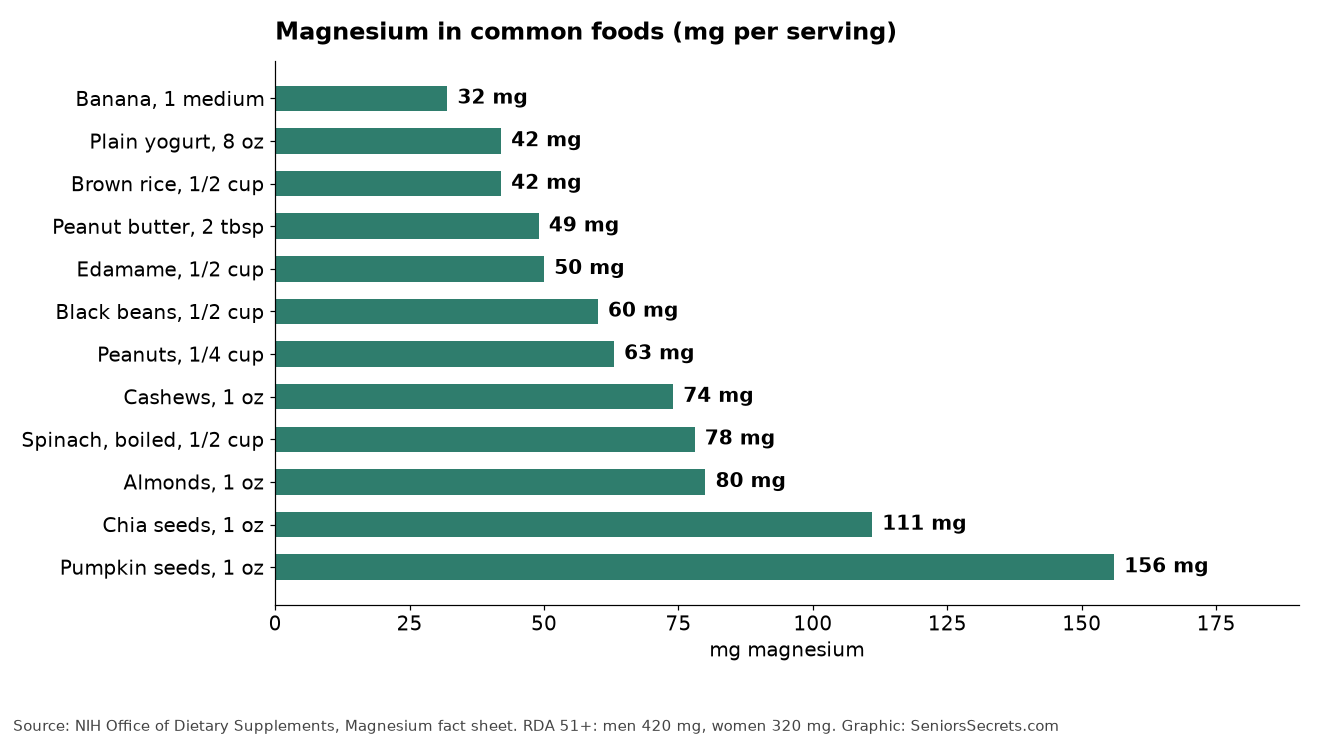
Values below are from the NIH ODS:
- Pumpkin seeds, 1 ounce: 156 mg
- Chia seeds, 1 ounce: 111 mg
- Almonds, 1 ounce: 80 mg
- Spinach, boiled, ½ cup: 78 mg
- Cashews, 1 ounce: 74 mg
- Black beans, ½ cup: 60 mg
- Edamame, ½ cup: 50 mg
- Peanut butter, 2 tablespoons: 49 mg
- Brown rice, ½ cup: 42 mg
- Plain yogurt, 8 ounces: 42 mg
A sample day that gets a woman close to her 320 mg: oatmeal with a tablespoon of chia and a sliced banana for breakfast, a black bean and brown rice bowl for lunch, a handful of almonds as a snack, and salmon with spinach for dinner. If chewing is hard, try nut butters, ground seeds, smoothies and soups.
Magnesium-rich foods also tend to be high in fiber and potassium, which is part of why eating patterns like the Mediterranean diet and the DASH diet work well. See also my list of high-fiber foods.

What the evidence shows, claim by claim
Sleep: modest and uncertain. A 2021 meta-analysis (Mah and Pitre, BMC Complementary Medicine and Therapies) found three small trials in older adults, with 151 people in total. Magnesium shortened the time to fall asleep by about 17 minutes compared with placebo, but the authors rated the evidence as low quality. It may help a little, and it’s lower-risk than many sleeping pills. For lasting results, see my guide to insomnia treatments that work.
Leg cramps: probably not. This is the most common reason older adults take magnesium, but a 2020 Cochrane review concluded it’s unlikely to give meaningful relief for typical nighttime leg cramps in older adults. See my leg cramps guide for what does help.
Blood pressure: supplements may lower blood pressure slightly, mostly in people who were low to begin with. They don’t replace blood pressure medicine.
Bones and blood sugar: magnesium is needed for bone formation and insulin action, and higher intake is linked to better outcomes in observational studies. A food-first approach is the safest way to cover these bases.
Constipation: magnesium citrate and oxide work as laxatives. That’s why diarrhea is the most common side effect.
If you take a supplement
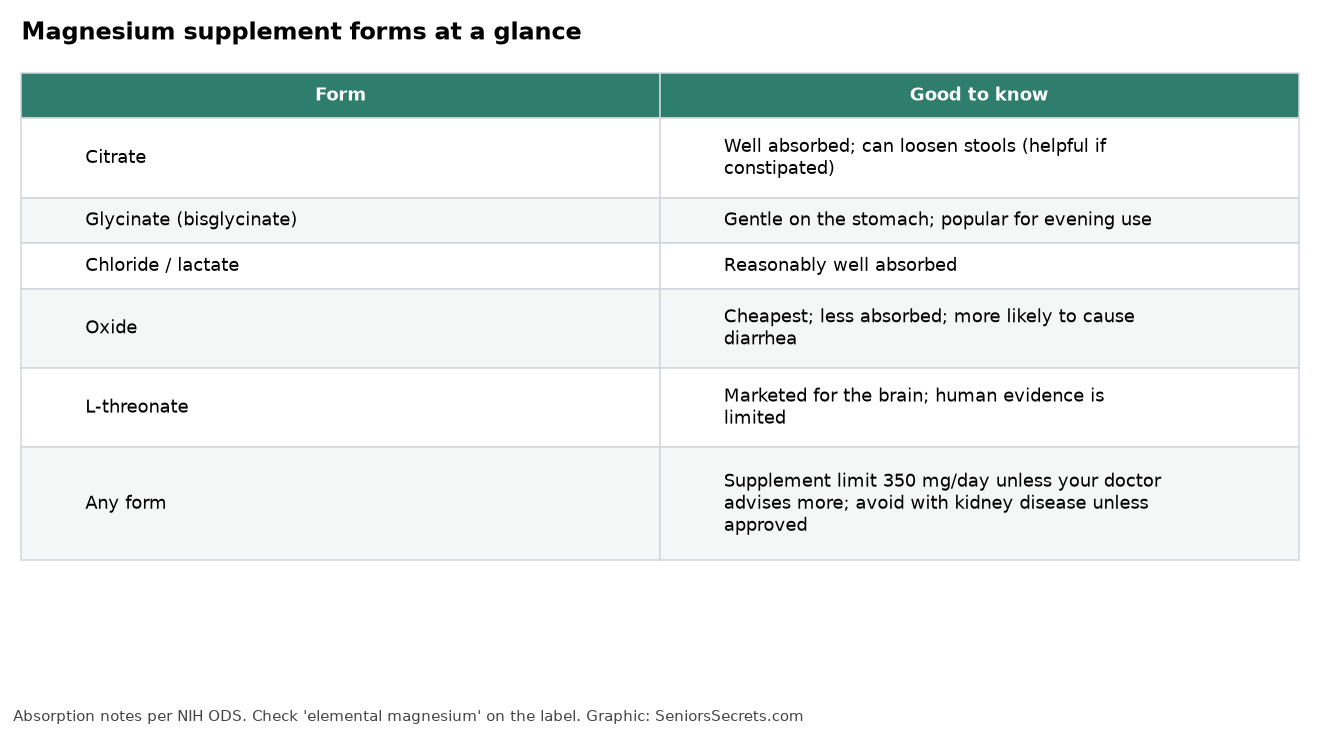
- Forms: the NIH ODS notes that magnesium citrate, chloride, lactate and aspartate are absorbed more completely than oxide or sulfate. Glycinate is popular because it’s gentle on the stomach. L-threonate is marketed for brain health, but human evidence is limited.
- Dose: read the label for elemental magnesium per serving. Unless your doctor advises otherwise, keep supplements at or below 350 mg a day. Many people do well with 100 to 200 mg.
- Timing and interactions:
- Take bisphosphonates (like alendronate) at least 2 hours apart from magnesium.
- Take tetracycline or quinolone antibiotics (like ciprofloxacin) at least 2 hours before, or 4 to 6 hours after, magnesium.
- Magnesium can also affect some thyroid medicine and digoxin levels. Ask your pharmacist.
- Watch for diarrhea, and stop if it happens.
- Kidney disease: avoid supplements and magnesium-containing laxatives and antacids unless your doctor approves.
Quick action plan
- Add one or two magnesium-rich foods a day, like a handful of nuts, a serving of beans or a bowl of oatmeal.
- If you take a PPI or diuretic long-term, ask your doctor whether to check your magnesium.
- If you consider a supplement, choose a well-absorbed form, stay at or under 350 mg unless advised, and check for interactions.
- Don’t count on magnesium for leg cramps. Its benefit for sleep is modest.
FAQ
How much magnesium should a senior take a day?
The total daily target from food and supplements is 420 mg for men 51+ and 320 mg for women 51+. Supplements alone shouldn’t exceed 350 mg a day unless your doctor advises it.
What’s the best magnesium supplement for seniors?
Forms like citrate, chloride and glycinate are better absorbed and tolerated than oxide. Choose by your needs (citrate if you’re constipated, glycinate if your stomach is sensitive), and check for interactions first.
Does magnesium help leg cramps?
A 2020 Cochrane review found it’s unlikely to give meaningful relief for typical nighttime leg cramps in older adults.
Can magnesium help with sleep?
Possibly a little. Small trials in older adults found people fell asleep about 17 minutes faster, but the evidence is low quality.
Who shouldn’t take magnesium supplements?
People with kidney disease, unless their doctor approves, and anyone on interacting medicines like bisphosphonates or certain antibiotics without spacing the doses.