Step-Ups for Seniors: How to Do Them Safely, an 8-Week Plan, and Why They Help With Stairs and Falls
Step-ups are one of the best home exercises for older adults because they train the exact move you use on stairs, curbs and bus steps. You stand on one leg, push up, and control the way down. Start on a low, steady step about 4 inches high, hold a rail, and do 2 sets of 5 per leg, 2 to 3 days a week. Build up slowly over about 8 weeks.
The research case is strong for this kind of training as a group. A Cochrane review of 108 trials found that exercise programs cut the rate of falls in older adults living at home by 23% (Sherrington, Cochrane 2019). The programs that worked best mixed balance and functional moves, and step-ups are both.
I research health topics for older readers. I am not a doctor or physical therapist. If you have had a fall, a joint replacement, or heart disease, check with your clinician first.
Why step-ups matter after 60
Leg strength and power fade with age, faster than most people expect. That loss shows up first in daily tasks: climbing stairs, getting out of a low car, stepping into a tub.
A step-up builds three things at once:
- Strength in the front of the thigh (quadriceps) and the buttocks (glutes)
- Balance on one leg, which you use every time you walk
- Control on the way down, which protects your knees on stairs
U.S. guidelines say older adults should do muscle-strengthening work at least 2 days a week and add balance training (ODPHP Physical Activity Guidelines). The National Institute on Aging also lists strength and balance as two of the main exercise types for healthy aging (NIA). Step-ups count toward both.
What you need
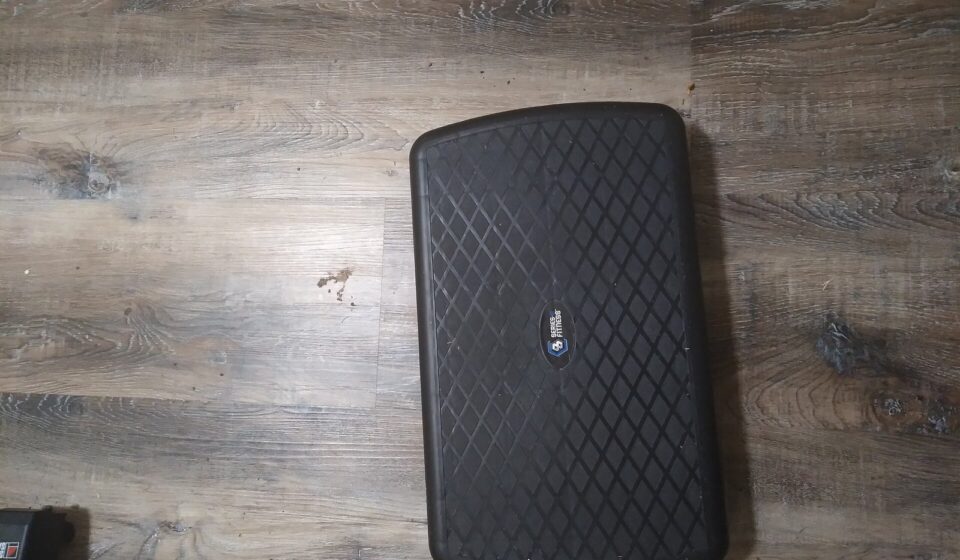
- A low, steady step. An exercise step platform at about 4 inches is a good start if it does not slide. Later, the bottom stair of your staircase (about 7 inches) is ideal because it has a rail.
- Something to hold. A stair rail, a sturdy counter, or a wall.
- Flat shoes with grip. Not socks or slippers.
Do not use a stool, a box, or anything that can tip.

How to do a step-up, step by step
- Stand facing the step, close enough that your toes almost touch it. Hold the rail.
- Place your whole right foot on the step. Your heel should not hang off.
- Lean forward a little from the hips. Press through your right heel to stand up on the step.
- Bring your left foot up next to your right. Stand tall for one second.
- Step down with the left foot first, slowly. Count “one, two, three” on the way down.
- Bring the right foot down. That is one rep.
- Do all your reps on the right leg, then switch.
Breathe out as you step up. Do not hold your breath.
An 8-week plan
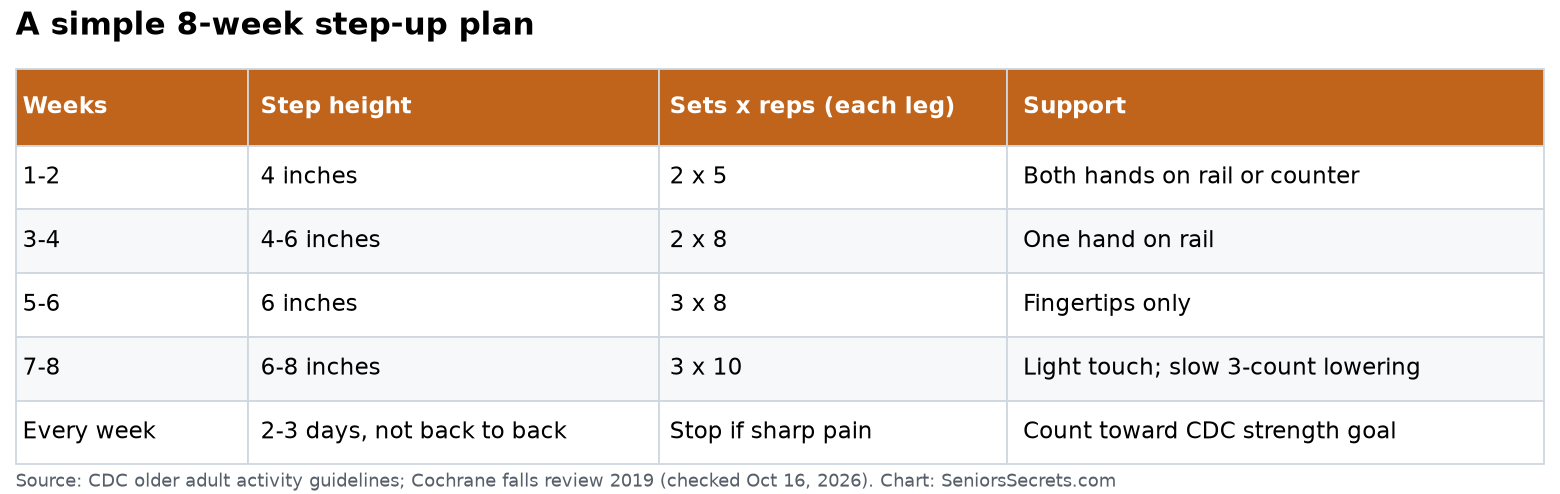
| Weeks | Step height | Sets x reps per leg | Support |
|---|---|---|---|
| 1 to 2 | 4 inches | 2 x 5 | Both hands on the rail or counter |
| 3 to 4 | 4 to 6 inches | 2 x 8 | One hand |
| 5 to 6 | 6 inches | 3 x 8 | Fingertips only |
| 7 to 8 | 6 to 8 inches | 3 x 10 | Light touch, slow 3-count lowering |
Do step-ups 2 to 3 days a week, never two days in a row. Your muscles get stronger on rest days.
Move up a level only when the current one feels steady and you have no knee pain the next day. Most people should add reps before height. A standard stair is about 7 inches, so once you can do 3 sets of 10 on a 6-inch step, real stairs feel easier.
Mistakes that make step-ups less useful
- Pushing off the back foot. If you bounce off the floor, the top leg does less work. Keep the back foot light.
- Knee caving in. Keep your kneecap pointing over your second toe.
- Dropping down fast. The slow lowering is where you build stair control. Take three seconds.
- Too high, too soon. If your hips twist or you grab the rail hard, lower the step.
- Gripping the rail with both hands all the time. That is fine in week 1. By week 4, try to use one hand.
Make it harder or easier
Easier:
- Use a lower step, like a thick book that will not slide, about 2 inches.
- Do “step-taps” first. Just tap the top of the step with each foot, holding the rail.
- Do glute bridges and sit-to-stands from a chair to build strength first.
Harder:
- Slow the lowering to a count of five.
- Add a knee lift at the top, holding the rail lightly.
- Hold a light dumbbell in the hand away from the rail.
- Try a lateral step-up, stepping up sideways.
Pair step-ups with calf raises and balance exercises for a short, complete leg routine.
Who should skip or change step-ups
Step-ups are safe for most people, but they are not right for everyone at the start:
- Recent hip or knee replacement: follow your surgeon’s and therapist’s rules. Many protocols add step-ups later in rehab, on a very low step.
- Severe knee arthritis: a low step may be fine. If pain lasts more than an hour after, stop and ask a physical therapist.
- Dizziness, recent falls, or poor balance: do step-taps first, with a person nearby.
- Heart disease or chest pain with effort: get your doctor’s okay first.
Stop right away if you feel chest pain, sharp joint pain, or dizziness.
Medicare and getting help
Medicare does not pay for a home exercise routine on its own. But if you have had falls or trouble with stairs, a doctor can order physical therapy. A PT can teach step-ups safely and build a plan for you, with Part B paying 80% after the deductible. See does Medicare cover physical therapy. Many Medicare Advantage plans also include a fitness benefit for gyms or classes.
Common questions
How many step-ups should a senior do?
Start with 2 sets of 5 per leg, 2 to 3 days a week. Build to 3 sets of 10 over about 8 weeks.
What height step is best for beginners?
About 4 inches. The bottom stair of a staircase is usually about 7 inches, so a lower platform or a very low step is a better start.
Are step-ups safe with bad knees?
Often yes, on a low step with slow, controlled form. If pain lasts more than an hour after, lower the step or ask a physical therapist.
Do step-ups help prevent falls?
They train leg strength and one-leg balance, which are key parts of the exercise programs shown to reduce falls by about 23% in a Cochrane review.
Can I do step-ups every day?
It is better not to. Give your legs a rest day between sessions so the muscles can recover and get stronger.
Written by Khasim Basha Shaik. I research health and Medicare topics for older readers. I am not a doctor, physical therapist, or licensed professional. This article is general education, not medical advice. Last reviewed October 16, 2026.