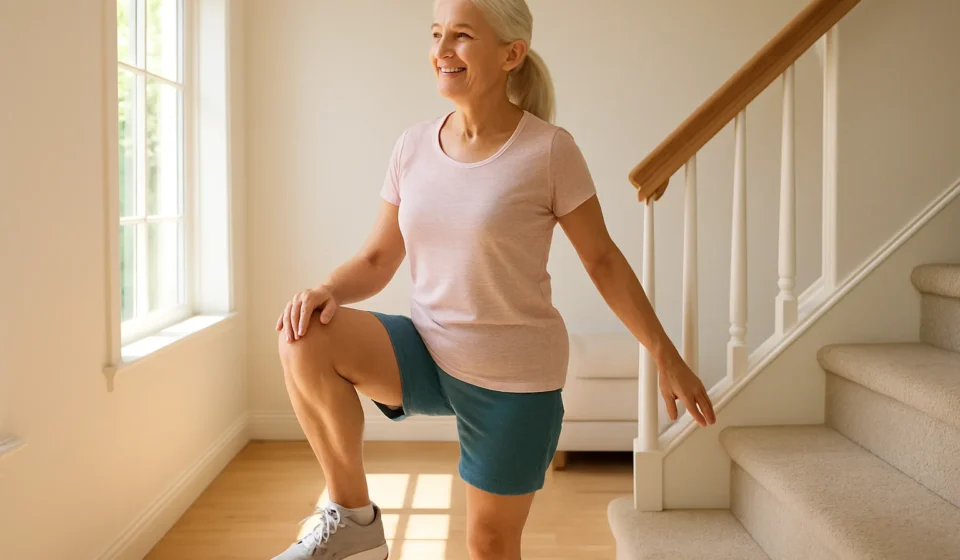

If climbing stairs has started to feel harder — or if a single flight leaves you reaching for the railing — step-ups for seniors are one of the most practical exercises you can do. A step-up trains the exact movement pattern your body uses on stairs, curbs, and the edge of the bathtub, building the leg strength and one-leg balance that keep you independent and prevent falls. Best of all, you need nothing more than a sturdy step and a wall or rail. Let me show you why this humble move is so effective and exactly how to do it safely.
Table of Contents
- Why Step-Ups Matter So Much After 60
- The Muscles and Skills You Build
- How to Do a Step-Up Safely
- Progressions and a Weekly Plan
- Common Mistakes to Avoid
- Safety and When to Check With Your Doctor
- Frequently Asked Questions
Why Step-Ups Matter So Much After 60
Step-ups are what exercise scientists call a functional, compound exercise — they work several joints and muscle groups together in a pattern you actually use in daily life. That’s a big deal as we age, because the strength and power in our legs decline faster than almost any other physical quality, and that decline is tightly linked to falls, difficulty rising from chairs, and loss of independence. Research on home-based weighted step training in older adults has shown meaningful gains in lower-limb muscle power and functional ability — the very qualities that let you catch yourself when you stumble.
Crucially, a step-up requires you to balance on one leg while lifting your full body weight upward. That single-leg loading trains both strength and proprioception — your body’s sense of where it is in space — which is exactly the combination the fall-prevention research keeps pointing to. It complements the work you may already be doing with stair climbing and calf raises.
The Muscles and Skills You Build
A single step-up trains an impressive list of muscles and abilities at once:
- Quadriceps (front of thigh) — the prime mover for standing up and climbing.
- Glutes (buttocks) — power and hip stability that protect the lower back and knees.
- Hamstrings (back of thigh) — control and knee support.
- Calves — push-off and ankle stability.
- Core and hip stabilizers — keep you upright and level on one leg.
- Balance and coordination — the single-leg phase trains your stabilizing reflexes.
How to Do a Step-Up Safely
Start with a low, stable surface — the bottom step of a staircase, a sturdy aerobic step, or a low platform 4 to 6 inches high. Stand next to a wall or handrail you can touch for balance.
- Stand facing the step, feet hip-width apart, one hand lightly on the rail.
- Place your whole right foot flat on the step. Press through your heel (not your toes) and straighten the leg to lift your body up, bringing your left foot up to meet it.
- Pause and stand tall on the step for a moment, fully balanced.
- Step back down with the left foot first, then the right, returning to the start with control — lowering slowly is where much of the strength is built.
- Complete your repetitions leading with the right leg, then switch and lead with the left.
Move slowly and deliberately. Keep your chest up, your knee tracking over your toes (not caving inward), and let your working leg — not the rail — do the lifting. The handrail is for balance and reassurance, not for pulling yourself up.
Progressions and a Weekly Plan
Begin with what feels controlled and build gradually. The table below offers a simple progression. Aim for step-ups 2 to 3 days a week, on non-consecutive days, alongside your walking and balance work.
| Level | Step Height | Sets & Reps | Support |
|---|---|---|---|
| Beginner | 4 inches | 2 sets of 5 per leg | One hand on rail |
| Intermediate | 6 inches | 2–3 sets of 8 per leg | Fingertips on rail |
| Advanced | 8 inches (full stair) | 3 sets of 10–12 per leg | No hands / light dumbbells |
Once you can do three sets comfortably without holding on, you can make step-ups harder by increasing the step height, slowing the lowering phase to a count of three, holding light dumbbells, or adding a knee-lift at the top to challenge balance further. This is the same progressive-overload principle that makes any senior strength program keep working over time.
Common Mistakes to Avoid
Three errors undercut the exercise and raise injury risk. First, pushing off the back foot — bouncing off the floor with your trailing leg instead of letting the top leg do the work — robs you of the strength benefit. Second, letting the knee collapse inward, which stresses the joint; keep the kneecap pointed over the second toe. Third, rushing the descent; controlling the way down builds as much strength as the way up and protects your knees. If your balance wavers, lower the step height rather than gripping the rail harder.
Safety and When to Check With Your Doctor
Step-ups are safe for most older adults, but check with your physician before starting if you have significant knee or hip arthritis, a recent joint replacement, severe balance problems, heart disease, or a history of falls. Always exercise near a wall or sturdy rail, wear supportive flat shoes, and never attempt step-ups when you feel dizzy or unsteady. If a movement causes sharp joint pain (as opposed to normal muscle effort), stop and have it assessed. Pairing strength work with good posture exercises makes every movement safer and more efficient.
Frequently Asked Questions
Are step-ups safe for seniors with knee problems?
Often yes, when done on a low step with good form, because the controlled motion can strengthen the muscles that support the knee. But if you have significant arthritis or a recent replacement, get your doctor’s or physical therapist’s okay first and start with a 4-inch step.
How many step-ups should a senior do?
Begin with 2 sets of 5 per leg, 2–3 days a week, and build toward 3 sets of 10–12. Progress by adding reps first, then height, then light weights, only when the current level feels controlled.
Do step-ups help prevent falls?
Yes. They build lower-body strength and train single-leg balance and proprioception simultaneously — the exact combination shown to reduce fall risk in older adults, while also making real stairs feel easier and safer.
What height step is best for beginners?
Start at 4 inches — about the height of a low platform or the bottom stair — and only increase once you can complete your sets with control and without leaning on the rail for support.
Related Articles You May Find Helpful
- Senior Fitness & Exercise Guide 2026
- Stair Climbing for Seniors 2026: Heart & Leg Strength
- Calf Raises for Seniors 2026: Circulation & Balance
- Posture Exercises for Seniors 2026: Stand Tall Again
- Nordic Walking for Seniors 2026: Full-Body Workout
Sources
- Johns Hopkins Medicine — Fall Prevention: Balance and Strength Exercises for Older Adults
- Harvard Health Publishing — Step up your fitness and safety
- National Institutes of Health (PMC) — Home-Based Weighted Step Exercise Training in Older Adults
This article is for educational purposes and is not a substitute for personalized medical advice. Check with your doctor before beginning a new exercise program. See our Medical Disclaimer.
Related guides