Sleep Apnea in Older Adults: 7 Warning Signs, How It’s Tested and Treatment Options Beyond CPAP

Obstructive sleep apnea becomes more common with every decade of life, yet it’s easy to miss after 65. The classic picture is a heavy middle-aged man who snores like a freight train. In older adults, it more often shows up as getting up three times a night to use the bathroom, waking with a headache, nodding off in the afternoon, or memory slips that get blamed on age.
This guide covers the warning signs, how testing works, the full range of treatments, and what research does and doesn’t show about the risks. For the Medicare rules on CPAP, including the 12-week trial and 4-hour rule, see my separate guide: Does Medicare cover CPAP?
I’m a health researcher, not a doctor. This is general information to help you talk with your own clinician. Sources include the National Heart, Lung, and Blood Institute and the American Academy of Sleep Medicine, checked October 1, 2026.
What sleep apnea is
In obstructive sleep apnea (OSA), the muscles of your throat relax during sleep and the airway narrows or closes. Breathing slows or stops for 10 seconds or more, oxygen drops, and your brain jolts you partly awake to reopen the airway. You usually don’t remember it, but it can happen dozens of times an hour.
Doctors measure severity with the apnea-hypopnea index (AHI), the number of breathing pauses or shallow-breathing episodes per hour of sleep:
- Mild: 5 to 14 an hour
- Moderate: 15 to 29 an hour
- Severe: 30 or more an hour
Central sleep apnea is less common. The brain doesn’t send the signal to breathe, rather than the airway closing. It’s more likely in people with heart failure, after a stroke, or with opioid pain medicines, and it’s treated differently.
Why it’s more common as you age
The airway muscles lose tone with age, the soft tissue of the throat changes, and many people gain weight around the neck. Menopause removes some protection for women, so the gap between men and women narrows after 50. Alcohol, sleeping pills, opioids and some anxiety medications relax the throat further.
7 warning signs in older adults
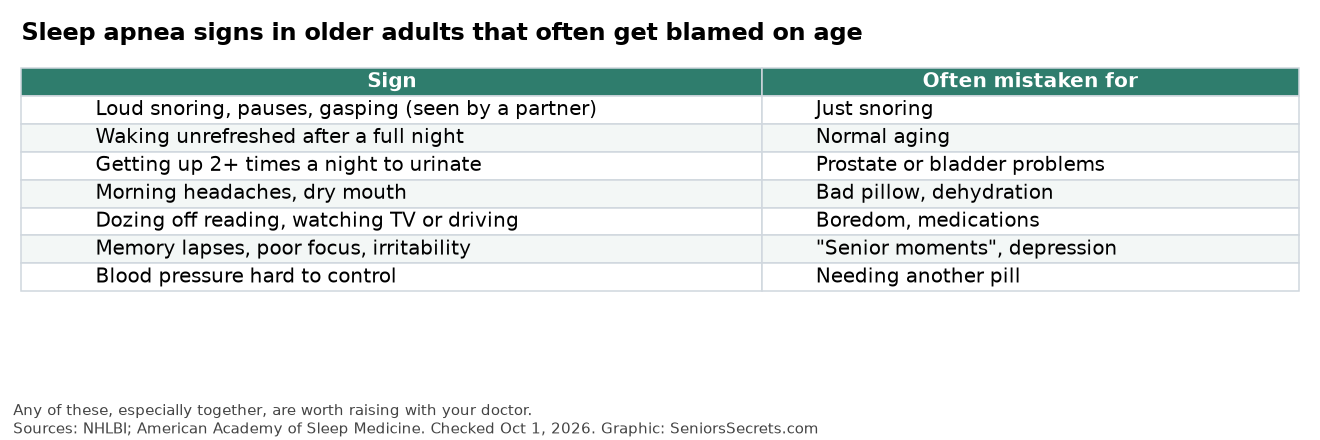
- Loud snoring with pauses, gasping or choking. A bed partner is often the first to notice. If you sleep alone, a phone sleep-recording app can capture snoring and gasps to show your doctor.
- Waking unrefreshed after seven or eight hours in bed. Broken sleep doesn’t restore you, however long you’re in bed.
- Getting up two or more times a night to urinate. The strain of breathing against a closed airway makes the heart release a hormone that increases urine. Treating apnea often cuts night-time bathroom trips.
- Morning headaches or a very dry mouth. Both are common after a night of mouth breathing and low oxygen.
- Dozing off during the day, while reading, watching TV, at the wheel, or at a red light. Drowsy driving is the most urgent reason to get tested.
- Memory lapses, poor focus and irritability. These can look like mild cognitive impairment or depression and can improve when apnea is treated.
- Blood pressure that’s hard to control, especially if you already take three or more medicines. Sleep apnea is a known cause of resistant high blood pressure.
Other clues include waking with a racing heart, new atrial fibrillation, heartburn at night and restless, sweaty sleep.
The risks: what the evidence shows
Untreated moderate or severe sleep apnea is linked to high blood pressure, atrial fibrillation, heart failure, stroke, type 2 diabetes and car crashes. The American Heart Association lists it as a risk factor for heart disease. The blood pressure link is the best established: treatment usually lowers it a little, and more in people with resistant hypertension.
It’s honest to add what research hasn’t proven. In the large SAVE trial, published in the New England Journal of Medicine in 2016, CPAP didn’t reduce heart attacks or strokes in people with sleep apnea and heart disease over about four years (PubMed). But participants used their machines for only about three hours a night on average, so the question isn’t settled. CPAP did improve sleepiness, mood and quality of life.
The link with memory and dementia is real in observational studies, which find more cognitive decline in people with untreated apnea. Whether treatment lowers dementia risk hasn’t been shown in a large randomized trial yet. Treatment does often improve alertness and concentration. For more, see poor sleep and dementia risk and 14 dementia risk factors you can reduce.
How sleep apnea is tested
Start with your primary care doctor. Many use a short questionnaire such as STOP-Bang, which asks about snoring, tiredness, observed pauses, blood pressure, BMI, age, neck size and sex. A high score means you should be tested. There are two kinds of test:
Home sleep apnea test. You wear a small device for one to three nights in your own bed. It records breathing, airflow, oxygen and heart rate. It’s cheaper and more comfortable, and it works well when the main question is moderate-to-severe obstructive apnea.
In-lab sleep study (polysomnography). You spend a night in a sleep center wired to monitor brain waves, breathing, oxygen, heart rhythm and leg movements. It’s the better choice if a home test was unclear or negative despite symptoms, or if you have heart failure, COPD, a past stroke, use opioids, or might have central apnea or another sleep disorder.
Medicare Part B covers both when your doctor orders them. You pay 20% after the $283 deductible in 2026, unless you have a Medigap plan that covers it.
Treatment options
CPAP: still the first choice
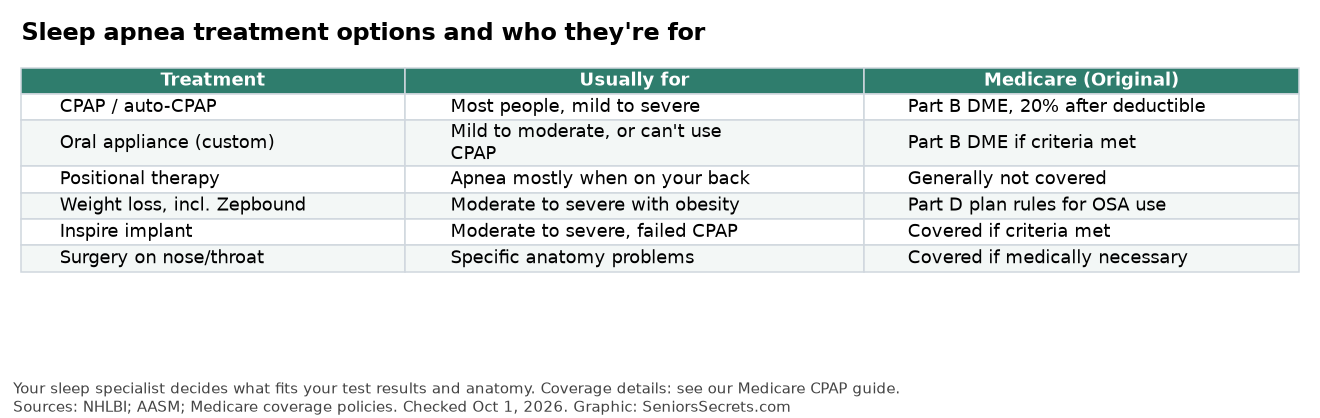
A CPAP machine blows gentle air through a mask to keep your airway open. It works whenever you use it, and most people feel the difference in sleepiness within weeks. Modern machines are quiet, adjust the pressure automatically, and include humidifiers and a “ramp” that starts low.
The problem is sticking with it. Tips that help:
- Try several masks. Nasal pillows, nasal masks and full-face masks suit different faces. Mask fit causes most complaints. Ask for a refit in the first month.
- Use the heated humidifier if your nose or mouth gets dry.
- Wear it while awake for 20 to 30 minutes watching TV to get used to the feel.
- Put it on every time you sleep, including naps.
- Call your supplier or sleep doctor early if you’re struggling. Pressure and settings can be changed.
Medicare checks whether you use the machine in the first three months, so these early weeks matter. The Medicare CPAP guide explains the rules.
Oral appliances
A dentist trained in sleep medicine can make a custom mouthpiece that holds your lower jaw forward. It’s an option for mild to moderate apnea or for people who can’t tolerate CPAP. It’s less powerful than CPAP but many people use it more consistently. You need healthy enough teeth to anchor it, which rules it out for some people with dentures.
Positional therapy
Some people have apnea mostly when they sleep on their back. A wearable device that vibrates when you roll over, or a pillow or backpack that keeps you on your side, can help if your sleep test shows this pattern.
Weight loss and Zepbound
Losing weight reduces apnea in people with obesity. In December 2024 the FDA approved Zepbound (tirzepatide) for moderate to severe obstructive sleep apnea in adults with obesity. In the trials behind the approval, it cut breathing pauses by roughly half or more over a year (PubMed). Because it’s approved for sleep apnea, Medicare drug plans can cover it for that use, with prior authorization rules that vary by plan. See GLP-1 drugs and Medicare.
Inspire nerve stimulator
Inspire is an implanted device that stimulates the nerve controlling the tongue, moving it forward with each breath. It’s for moderate to severe obstructive apnea in people who can’t use CPAP. Medicare covers it when strict criteria are met, typically including a failed CPAP trial, a qualifying AHI and body weight range, and a scope exam of the airway during sedated sleep.
Surgery and other steps
Surgery on the nose, tonsils, palate or jaw helps selected people with a specific blockage. For everyone, these steps help: avoid alcohol within three hours of bed, ask your doctor whether any sleeping pills, opioids or sedating medicines can be reduced, treat nasal congestion, and keep a regular sleep schedule.
Sleep apnea or insomnia?
The two often go together, and treating one can help the other. If your main problem is lying awake rather than waking tired, read my guide to insomnia in older adults and CBT-I.
When to see a doctor soon
Ask for an evaluation promptly if you fall asleep while driving, a partner sees you stop breathing, you have new atrial fibrillation or heart failure, or your blood pressure stays high despite treatment. Related reading: atrial fibrillation in seniors and high blood pressure treatment.
FAQ
Can you have sleep apnea without snoring?
Yes. Older adults, women and people with central sleep apnea often snore little or not at all. Daytime sleepiness, night-time urination and morning headaches can be the only clues.
Is a home sleep test good enough?
Often, yes, for suspected moderate or severe obstructive apnea. An in-lab study is better if you have heart or lung disease, a past stroke, use opioids, or a home test was negative despite symptoms.
Is CPAP worth it at 75 or 80?
For most people with moderate or severe apnea, yes. Benefits like less sleepiness, fewer bathroom trips and better focus don’t depend on age.
What if I can’t tolerate CPAP?
Talk to your sleep doctor before giving up. Mask changes and settings fix many problems. Alternatives include an oral appliance, positional therapy, weight loss including Zepbound, and the Inspire implant.
Does Medicare cover sleep apnea treatment?
Yes. Part B covers sleep tests, CPAP and supplies, and oral appliances when criteria are met. Details are in the Medicare CPAP guide.
Related guides