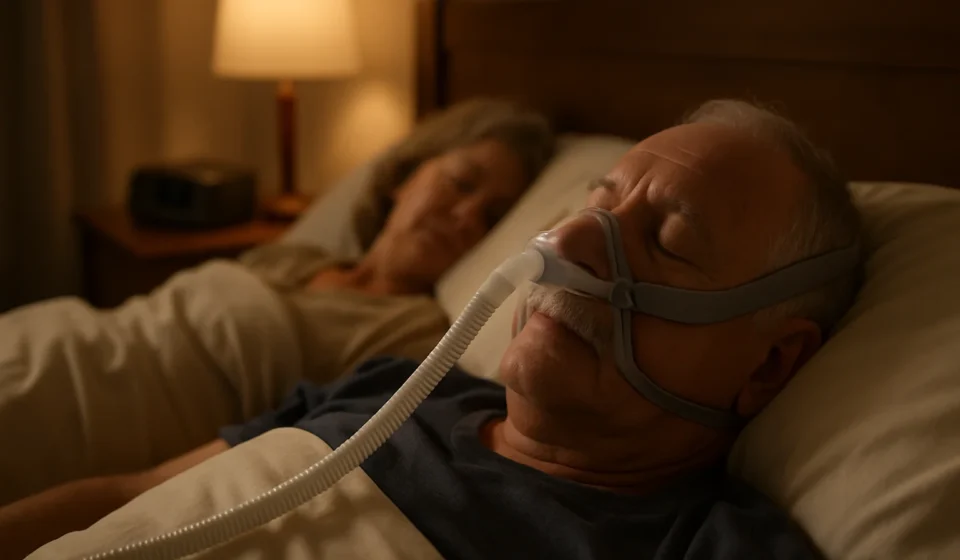

Sleep apnea in seniors is vastly underdiagnosed—and the consequences extend far beyond loud snoring. Undetected obstructive sleep apnea (OSA) in adults over 65 doubles the risk of atrial fibrillation, triples the risk of stroke recurrence, and accelerates cognitive decline at rates that mirror early-stage dementia. Approximately 56% of adults over 65 have clinically significant sleep apnea, yet fewer than one in five are diagnosed. This guide covers the 7 warning signs most seniors miss, the available treatments in 2026 including newer non-CPAP options, and how Medicare covers diagnosis and equipment.
Table of Contents
- Why Sleep Apnea Is More Dangerous Over Age 65
- 7 Warning Signs Seniors (and Their Partners) Shouldn’t Ignore
- Diagnosis: Home Sleep Test vs. In-Lab Polysomnography
- CPAP Therapy: Still the Gold Standard—and More Comfortable Than Ever
- Non-CPAP Alternatives in 2026: Oral Appliances, Inspire, Positional Therapy
- Sleep Apnea, Heart Disease, and Dementia: What the Evidence Shows
- Medicare Coverage for Sleep Apnea Diagnosis and CPAP in 2026
- Frequently Asked Questions
Why Sleep Apnea Is More Dangerous Over Age 65
Obstructive sleep apnea occurs when the muscles of the pharynx relax during sleep, allowing the airway to collapse partially or completely. Each collapse triggers a brief arousal—often lasting only 3–10 seconds, too brief to remember—that fragments sleep architecture, activates the sympathetic nervous system, and causes repetitive hypoxemia (oxygen desaturation below 90%).
In older adults, two age-related changes amplify these effects. First, the arousal threshold rises with age, meaning seniors take longer to awaken from apnea episodes and sustain longer hypoxemic periods per event. Second, older adults have less physiological reserve—the cardiovascular and neurological systems tolerate repeated nocturnal oxygen desaturations less well than in younger adults. An Apnea-Hypopnea Index (AHI) of 15 events/hour carries substantially greater clinical risk in a 72-year-old with hypertension and early cognitive impairment than in a 40-year-old without comorbidities.
The epidemiological scale is striking. The Sleep Heart Health Study found OSA prevalence of 56% in adults 65–70 and 67% in those over 75, using an AHI threshold of ≥5. The Wisconsin Sleep Cohort, which followed participants for over 20 years, found that untreated moderate-to-severe OSA increased all-cause mortality by 3-fold and cardiovascular mortality by 5-fold.
7 Warning Signs Seniors (and Their Partners) Shouldn’t Ignore
The warning signs of sleep apnea in older adults often differ from the classic presentation. Younger patients typically report loud snoring and witnessed apneas. Seniors more commonly present with atypical symptoms that are attributed to normal aging or other conditions:
| Warning Sign | Why Seniors Miss It | What It Actually Signals |
|---|---|---|
| Waking unrefreshed despite 7–9 hours sleep | Attributed to “just getting older” | Sleep fragmentation from apnea arousals |
| Nocturia (waking 2+ times to urinate) | Assumed to be prostate or bladder issue | Apnea-triggered ANP release (atrial natriuretic peptide) causes kidney to excrete urine during apnea episodes |
| Morning headaches | Attributed to poor pillow or neck pain | CO₂ retention from hypoventilation during apnea |
| Memory lapses and cognitive fog | Attributed to “senior moments” or MCI screening | Hippocampal atrophy from chronic nocturnal hypoxemia |
| Mood changes (irritability, depression) | Attributed to retirement, loneliness, or life stress | Sleep deprivation and hypoxemia alter serotonin and dopamine regulation |
| High blood pressure that doesn’t respond well to medication | Assumed to be refractory hypertension | Repeated sympathetic activation from apnea events raises 24-hour mean blood pressure |
| Loud snoring with breathing pauses (reported by partner) | Partner may not be present or may sleep separately | Direct evidence of airway obstruction; pauses >10 seconds are apnea episodes |
Diagnosis: Home Sleep Test vs. In-Lab Polysomnography
Medicare covers two diagnostic pathways for sleep apnea in 2026. A Home Sleep Apnea Test (HSAT) uses a portable monitoring device worn for one or two nights that records airflow, respiratory effort, heart rate, and oxygen saturation. It is less expensive, more convenient, and appropriate when OSA is the primary suspected diagnosis without significant comorbidities. Medicare Part B covers HSATs at 80% after the $283 deductible.
In-lab polysomnography (PSG) is indicated when the HSAT is non-diagnostic or inconclusive, when central sleep apnea (CSA) is suspected (more common in seniors with heart failure), or when the patient has comorbidities that complicate home testing, such as severe COPD, morbid obesity, or heart failure with reduced ejection fraction. PSG measures 16 physiological channels simultaneously—including EEG sleep staging, EMG leg movement, and precise airflow—providing diagnostic information that HSAT cannot capture. Medicare covers PSG in an accredited sleep lab under the same Part B benefit.
CPAP Therapy: Still the Gold Standard—and More Comfortable Than Ever
Continuous positive airway pressure (CPAP) remains the most effective treatment for moderate-to-severe OSA. The device delivers a continuous stream of pressurized air through a mask, acting as a pneumatic splint to hold the airway open. A 2024 Cochrane meta-analysis of 75 randomized trials confirmed that CPAP reduces AHI by 82% on average, improves Epworth Sleepiness Scale scores by 3.0 points, and significantly reduces systolic blood pressure (mean reduction: −2.5 mmHg).
Modern CPAP technology in 2026 is dramatically more tolerable than devices from a decade ago. Auto-titrating CPAP (APAP) automatically adjusts pressure throughout the night based on detected events—eliminating the discomfort of fixed high pressure when it isn’t needed. Heated humidification virtually eliminates the dry mouth and nasal congestion that caused many seniors to abandon older machines. Mask options now include minimal-contact nasal pillows that do not cover the nose bridge—highly preferred by seniors with claustrophobia.
CPAP compliance remains the key challenge. Research shows 30–50% of patients do not use CPAP consistently. For seniors, the most effective adherence strategies include telemedicine follow-up with a respiratory therapist in the first 90 days, mask resizing (mask fit is the #1 reason for abandonment), and treatment of comorbid rhinitis or nasal obstruction that makes breathing through the nose difficult.
Non-CPAP Alternatives in 2026: Oral Appliances, Inspire, Positional Therapy
Oral Appliance Therapy (OAT) uses a custom-fitted mandibular advancement device (MAD) that repositions the lower jaw forward, enlarging the upper airway. OAT is recommended for mild-to-moderate OSA and for patients who cannot tolerate CPAP. A 2024 JAMA Internal Medicine meta-analysis found OAT reduces AHI by 50–60% in appropriate candidates—less effective than CPAP for severe OSA but producing comparable improvements in cardiovascular outcomes and quality of life due to higher compliance rates. Medicare Part B covers oral appliances prescribed by a dentist or physician, classified under DME.
Inspire Upper Airway Stimulation (UAS) is an implantable neurostimulation device approved by the FDA for patients with moderate-to-severe OSA who cannot use CPAP. The device stimulates the hypoglossal nerve (cranial nerve XII) synchronously with breathing, activating the tongue and pharyngeal dilator muscles to prevent airway collapse. The STAR trial showed a 68% reduction in AHI at 12 months, and 5-year follow-up data confirm durable benefit. Medicare covers Inspire under Part B for eligible beneficiaries: AHI 15–65 events/hour, BMI ≤32, failed or intolerant CPAP, and specific anatomical criteria (no complete concentric collapse at the velum on drug-induced sleep endoscopy).
Positional Therapy addresses position-dependent OSA—cases where AHI doubles or more in the supine (back-sleeping) position. Approximately 30% of OSA patients have predominantly positional OSA. Wearable positional trainers (vibrating vest or neck device) alert the sleeper when they roll onto their back, training supine avoidance. These devices reduce AHI by 60–70% in position-dependent cases without the pressure and mask of CPAP.
Sleep Apnea, Heart Disease, and Dementia: What the Evidence Shows
The relationship between untreated OSA and cardiovascular disease is among the most robustly established in sleep medicine. Nocturnal oxygen desaturations trigger sympathetic surges that acutely raise heart rate and blood pressure with each apnea event—often 15–40 events per hour across an 8-hour sleep period. Over years, this produces structural cardiac changes: left ventricular hypertrophy, diastolic dysfunction, and pulmonary hypertension. The Sleep Heart Health Study found untreated OSA with AHI >30 doubled the incidence of atrial fibrillation and increased the risk of complex ventricular arrhythmias 4-fold.
The dementia connection is mechanistic and concerning. During sleep, the glymphatic system—a brain-wide waste clearance network driven by cerebrospinal fluid pulsation during slow-wave sleep—removes amyloid-beta and tau proteins that accumulate during waking hours. OSA fragments and suppresses slow-wave sleep, directly impairing glymphatic clearance. A 2023 JAMA Network Open study of 4,257 adults found OSA associated with a 26% higher risk of mild cognitive impairment and a 2.0-fold higher risk of Alzheimer’s dementia, independent of age, education, and cardiovascular risk factors.
Medicare Coverage for Sleep Apnea Diagnosis and CPAP in 2026
Medicare Part B covers CPAP as Durable Medical Equipment (DME) under a rental-to-own arrangement. For the first 13 months, Medicare rents the CPAP at 80% of the approved amount after the $283 deductible; ownership transfers to the patient after 13 months of continuous rental. The rental includes mask replacement every 3 months, tubing every month, filters every month, and humidifier chamber every 6 months.
Critically, Medicare requires documented compliance to continue CPAP coverage: the patient must use the CPAP for ≥4 hours per night on ≥70% of nights in any consecutive 30-day period during months 2 and 3 of rental. Modern CPAP machines transmit compliance data via cellular modem to the prescribing physician—making monitoring straightforward. Failure to meet compliance thresholds results in Medicare stopping coverage, and the patient becoming responsible for continued rental costs.
Frequently Asked Questions
Is snoring the same as sleep apnea?
No. Snoring is the sound produced by vibrating pharyngeal tissues and may occur without apnea. However, loud snoring with gasping, choking, or witnessed pauses in breathing strongly suggests OSA and warrants formal evaluation. Habitual snoring without apnea (primary snoring) carries less cardiovascular risk but can still disrupt bed partners’ sleep and is associated with upper airway resistance syndrome—a condition that causes excessive daytime sleepiness without meeting full OSA criteria.
Can losing weight cure sleep apnea in seniors?
Weight loss significantly reduces OSA severity—a 10% reduction in body weight produces approximately a 26% reduction in AHI in obese patients. However, most seniors cannot lose sufficient weight to eliminate OSA entirely, and anatomical factors beyond weight (tongue size, jaw structure, pharyngeal length) contribute independently to airway collapsibility. Weight loss is strongly recommended as adjunctive therapy but rarely sufficient as the sole treatment for moderate-to-severe OSA.
Does Medicare cover Inspire for sleep apnea?
Yes. Medicare Part B covers Inspire Upper Airway Stimulation under the surgical DME benefit when strict clinical criteria are met: AHI between 15 and 65 events/hour, BMI ≤32, documented CPAP failure or intolerance, and confirmation of absence of complete concentric collapse at the velum via drug-induced sleep endoscopy (DISE). Prior authorization is required, and coverage requires implantation at a Medicare-certified facility. Contact your sleep specialist for a formal candidacy evaluation.
How do I know if my CPAP pressure needs adjustment?
Modern APAP machines self-adjust and display nightly AHI on a small screen or companion app. An AHI below 5 with the device indicates effective treatment. If your device is consistently reporting AHI above 10, or if you continue to feel unrefreshed despite good compliance, contact your sleep specialist. Mask leak is the most common reason for inadequate pressure delivery and can be identified through the machine’s data download. Annual review of CPAP data with your prescriber is the best practice for ongoing optimization.
Related Articles You May Find Helpful
- Heart Failure in Seniors 2026: Symptoms, Treatments & Medicare Coverage
- Atrial Fibrillation in Seniors 2026: 5x Stroke Risk & Treatment Options
- Poor Sleep Raises Dementia Risk 40% — What Seniors Must Know
- Brain Fitness for Seniors 2026: Science-Backed Protocol for a Sharper Mind
- Senior Health Conditions 2026: Expert Guide to Prevention & Treatment
Sources: Sleep Heart Health Study (NEJM 2000, 20-year follow-up); Wisconsin Sleep Cohort (JAMA Internal Medicine); STAR Trial for Inspire UAS (NEJM 2014); Cochrane Review of CPAP for OSA (2024); JAMA Network Open — OSA and Dementia Risk (2023); Medicare DME Coverage Policy for CPAP (CMS 2026).