Does Medicare Cover CPAP for Sleep Apnea? The 12-Week Trial, the 4-Hour Rule, Supplies and What You’ll Pay

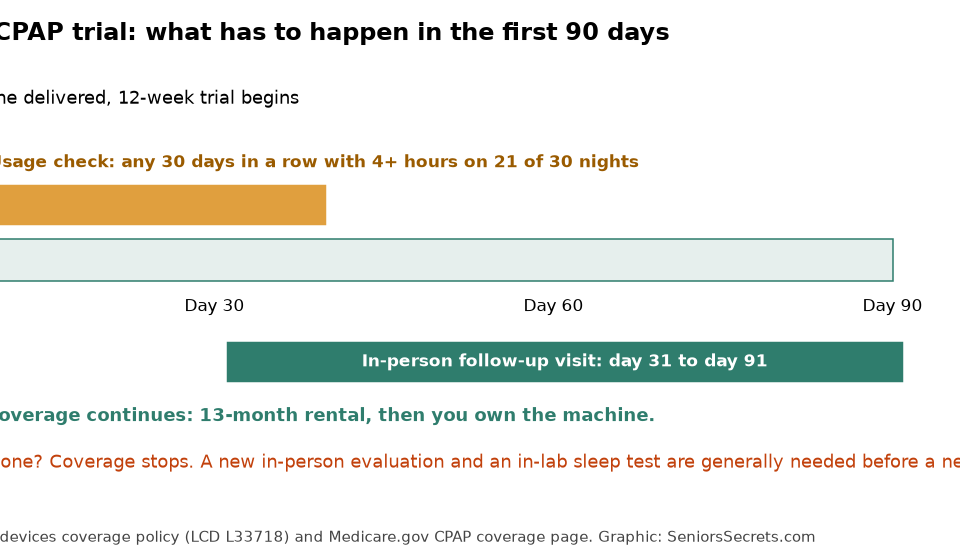
Yes. Medicare Part B covers a CPAP machine and supplies for adults diagnosed with obstructive sleep apnea. But Medicare’s coverage comes with a condition most people don’t hear about until it’s too late: you have to prove you’re using the machine. In the first three months, Medicare wants to see at least 4 hours a night on 70% of nights during a 30-day stretch, and a follow-up visit showing the therapy is helping.
Meet those rules and Medicare rents the machine for 13 months, after which you own it. You’ll pay 20% of the Medicare-approved amount after the Part B deductible, which is $283 in 2026.
I’m a researcher, not a medical professional or licensed agent. Talk with your doctor about your sleep apnea treatment. The coverage rules below come from Medicare.gov’s CPAP page and the Medicare coverage policy for PAP devices, and I link to both.
Step 1: Diagnosis with a sleep test
Medicare covers CPAP only after a sleep study confirms obstructive sleep apnea. Medicare covers both kinds of test:
- An in-lab sleep study (polysomnography) at a sleep center.
- A home sleep apnea test your doctor orders.
Before the test, your doctor needs to see you in person to evaluate your symptoms, such as loud snoring, stopped breathing, daytime sleepiness or morning headaches. The test results, measured as the apnea-hypopnea index (AHI), decide whether you qualify. Moderate or severe sleep apnea generally qualifies on its own. Milder sleep apnea can qualify if you have certain symptoms or conditions, like high blood pressure, heart disease, history of stroke, insomnia or excessive sleepiness. Those thresholds are spelled out in the Medicare PAP coverage policy (LCD L33718).
For the warning signs that should prompt a sleep test, see sleep apnea in seniors.
Step 2: The 12-week trial and the 4-hour rule
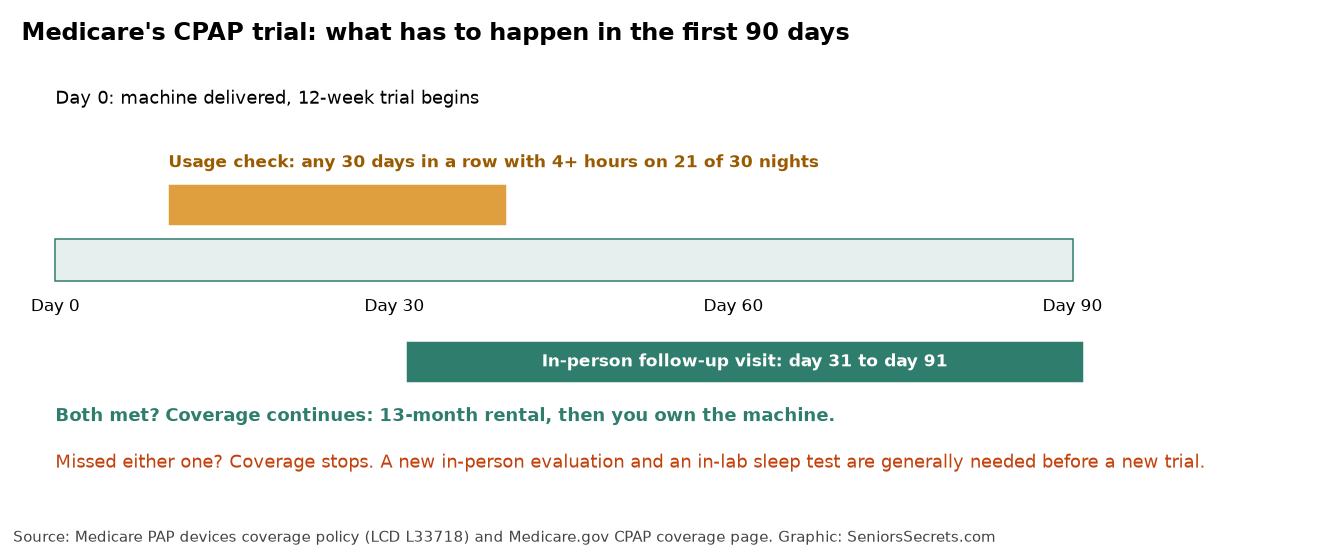
Medicare first covers CPAP for a 12-week trial. To keep coverage after that, two things must happen:
- You meet the usage requirement. Your machine records how much you use it. Medicare requires use of at least 4 hours a night on 70% of nights (21 of 30) during one 30-day period in the first three months.
- You have a follow-up visit. Between day 31 and day 91 of therapy, your doctor must see you in person and document that your symptoms are better.
Most modern CPAP machines send usage data to your supplier and doctor automatically. Check your own numbers in the machine’s app or on its screen during the first month. If you’re under 4 hours, call your supplier or doctor early. A different mask often fixes the problem.
What if you fail the trial?
If you don’t meet the usage rule, Medicare stops paying. To qualify again, you generally need another in-person evaluation and a repeat sleep test in a sleep lab, then a new trial. That’s a lot of extra appointments, so it’s worth fighting for the first trial.
Step 3: Rental, ownership and what you pay
CPAP is a “capped rental” item. Medicare pays the supplier monthly rent for 13 continuous months, and then you own the machine.
| Cost | What you pay with Original Medicare (2026) |
|---|---|
| Part B deductible | $283 a year, if not already met |
| CPAP machine rental (13 months) | 20% of the Medicare-approved amount each month |
| Masks, tubing, filters, other supplies | 20% of the Medicare-approved amount |
| Sleep test and doctor visits | 20% of the Medicare-approved amount after the deductible |
Use a supplier enrolled in Medicare that accepts assignment, meaning it agrees to Medicare’s approved amount as full payment. Otherwise you can be charged more. Medigap plans usually cover the 20%. In a Medicare Advantage plan, costs and approved suppliers depend on the plan, and prior authorization is common.
If you switch from Medicare Advantage to Original Medicare, or join Medicare with a machine you already own, Medicare may cover supplies and a replacement machine under its own rules. Ask your supplier to check before you order.
Replacement supplies: how often Medicare pays
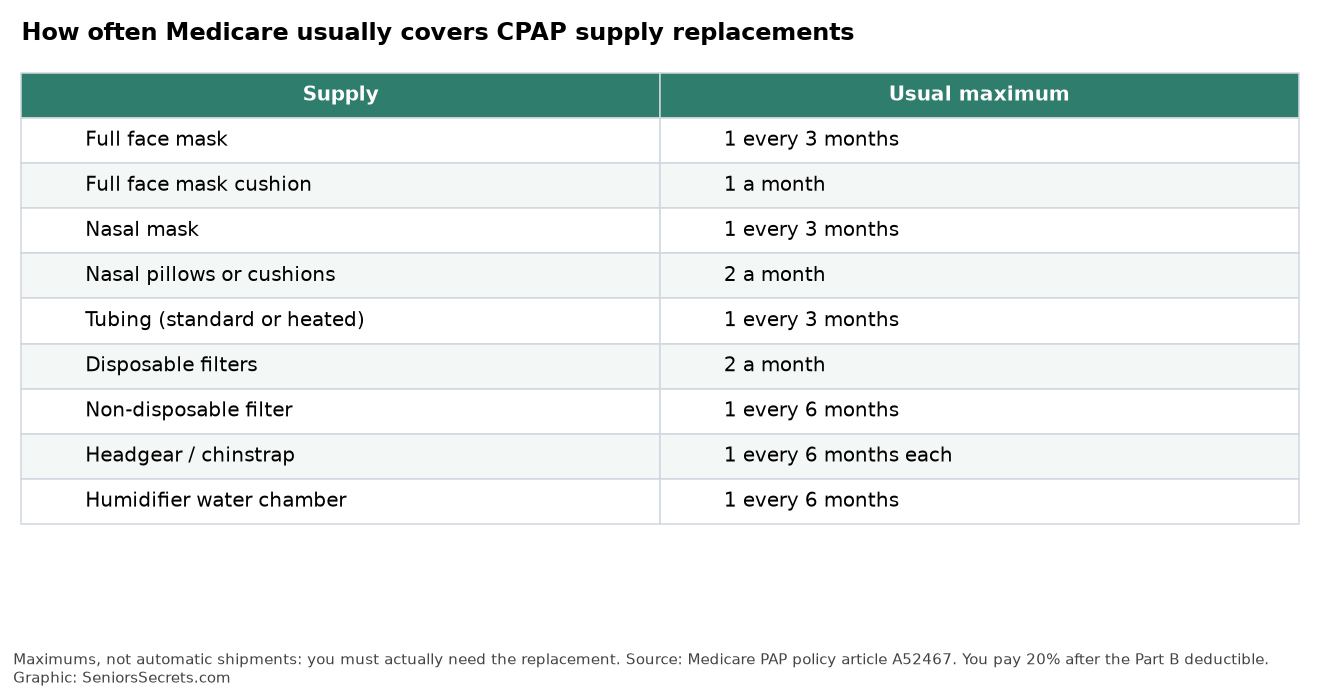
Masks and cushions wear out, and old ones leak. Medicare pays for replacements on a set schedule. These are the usual limits under the Medicare policy:
| Supply | How often Medicare usually covers a replacement |
|---|---|
| Full face mask | 1 every 3 months |
| Full face mask cushion | 1 a month |
| Nasal mask | 1 every 3 months |
| Nasal pillows or cushions | 2 a month |
| Tubing (standard or heated) | 1 every 3 months |
| Disposable filters | 2 a month |
| Non-disposable filters | 1 every 6 months |
| Headgear and chinstrap | 1 every 6 months each |
| Humidifier water chamber | 1 every 6 months |
The schedule shows the maximum, not an automatic shipment. Medicare requires that you actually need the replacement. Some suppliers ship on autopilot. If you’re getting supplies you don’t use, ask them to stop.
The machine itself is generally eligible for replacement after its useful lifetime of 5 years, or sooner if it’s lost, stolen or damaged beyond repair.
Getting past the first month
Many people struggle with CPAP at first. Common fixes your supplier or doctor may suggest:
- Try a different mask. Nasal pillows suit some people, full face masks suit mouth breathers.
- Turn on the humidifier if your nose or mouth gets dry.
- Use the ramp setting, which starts at a lower pressure as you fall asleep.
- Wear it while awake for short periods, reading or watching TV, to get used to it.
- Ask about an auto-adjusting machine if the pressure feels too strong.
Other treatments Medicare may cover
CPAP is the standard treatment, but it isn’t the only one:
- Oral appliances made by a dentist can be covered for some people with obstructive sleep apnea, under Medicare’s rules for those devices.
- Hypoglossal nerve stimulation (an implanted device) can be covered for some people who can’t use CPAP and meet strict criteria.
- Zepbound (tirzepatide) was approved by the FDA in December 2024 to treat moderate to severe obstructive sleep apnea in adults with obesity. Because it’s approved for sleep apnea, Medicare Part D plans can cover it for that use. Coverage, prior authorization rules and costs vary by plan. My guide to GLP-1 drugs and Medicare covers the details.
If Medicare denies your CPAP
Denials often come down to paperwork: a missing follow-up note, usage data that wasn’t sent, or a supplier that isn’t enrolled. Ask your supplier and doctor what’s missing. If it can’t be fixed, you can appeal. My guide to Medicare appeals explains the deadlines. For other equipment, see Medicare coverage for walkers and wheelchairs and oxygen therapy.
FAQ
Does Medicare pay for a CPAP machine?
Yes. Part B covers CPAP for obstructive sleep apnea after a qualifying sleep test. Medicare rents the machine for 13 months, then you own it, and you pay 20% after the deductible.
What is the 4-hour rule for CPAP?
To keep coverage after the 12-week trial, you must use CPAP at least 4 hours a night on 70% of nights during one 30-day period in the first three months, and see your doctor between day 31 and day 91.
How often does Medicare replace CPAP masks?
Usually one full face or nasal mask every 3 months, with cushions or pillows replaced monthly or twice a month.
Does Medicare cover a home sleep test?
Yes, when your doctor orders it after evaluating you.
What happens if I don’t use my CPAP enough?
Medicare stops paying after the trial. You’d generally need another evaluation and an in-lab sleep test before Medicare covers a new trial.
Related guides