Vitamin D for Seniors in 2026: How Much You Need, Signs of Low Levels and Safe Doses
Most adults age 71 and older need 800 IU (20 mcg) of vitamin D a day. Adults 51 to 70 need 600 IU (15 mcg). That is the official daily goal from the National Academies, listed by the NIH Office of Dietary Supplements (NIH ODS). The safe upper limit for adults is 4,000 IU a day from all sources.
Many seniors take far more than they need, and some take less. This guide shows the numbers that matter, the signs of low vitamin D that are real, and what the large trials actually found.
Why vitamin D matters more after 65
Vitamin D helps your body absorb calcium. Without enough, bones can get thin and weak. Very low levels can cause osteomalacia, which means soft bones that ache.
Older adults are more likely to run low. Your skin makes less vitamin D from sunlight as you age. Many seniors also spend more time indoors. The NIH lists older adults as a group at risk of low vitamin D, along with people with dark skin, people with obesity and people who have had gastric bypass surgery (NIH ODS).
What your blood test number means
Doctors check vitamin D with a blood test called 25(OH)D (25-hydroxy vitamin D). Results in the US are usually shown in ng/mL.
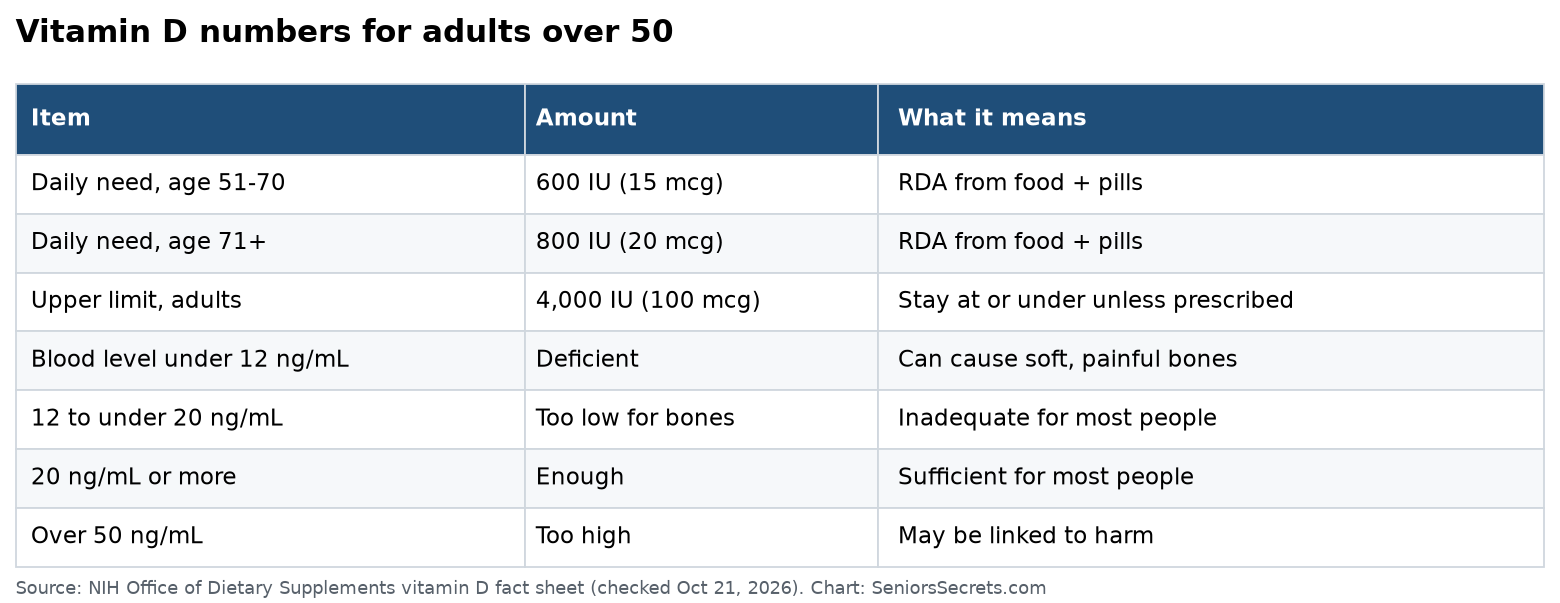
- Under 12 ng/mL: deficient. This can cause soft, painful bones.
- 12 to under 20 ng/mL: generally too low for bone health.
- 20 ng/mL or more: enough for most people.
- Over 50 ng/mL: may be linked to harm. There is no proven benefit to pushing levels this high.
These cutoffs come from the National Academies, as listed by the NIH (NIH ODS). Some labs flag anything under 30 ng/mL as “insufficient.” That is a different, stricter cutoff, and it is one reason so many people are told they are low.
Should every senior get tested? The US Preventive Services Task Force says there is not enough evidence to judge the benefits and harms of screening adults who have no symptoms (USPSTF). The Endocrine Society also advises against routine testing in healthy people. A test makes more sense if you have osteoporosis, a gut problem that limits absorption, kidney or liver disease, or you take a drug that lowers vitamin D.
Signs of low vitamin D: what is real and what is hype
Many websites list 10 or more “warning signs.” The truth is that low vitamin D often causes no symptoms at all, especially when it is only mildly low. Here is how the common claims stack up.
Signs with good evidence (usually when levels are very low):
- Bone pain or aching, often in the hips, ribs, legs or lower back. This comes from soft bones (osteomalacia).
- Muscle weakness, mainly in the thighs and hips. You may have trouble getting up from a chair or climbing stairs.
- Low bone density or a fracture after a minor fall.
Signs that are vague and have many other causes:
- Tiredness or low energy
- Low mood
- Getting sick often
- Slow wound healing
- Hair loss
- Memory fog
These can happen with low vitamin D. But they are also common with poor sleep, thyroid problems, low B12, anemia, depression and medicine side effects. Don’t assume vitamin D is the cause. For example, a review of 9 trials with 4,923 adults found vitamin D pills did not significantly ease depression symptoms (NIH ODS).
My take: if you have bone pain or real muscle weakness, ask for a blood test. If you only feel tired, check the more common causes first.
What the big trials found
This is where many articles oversell vitamin D.
- Fractures. The VITAL trial gave 2,000 IU a day or a placebo to 25,871 healthy adults for about 5 years. Vitamin D did not lower total fractures, hip fractures or other fractures. Most people in the trial were not low to begin with (NIH ODS).
- Falls. A USPSTF review found with moderate certainty that vitamin D does not reduce falls in adults 65 and older living at home who are not deficient or osteoporotic (NIH ODS). Balance and strength exercise works better. See our balance exercises for seniors over 70.
- Cancer. VITAL did not lower cancer rates. A meta-analysis found daily vitamin D was linked to about 13% lower cancer death rates, but not fewer cancers.
The takeaway: vitamin D fixes a real deficiency. It is not a cure-all for people who already have enough.
That said, the Endocrine Society now suggests vitamin D for adults age 75 and older even without a test, at doses close to the daily goal (NIH ODS). That is a reasonable middle path for older adults.
How to get enough vitamin D
Food first. Few foods have much vitamin D. Here are the best, per NIH:
| Food | Vitamin D |
|---|---|
| Rainbow trout, farmed, 3 oz | 645 IU |
| Sockeye salmon, 3 oz | 570 IU |
| UV-exposed mushrooms, ½ cup | 366 IU |
| Milk, fortified, 1 cup | 120 IU |
| Soy, almond or oat milk, fortified, 1 cup | 100 to 144 IU |
| Fortified cereal, 1 serving | 80 IU |
| Egg, 1 large | 44 IU |
| Sardines, 2 | 46 IU |
Two servings of salmon a week plus fortified milk gets many people close. Our sardines guide and calcium guide cover more bone-friendly foods.
Sunlight. Short sun exposure helps, but it is hard to measure. Skin makes less vitamin D with age, in winter and in northern states. Don’t rely on the sun alone, and don’t skip sunscreen for long sun exposure.
Supplements. For most seniors, 800 to 1,000 IU a day of vitamin D3 covers the gap. D3 (cholecalciferol) and D2 (ergocalciferol) both work, but D3 tends to raise blood levels a bit more. Take it with a meal that has some fat.

Gotchas that catch seniors
1. Double dosing. Your multivitamin, calcium pill and vitamin D pill may each contain vitamin D. Add up every label. Our multivitamin guide shows what to check.
2. Mega doses. Some people take 5,000 or 10,000 IU a day for years. Too much vitamin D raises blood calcium. That can cause nausea, confusion, kidney stones, kidney damage and heart rhythm problems. Stay at or under 4,000 IU a day unless your doctor prescribes more for a diagnosed deficiency, and then retest.
3. Drug interactions. The NIH lists several (NIH ODS):
- Thiazide water pills (like hydrochlorothiazide). Taken with vitamin D and calcium, they can raise calcium too high in older adults.
- Steroids like prednisone lower calcium absorption and vitamin D use.
- Some statins (atorvastatin, lovastatin, simvastatin). High vitamin D doses might make them work less well.
- Orlistat (Alli, Xenical) lowers vitamin D absorption.
If you take several medicines, our polypharmacy guide explains how to get a free drug review.
4. “K2 and magnesium are required.” Some sites say you must take vitamin K2 or magnesium with D. Magnesium is needed to use vitamin D, but most people get it from food. There is no strong evidence that most seniors need K2 pills with D. If you take warfarin, don’t start vitamin K without your doctor.
What Medicare covers
- Vitamin D pills: Original Medicare and Part D plans do not pay for over-the-counter vitamins. Some Medicare Advantage plans include an OTC allowance that can be used for them.
- Vitamin D blood test: Part B covers lab tests your doctor orders when there is a medical reason, such as osteoporosis or kidney disease. You usually pay nothing for covered lab tests. Routine screening without a reason may not be covered, so ask first.
- Bone density scan: Part B covers it every 24 months, or more often if medically needed, for people at risk.
Common questions
How much vitamin D should a 75-year-old take?
The daily goal after age 70 is 800 IU (20 mcg). Many people take 800 to 1,000 IU a day. Stay under 4,000 IU unless your doctor tells you otherwise.
What is a good vitamin D level for seniors?
A blood level of 20 ng/mL or more is enough for most people, per the National Academies. Levels over 50 ng/mL may cause harm and have no proven extra benefit.
What are the signs of low vitamin D in older adults?
The clearest signs are bone pain and muscle weakness in the hips and thighs. Tiredness and low mood are common but have many other causes.
Does vitamin D prevent falls or fractures?
Not in seniors who already have enough. The VITAL trial found no drop in fractures, and a USPSTF review found no drop in falls.
Is 5,000 IU of vitamin D a day too much?
It is above the 4,000 IU upper limit. Only take that much if a doctor prescribes it to fix a deficiency, and get your level checked.
Written by Khasim Basha Shaik. I research and compare Medicare plans and health topics for readers. I am not a doctor or licensed insurance agent. This article summarizes the NIH Office of Dietary Supplements, the USPSTF and published trials and is not medical advice. Last reviewed October 21, 2026.