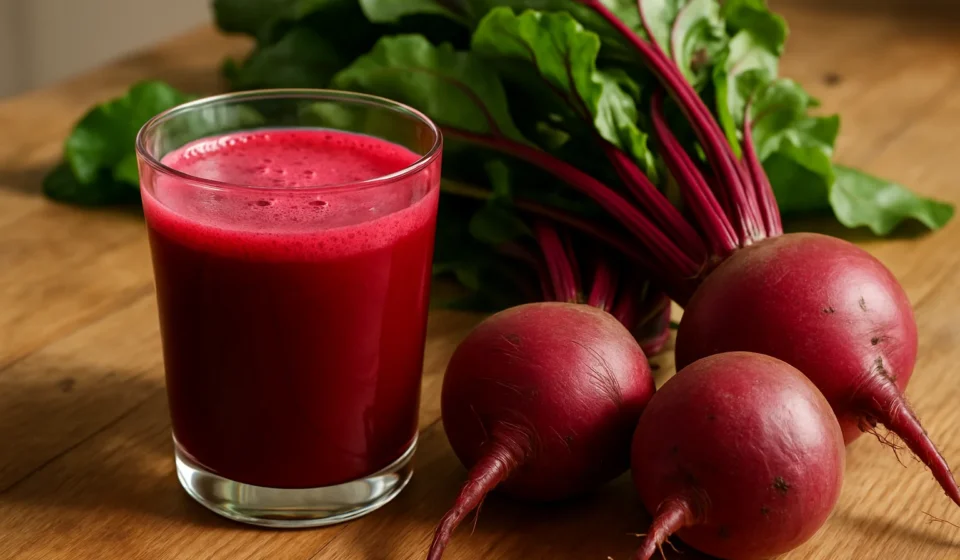

Few “superfood” claims survive scientific scrutiny, but beetroot juice for seniors is a rare exception — backed by randomized trials showing it can meaningfully lower blood pressure in older adults. The effect is real, it is biological, and it appears to be stronger in seniors than in young people. That does not make beet juice a substitute for medication, and it is not right for everyone. But understood correctly, a daily glass of beet juice is one of the better-evidenced dietary tools an older adult can use to support healthy blood pressure and circulation. Here is what the research actually shows, the right dose, and who should be cautious.
Table of Contents
- How Beetroot Juice Lowers Blood Pressure
- What the Trials Show
- Why Seniors Respond More
- How Much to Drink
- Beyond Blood Pressure
- Who Should Be Cautious
- Frequently Asked Questions
How Beetroot Juice Lowers Blood Pressure
The active ingredient in beetroot juice is not a vitamin or an antioxidant — it is dietary nitrate. Beets are one of the richest natural sources. When you drink the juice, nitrate is absorbed, concentrated in saliva, and converted to nitrite by friendly nitrate-reducing bacteria that live on the tongue. That nitrite is then turned into nitric oxide (NO), a molecule that relaxes and widens blood vessels. Wider vessels mean lower resistance and lower pressure. This “nitrate–nitrite–nitric oxide pathway” matters especially in aging, because the body’s own production of nitric oxide declines with age — one reason blood vessels stiffen over the decades.
What the Trials Show
The evidence is unusually good for a food. In a placebo-controlled crossover trial of 36 adults aged 67–79, nitrate-rich beetroot juice produced a significant fall in brachial mean arterial pressure of about 4 mmHg — while young, healthy adults in the same study showed no change. A 2025 study added a fascinating mechanism: beet juice lowered blood pressure in older adults partly by reshaping the oral microbiome, shifting it toward the bacteria that produce nitric oxide.
Longer, higher-dose studies show larger effects. In middle-aged and older participants given high-nitrate beet juice (~400 mg nitrate) for 60 days, 24-hour systolic pressure dropped by roughly 10.8 mmHg and diastolic by about 5.4 mmHg. A systematic review and meta-analysis of hypertensive adults likewise concluded that beetroot-derived nitrate lowers blood pressure. Honesty matters, though: results are not universal. Some trials in seniors already on blood-pressure medication found little or no added benefit, likely because their vessels were already being relaxed pharmacologically. The pattern that emerges is that beet juice helps most when blood pressure is elevated and not yet fully controlled.
| Study population | Dose / duration | Blood pressure change |
|---|---|---|
| Adults 67–79 | Nitrate-rich juice, crossover | ~4 mmHg lower mean arterial pressure |
| Adults 50–70 | ~400 mg nitrate, 60 days | ~10.8 mmHg lower 24-h systolic |
| Treated hypertensives | 4 weeks | Little to no added effect in some trials |
Why Seniors Respond More
The age difference is the most interesting finding. Young, healthy bodies already make plenty of nitric oxide, so an extra dietary supply changes little. With age, the natural NO-producing machinery in blood vessel linings falters, and arteries stiffen. Supplying nitrate through diet essentially restores a pathway that has weakened — which is why the same glass of juice can move the needle in a 75-year-old but not a 25-year-old. This is a case where being older makes the intervention more, not less, worthwhile.
How Much to Drink
Most trials used either a concentrated 70 mL “beet shot” delivering roughly 400 mg of nitrate, or about 250 mL (a cup) of regular beetroot juice. A practical starting point is one small glass daily, ideally consistent rather than occasional, since the blood-pressure effect builds with regular intake. Two tips dramatically affect whether it works:
- Don’t use antibacterial mouthwash. It kills the very tongue bacteria that convert nitrate to nitrite — and studies show this blunts or abolishes the blood-pressure benefit.
- Be consistent. The effect is strongest with daily use over weeks, not a one-time glass.
Whole beets and nitrate-rich leafy greens — arugula, spinach, and Swiss chard — provide the same nitrate and are excellent food-first alternatives for anyone who finds juice too sugary.
Beyond Blood Pressure
The same nitric-oxide boost has other documented effects. Dietary nitrate modestly improves exercise efficiency and endurance — useful for seniors trying to walk farther with less fatigue — by lowering the oxygen cost of movement. Early research also suggests beet juice can increase blood flow to the brain, with small studies hinting at benefits for cognitive function, though this evidence is much weaker than the blood-pressure data and should not be oversold.
Who Should Be Cautious
Beet juice is food, but a few groups should take care:
- People on blood-pressure medication. The effects can add together. Don’t stop your medication; instead monitor your readings at home and tell your doctor before making beet juice a daily habit.
- Those prone to kidney stones. Beets are high in oxalate, which can contribute to calcium-oxalate stones in susceptible people.
- Anyone watching blood sugar. Juices concentrate natural sugars; whole beets or greens are gentler choices.
- Don’t be alarmed by red urine or stool (beeturia) — it is harmless and simply means pigment passed through.
Beetroot juice complements, but never replaces, prescribed treatment. This article is educational and not medical advice; see our medical disclaimer and talk with your physician before changing your routine.
A Simple, Safe Way to Start
If you want to try beet juice, treat it like any other change that affects your blood pressure: introduce it deliberately and measure the result. Begin by taking a baseline — check your blood pressure at home at the same time of day, seated and rested, for several days before you start. Then add one small glass (about 250 mL) or a single concentrated shot each morning, and keep checking. Because the effect builds over weeks, give it a fair trial of three to four weeks before judging it. Pair the juice with the habits that amplify nitric oxide naturally: regular walking, which itself stimulates the vessel lining; adequate sleep; and a diet already rich in nitrate-containing greens. If your readings drop noticeably and you take blood-pressure medication, that is a conversation to have with your physician — not a reason to self-adjust your doses. Used this way, beet juice becomes a measurable, evidence-based addition to your routine rather than a hopeful guess.
Frequently Asked Questions
How quickly does beetroot juice lower blood pressure?
A single dose can lower blood pressure within a few hours as nitric oxide rises, but the meaningful, lasting reductions seen in trials come from drinking it daily for several weeks.
Can beetroot juice replace my blood pressure medication?
No. It is a complement, not a substitute. Some seniors already on medication see little extra benefit. Never stop a prescribed drug; monitor your readings and discuss any changes with your doctor.
How much beetroot juice should a senior drink per day?
Trials typically used a 70 mL concentrated shot (~400 mg nitrate) or about a cup (250 mL) of juice daily. Start with one small glass a day and keep it consistent.
Why does mouthwash interfere with beetroot juice?
The blood-pressure benefit depends on tongue bacteria that convert nitrate to nitrite. Antibacterial mouthwash kills those bacteria and can wipe out the effect, so avoid it if you’re drinking beet juice for your blood pressure.
Related Articles You May Find Helpful
- Senior Nutrition Guide 2026
- High Blood Pressure in Seniors: Treatment Guidelines
- Isometric Exercises to Lower Blood Pressure
- AHA Heart-Healthy Diet for Seniors
- Anti-Inflammatory Diet for Seniors
Sources
- News-Medical / University study (2025) — Beetroot juice lowers blood pressure in older adults by reshaping oral bacteria
- NCBI/PMC — Randomized crossover trials of dietary nitrate on aortic and brachial blood pressure in older adults
- PubMed — Nitrate from beetroot juice lowers blood pressure in arterial hypertension: systematic review and meta-analysis