
Calcium for seniors is one of those nutrients everyone knows they need yet few get right. Get too little and your body quietly withdraws calcium from your skeleton to keep your blood levels stable, accelerating the bone loss that leads to osteoporosis and fractures. Get too much from supplements and you may raise your risk of kidney stones and possibly cardiovascular problems. The goal for older adults is not simply “more calcium” — it is the right amount, from the right sources, paired with vitamin D. This 2026 guide explains how much calcium seniors actually need, why food beats pills, who genuinely benefits from a supplement, and how to take it safely.
Table of Contents
- How Much Calcium Seniors Need
- Why Calcium Matters More With Age
- Best Food Sources of Calcium
- Supplements: Who Needs Them and the Risks
- The Vitamin D and Magnesium Connection
- Frequently Asked Questions
How Much Calcium Seniors Need
The recommended dietary allowance for calcium rises with age. For women 51 and older and all adults over 70, the target is 1,200 milligrams per day; men aged 51 to 70 need 1,000 milligrams. Crucially, the safe upper limit for adults over 50 is about 2,000 milligrams daily from all sources combined — food plus supplements — and routinely exceeding that offers no extra bone benefit while adding risk.
| Group | Recommended Daily Calcium | Upper Safe Limit |
|---|---|---|
| Women 51+ | 1,200 mg | 2,000 mg |
| Men 51–70 | 1,000 mg | 2,000 mg |
| Men 71+ | 1,200 mg | 2,000 mg |
The body absorbs calcium best in doses of 500 milligrams or less at a time, so spreading intake across meals is far more effective than a single large dose.
Why Calcium Matters More With Age
Calcium does far more than build bone. It is essential for muscle contraction, nerve signaling, blood clotting, and a normal heartbeat. Your blood calcium level is so vital that the body keeps it in a tight range no matter what — and if your diet falls short, parathyroid hormone signals the skeleton to release calcium to compensate. Over years, this silent withdrawal thins the bones. After menopause, declining estrogen accelerates the loss in women, which is why post-menopausal women are at the highest risk of osteoporosis and the fragility fractures — hip, spine, wrist — that so often steal independence in later life.
Best Food Sources of Calcium
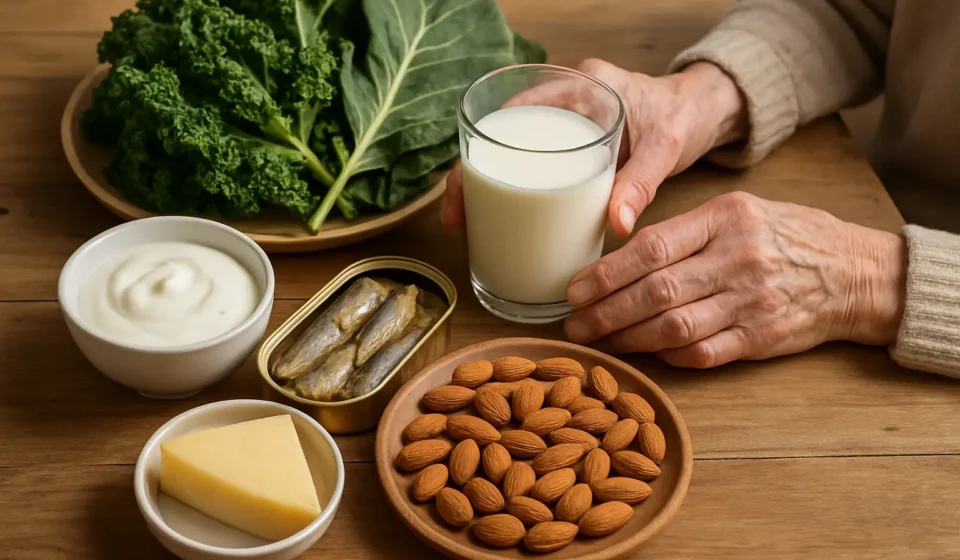
Dietary calcium is the gold standard because it is absorbed gradually, comes packaged with other nutrients, and — unlike supplements — is associated with a lower risk of kidney stones. Excellent sources include:
- Dairy — a cup of milk or yogurt provides roughly 300 mg; an ounce of hard cheese about 200 mg.
- Fortified foods — calcium-fortified orange juice, plant milks, and cereals can each deliver 200–300 mg per serving.
- Canned fish with bones — sardines and canned salmon are calcium powerhouses.
- Leafy greens — collard greens, kale, and bok choy (note spinach’s calcium is poorly absorbed due to oxalates).
- Tofu set with calcium, beans, and almonds.
A practical strategy is to tally your typical day: three servings of dairy or fortified equivalents plus greens often gets a senior most of the way to 1,000–1,200 mg without any pills.
Supplements: Who Needs Them and the Risks
Most older adults do not reach the recommended intake from food alone, so supplements have a role — but they should fill the gap, not pile on top of an already adequate diet. The two common forms differ in how to take them: calcium carbonate is cheapest and most concentrated but needs stomach acid, so take it with food; calcium citrate is absorbed with or without food and is the better choice for anyone on acid-reducing medication such as a proton pump inhibitor.
The cautions are real. Calcium supplements modestly raise the risk of kidney stones, and some studies have linked high supplemental (not dietary) calcium to a possible increase in cardiovascular events, though the evidence is mixed and inconsistent. People with chronic kidney disease should use supplements only under medical guidance. The sensible approach: prioritize food, supplement only to close the gap toward your daily target, keep total intake under 2,000 mg, and discuss it with your provider — especially if you have a history of stones or heart disease.
The Vitamin D and Magnesium Connection
Calcium cannot do its job without vitamin D, which is required for the gut to absorb it. Many seniors are deficient in vitamin D, and the combination of calcium plus vitamin D — not calcium alone — is what has shown a modest reduction in fractures in clinical trials. Magnesium also participates in bone metabolism and vitamin D activation. For most older adults, the winning formula is adequate dietary calcium, sufficient vitamin D (often 800–1,000 IU daily, confirmed by a blood test), weight-bearing exercise, and avoidance of smoking and excess alcohol.
Frequently Asked Questions
Is it better to get calcium from food or supplements?
Food is preferred. Dietary calcium is absorbed gradually and is linked to lower kidney stone risk, whereas supplements carry a small risk of stones and possibly cardiovascular effects. Use supplements only to fill the gap your diet leaves.
Can too much calcium be harmful?
Yes. Exceeding about 2,000 mg a day from all sources provides no added bone benefit and may increase the risk of kidney stones and constipation, with some evidence of cardiovascular concern from high supplemental doses.
Should I take calcium carbonate or citrate?
Take calcium carbonate with food since it needs stomach acid. Choose calcium citrate if you take acid-reducing medication or have low stomach acid, as it absorbs well on an empty stomach.
Do I need vitamin D with calcium?
Yes — vitamin D is required to absorb calcium, and the fracture-reducing benefit in studies comes from the calcium-plus-vitamin-D combination, not calcium alone.
How to Build a Calcium-Rich Day Without Pills
Reaching 1,200 milligrams from food is more achievable than most seniors realize when you plan around three calcium “anchors.” A breakfast of fortified cereal with milk or a cup of yogurt can deliver 400–500 milligrams before the day even starts. A lunch that includes canned salmon or sardines (eaten with the soft, edible bones) adds another 300 milligrams plus bone-friendly vitamin D and omega-3s. A dinner featuring cooked collard greens, kale, or calcium-set tofu, finished with a small piece of cheese or a glass of fortified plant milk, closes the gap. Snacking on almonds or a fortified orange juice fills any remainder. Spacing these across meals also respects the body’s 500-milligram-per-dose absorption ceiling, so you actually use what you eat. If you track a typical day and still fall short — common for seniors with poor appetite or lactose intolerance — that is the precise gap a modest supplement should fill, rather than adding calcium on top of an already adequate diet.
Related Articles You May Find Helpful
- Senior Nutrition Guide 2026: Best Diets, Vitamins & Supplements
- Osteoporosis Prevention for Seniors in 2026
- Osteoporosis Medications 2026: Which Treatment Is Right?
- Magnesium for Seniors 2026: The #1 Mineral Most Elderly Are Missing
- Hip Fractures in Seniors 2026: Prevention, Recovery & Medicare
Sources
- National Institutes of Health, Office of Dietary Supplements — Calcium Fact Sheet
- Mayo Clinic — Calcium Intake for Adults Over Age 55
- Institute of Medicine — Dietary Reference Intakes for Calcium and Vitamin D
This article is educational and not a substitute for personalized medical advice. Talk with your provider before starting a calcium supplement, especially if you have kidney disease or a history of stones.