
GERD (gastroesophageal reflux disease) means stomach acid backs up into your esophagus often enough to cause symptoms or damage. In older adults, it doesn’t always feel like classic heartburn. It can show up as a long-lasting cough, hoarseness, trouble swallowing or chest pain.
The good news: lifestyle steps and the right medicine control most cases. The catch: many seniors stay on acid pills called PPIs for years without a clear reason. This guide covers safe treatment, the real risks and how to step down safely.
Symptoms to know
Classic signs:
- Heartburn, a burning feeling behind the breastbone, often after meals or at night
- Sour or bitter taste from food or acid coming back up
Signs that are more common in older adults:
- Long-lasting dry cough or throat clearing
- Hoarse voice
- Feeling of a lump in the throat
- Trouble or pain swallowing
- Chest pain
Chest pain is never something to guess about. It can be a heart attack. If you have chest pain with shortness of breath, sweating, nausea or pain spreading to your arm, jaw or back, call 911. See our heart disease warning signs guide.
Red flags: see a doctor soon
The NIDDK says to see a doctor if you have any of these (NIDDK):
- Chest pain
- Loss of appetite
- Vomiting that won’t stop
- Trouble or pain swallowing
- Vomit with blood or that looks like coffee grounds
- Black, tarry or bloody stools
- Weight loss you can’t explain
These can point to bleeding, a narrowing of the esophagus or, rarely, cancer. You may need an upper endoscopy (a camera test of the esophagus and stomach).
Medicines that can make reflux worse
This is a common hidden cause in seniors. The NIDDK lists (NIDDK):
- Benzodiazepines and other sedatives
- Calcium channel blockers for blood pressure (like amlodipine)
- Certain asthma medicines
- NSAIDs like ibuprofen and naproxen
- Tricyclic antidepressants (like amitriptyline)
Don’t stop any of these on your own. Ask your doctor or pharmacist if one of them could be part of the problem. Our polypharmacy guide explains how to get a full medicine review.
Lifestyle steps that help
From the NIDDK (NIDDK):
- Raise the head of your bed 6 to 8 inches with blocks or a foam wedge under your upper body. Extra pillows under your head alone often don’t work, because they just bend your neck.
- Lose weight if you’re overweight. Even a few pounds can help.
- Quit smoking.
- Change eating habits. Eat smaller meals and stop eating 2 to 3 hours before bed.
Many people also find certain foods trigger symptoms, like fatty or fried food, chocolate, mint, coffee, alcohol, tomato and citrus. Triggers vary from person to person. Keep a simple food and symptom diary for 2 weeks to find yours, rather than cutting everything.
Medicines for GERD, compared
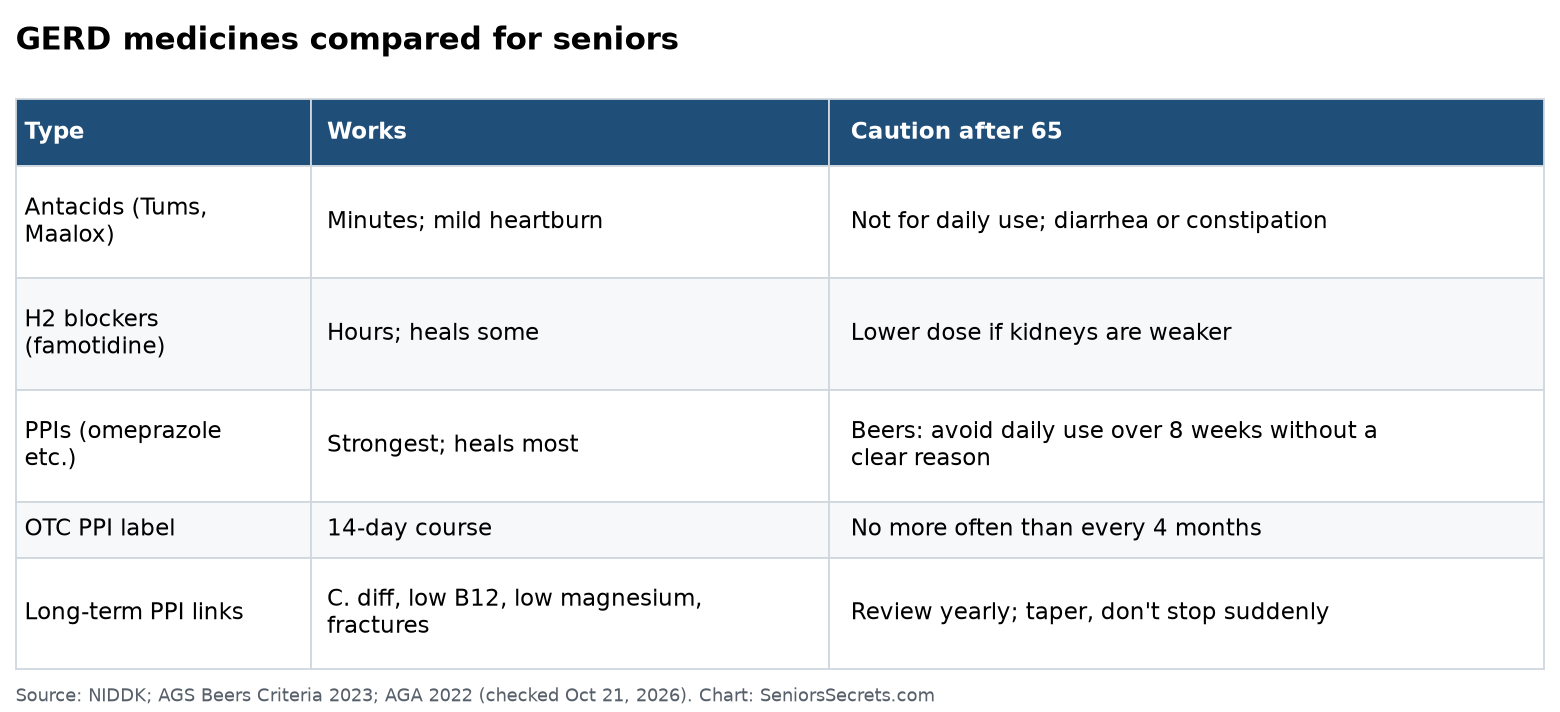
Antacids (Tums, Maalox, Mylanta) work in minutes for mild heartburn. The NIDDK says not to use them every day or for severe symptoms without talking to your doctor. They can cause diarrhea or constipation. Calcium-based ones add to your calcium total.
H2 blockers (famotidine/Pepcid) lower acid for several hours. They help heal the esophagus, but not as well as PPIs (NIDDK). In older adults with weaker kidneys, the dose may need to be lower.
PPIs (omeprazole/Prilosec, esomeprazole/Nexium, pantoprazole/Protonix, lansoprazole/Prevacid) are the strongest. They treat symptoms best and heal the esophageal lining in most people. Take them 30 to 60 minutes before breakfast for the best effect.
OTC PPI rule: the Drug Facts label on over-the-counter omeprazole says to take it for 14 days and not more often than every 4 months unless a doctor tells you to. If you need it more than that, see your doctor.
The real risks of long-term PPIs
PPIs are generally safe and effective, says the NIDDK. Side effects are uncommon and include headache, diarrhea and upset stomach. Research also links them to a higher chance of C. diff infection, a serious diarrhea infection (NIDDK).
Long-term use has also been linked to:
- Low vitamin B12, because stomach acid helps absorb B12 from food
- Low magnesium
- Bone fractures
Many of these links come from observational studies and may not be caused by the PPI itself. That’s why the experts’ advice is balanced:
- The American Geriatrics Society Beers Criteria says older adults should avoid daily PPI use for more than 8 weeks unless there’s a clear reason. Clear reasons include erosive esophagitis, Barrett’s esophagus, long-term steroid or NSAID use, or failed attempts to stop (AGS Beers Criteria 2023, PubMed 37139824).
- The American Gastroenterological Association says PPIs are generally safe, but no one should take any medicine without a reasonable expectation of benefit. It recommends reviewing every long-term PPI and trying to step down when there’s no clear need (Gastroenterology, PubMed 35183361).
My take: if you have Barrett’s esophagus or severe esophagitis, don’t stop your PPI. It protects you. If you started one years ago “for heartburn” and nobody has reviewed it, ask your doctor this year.
How to step down from a PPI safely
Stopping suddenly can cause rebound acid: a burst of heartburn for a few weeks that makes people think they still need the pill. A gradual plan works better. Common approaches (agree on one with your doctor):
- Cut the dose in half for 2 to 4 weeks.
- Then take it every other day, or only when symptoms flare.
- Use an antacid or H2 blocker for breakthrough heartburn.
- Keep up the lifestyle steps, especially head-of-bed raising and earlier dinners.
If you’ve been on a PPI a long time, ask for B12 and magnesium blood tests. Our B12 deficiency guide lists the signs.
Surgery and procedures
If lifestyle steps and medicine don’t work, or you can’t take medicine long-term, doctors may suggest surgery. The most common is fundoplication, which tightens the valve between the esophagus and stomach. Newer, less invasive options also exist. A hiatal hernia (part of the stomach pushed up into the chest) can make GERD worse and may be repaired at the same time. See our hernia guide.
What Medicare covers in 2026
- Doctor visits and tests under Part B, including upper endoscopy when medically needed: you pay 20% of the Medicare-approved amount after the $283 deductible. If the test is done in a hospital outpatient department, there may also be a facility copayment.
- Prescription PPIs and H2 blockers under Part D. Generic versions are usually on low-cost tiers. Out-of-pocket drug costs are capped at $2,100 in 2026.
- OTC antacids and acid reducers are not covered by Original Medicare or Part D. Some Medicare Advantage plans include an OTC allowance.
- Surgery for GERD, when medically needed, is covered under Part A (inpatient) or Part B (outpatient).
CMS hasn’t posted 2027 Part B costs yet. We’ll update this page when it does.
Common questions
What are the symptoms of GERD in older adults?
Heartburn and sour taste are common. Seniors also often have chronic cough, hoarseness, trouble swallowing or chest pain.
Is it safe for seniors to take omeprazole every day?
It can be when there’s a clear reason, like Barrett’s esophagus or severe esophagitis. Otherwise, the Beers Criteria advise against daily use beyond 8 weeks.
How do I stop taking a PPI without rebound heartburn?
Taper slowly with your doctor. Cut the dose in half for a few weeks, then use it less often, with an antacid for flares.
What medicines make acid reflux worse?
The NIDDK lists sedatives like benzodiazepines, calcium channel blockers, certain asthma drugs, NSAIDs and tricyclic antidepressants.
When is acid reflux an emergency?
Call 911 for chest pain that could be your heart. See a doctor quickly for vomiting blood, black stools, trouble swallowing or weight loss.
Written by Khasim Basha Shaik. I research and compare Medicare plans and health topics for readers. I am not a doctor or licensed insurance agent. This article summarizes NIDDK, the AGS Beers Criteria, AGA guidance and Medicare.gov and is not medical advice. Last reviewed October 21, 2026.
Related guides