Heart Disease Warning Signs in Seniors Over 70: What to Watch For and When to Call 911
After 70, heart trouble often doesn’t look like the movies. Instead of crushing chest pain, many older adults feel short of breath, unusually tired, dizzy or sick to their stomach. The National Heart, Lung, and Blood Institute says silent heart attacks, with mild or no symptoms, are more common in older adults and in people with diabetes (NHLBI).
In the US, someone has a heart attack every 40 seconds (CDC). Knowing the quieter signs can save your life or a loved one’s. This guide covers warning signs by condition, when to call 911, and the heart tests Medicare covers.
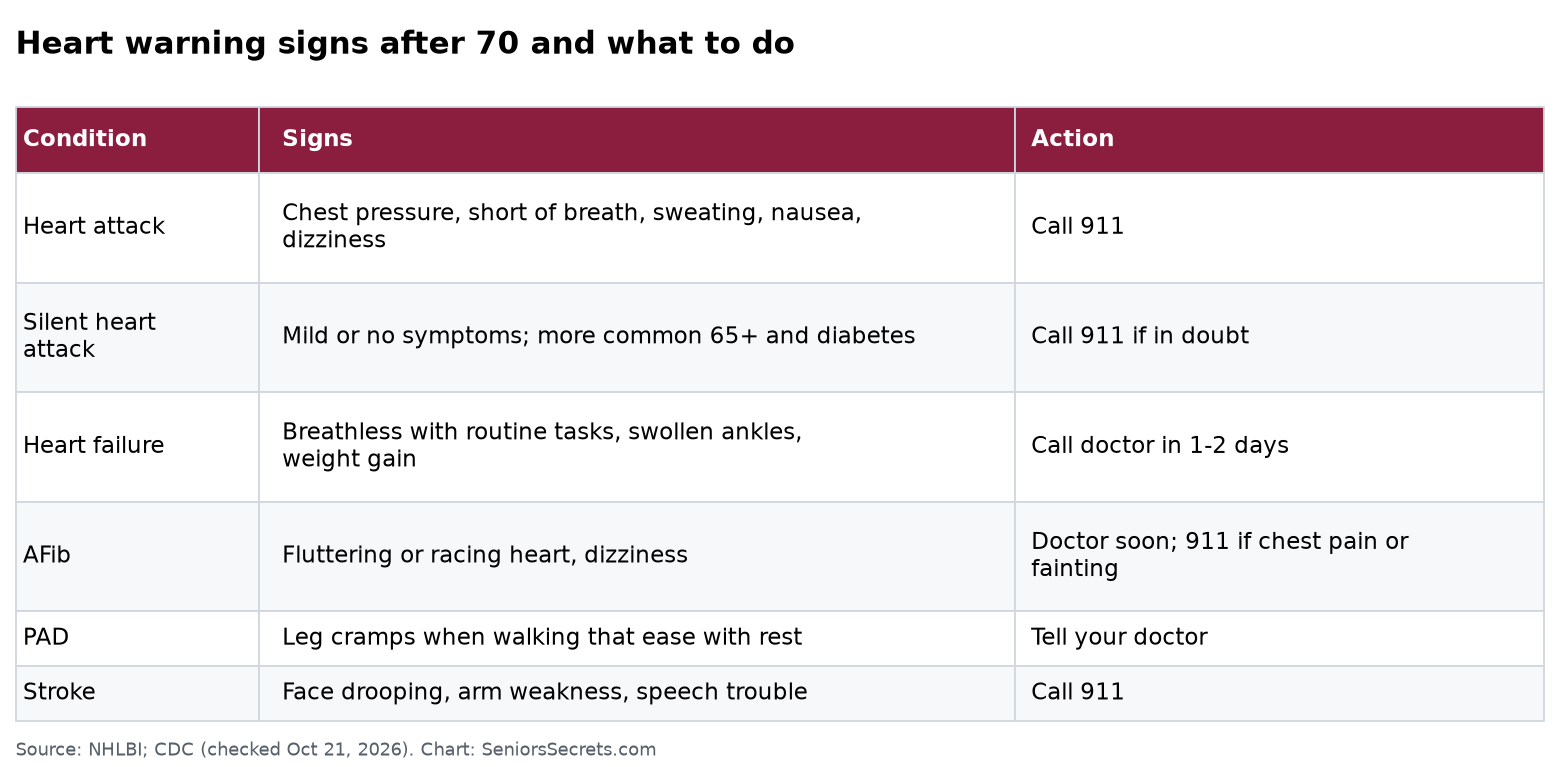
Heart attack: the signs
A heart attack happens when part of the heart muscle doesn’t get enough blood. The NHLBI lists these symptoms (NHLBI):
- Chest pain, pressure, heaviness or discomfort in the center or left side of the chest. This is still the most common symptom.
- Pain or discomfort in one or both arms, the back, shoulders, neck, jaw or above the belly button
- Shortness of breath at rest or with light activity. NHLBI says this is more common in older adults.
- Sweating a lot for no reason
- Feeling unusually tired, sometimes for days. This is more common in women.
- Nausea and vomiting
- Light-headedness or sudden dizziness
- A fast or irregular heartbeat
Symptoms can start slowly, be mild, and come and go over several hours. If you’ve had a heart attack before, the next one may feel different. Women often have the “other” symptoms, like tiredness and nausea.
Women over 60: signs that get missed
The Office on Women’s Health says chest and upper body pain is still the most common sign in women. But shortness of breath and nausea are more common in women than in men. Jaw pain, back pain and sudden, deep tiredness can come with chest pain, or sometimes without it.
Women have a first heart attack at about 72 on average. For men, it is 64. After 65, women are more likely than men to die in the weeks after one. So call 911 fast, even if the signs feel “small.”
Women’s symptoms checked against womenshealth.gov on November 18, 2026.
Heart failure: the slow-building signs
Heart failure means the heart doesn’t pump as well as it should. It builds over weeks or months. Signs from the NHLBI (NHLBI):
- Shortness of breath after routine things, like climbing stairs. Later, it may happen while getting dressed or walking across a room.
- Trouble breathing when lying flat, or waking up short of breath
- Swelling in the ankles, feet, legs or belly
- Weight gain from fluid
- Nausea, poor appetite and needing to pee often
Practical tip: if you have heart failure, weigh yourself every morning after using the bathroom and before breakfast. Many care teams ask patients to call if their weight rises quickly, such as 2 to 3 pounds in a day or 5 pounds in a week. Ask your doctor for your own number. Our heart failure exercise guide covers safe activity.
Atrial fibrillation (AFib)
AFib is an irregular heartbeat that becomes more common with age. It raises the risk of stroke. Signs from the NHLBI (NHLBI):
- Palpitations: a heart that skips, flutters, pounds or races
- Dizziness or fainting
- Trouble breathing, especially lying down or during exercise
- Chest pain
- Low blood pressure
Some people with AFib feel nothing. It’s sometimes found on a routine pulse check or a smartwatch alert. Don’t ignore a watch warning. Book a visit and ask for an ECG.

Peripheral artery disease (PAD)
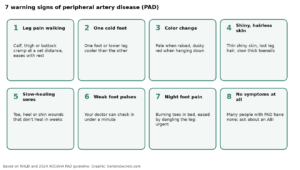
PAD is narrowing of the arteries to the legs. It is a warning sign that arteries elsewhere, including to the heart, may be narrowed too. The most common symptom is pain, aching, heaviness or cramping in the legs when walking or climbing stairs that goes away with rest (NHLBI). Many people blame this on “old age” or arthritis. Tell your doctor.
Call 911 or call your doctor?
Call 911 right away for:
- Chest pain or pressure lasting more than a few minutes, or that goes away and comes back
- Chest discomfort with shortness of breath, sweating, nausea or light-headedness
- Sudden severe shortness of breath
- Fainting
- Stroke and TIA warning signs guide
Don’t drive yourself, and don’t let someone drive you. NHLBI says an ambulance is the safest way, because the crew can start tests and treatment on the way, and people who arrive by ambulance often get faster care (NHLBI). Ask the 911 operator whether you should chew an aspirin. Don’t take it if you’re allergic or your doctor told you not to.
Call your doctor within a day or two for:
- Breathlessness that’s slowly getting worse
- New ankle swelling or fast weight gain
- New palpitations without other symptoms
- Leg pain when walking
My take: many seniors wait because they don’t want to “make a fuss.” Emergency teams would much rather see a false alarm than a heart attack that arrives hours late. When in doubt, call.
Risk factors to know
About half of all Americans have at least one of three key risk factors: high blood pressure, high cholesterol or smoking (CDC). Other risk factors include diabetes, being overweight, inactivity and family history.
Steps that lower risk at any age:
- Control blood pressure. Our high blood pressure guide covers targets.
- Take cholesterol and diabetes medicines as prescribed.
- Quit smoking.
- Move most days, building up to 150 minutes a week if your doctor agrees.
What Medicare covers in 2026
- Cardiovascular screening blood tests (cholesterol, lipids, triglycerides): once every 5 years, $0 if your provider accepts assignment (Medicare.gov).
- Annual Wellness Visit: $0, and includes a blood pressure check and a review of your risk factors.
- ECGs and other heart tests when your doctor orders them for symptoms: Part B, 20% after the $283 deductible.
- Ambulance in an emergency: Part B, 20% after the deductible.
- Cardiac rehab after a heart attack in the last 12 months, bypass surgery, stable angina, valve repair or replacement, angioplasty or stents, a heart transplant, or stable chronic heart failure: Part B, 20% after the deductible (Medicare.gov). Our cardiac rehab guide explains how to sign up.
For 2027, CMS set the Part B deductible at $292 and the premium at $209.40 a month (CMS 2027 fact sheet).
Common questions
What are the warning signs of heart problems in the elderly?
Chest discomfort, shortness of breath, unusual tiredness, dizziness, nausea, swollen ankles and a racing or irregular heartbeat.
Can older adults have a heart attack without chest pain?
Yes. NHLBI says silent heart attacks with mild or no symptoms are more common in older adults and people with diabetes.
Should I drive to the hospital if I think I’m having a heart attack?
No. Call 911. The ambulance crew can start treatment right away, and people who arrive by ambulance often get faster care.
What are early signs of heart failure?
Shortness of breath with routine activity, trouble breathing lying down, swelling in the ankles or legs, and sudden weight gain.
Does Medicare pay for heart screening?
Yes. Cholesterol and lipid blood tests are free every 5 years if your provider accepts assignment.
2027 amounts added Nov 18, 2026 from the CMS 2027 Parts A and B fact sheet.
Written by Khasim Basha Shaik. I research and compare Medicare plans and health topics for readers. I am not a doctor or licensed insurance agent. This article summarizes NHLBI, CDC and Medicare.gov and is not medical advice. Last reviewed October 21, 2026.
Related guides