Chair Yoga for Seniors: What the Studies Show, 8 Safe Seated Moves, and How to Start
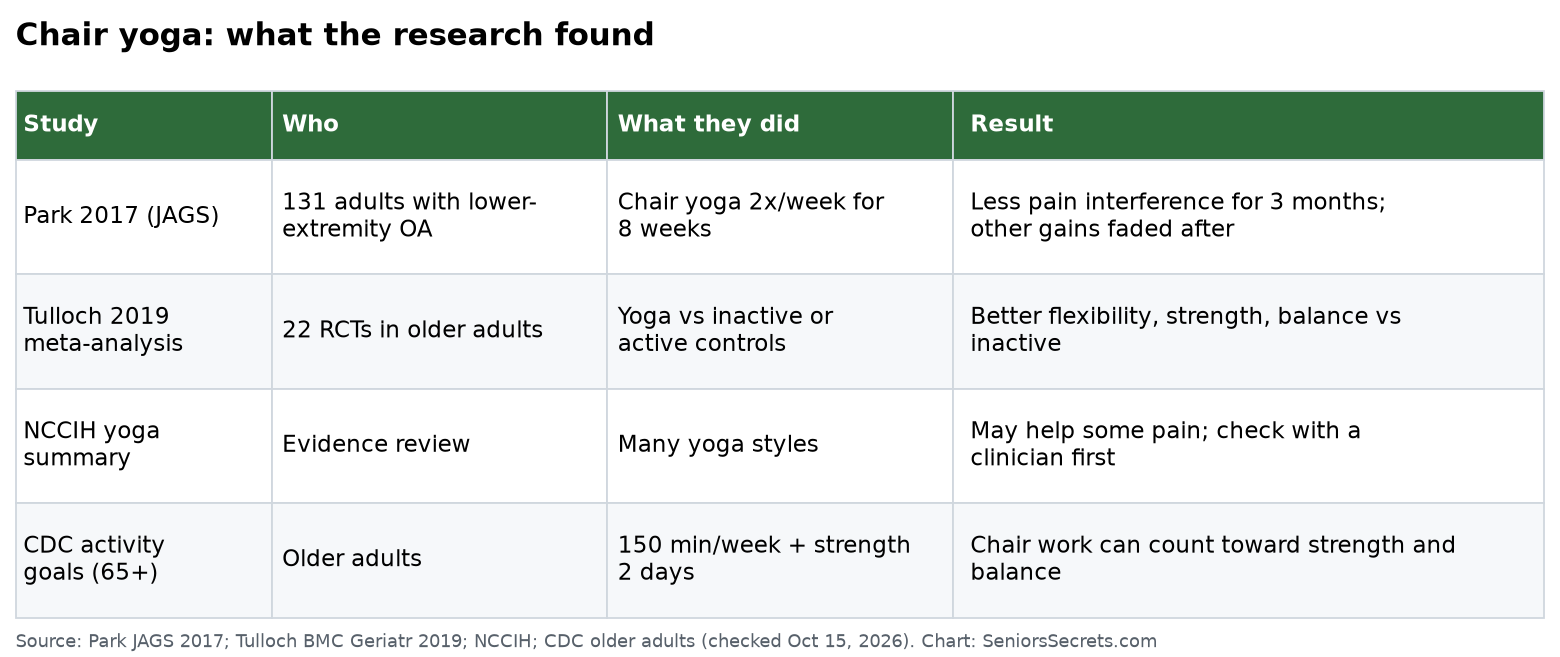
Chair yoga is yoga adapted so you stay seated or use a chair for support. For many adults over 60, it is a realistic way to work on flexibility, strength and balance when floor yoga feels unsafe. A randomized trial in older adults with lower-extremity osteoarthritis found that eight weeks of twice-weekly chair yoga reduced pain interference (how much pain gets in the way of daily life), with that benefit lasting three months (Park et al., Journal of the American Geriatrics Society, 2017). Other gains such as pain intensity and walking speed improved during the classes but faded after the program ended. So chair yoga helps, but it is not a one-time cure.
I am a researcher, not a yoga therapist or doctor. Use this to choose a class and talk with your clinician, especially if you have osteoporosis, spine disease, uncontrolled blood pressure, or recent surgery.
Why a chair helps
Standing yoga can challenge balance. A sturdy chair (four legs, no wheels) lets you:
- Stretch hips, spine and shoulders with less fall risk
- Build leg and core strength by pressing through your feet
- Pause and breathe without scrambling to the floor
The CDC older-adult activity guidelines call for about 150 minutes a week of moderate activity, strength work at least two days a week, and balance activities. Chair yoga will not replace all walking, but it can cover part of the strength and balance bucket if you put real effort into the poses.
What the evidence says (without the hype)
- Park 2017: 131 community-dwelling older adults with lower-extremity osteoarthritis; chair yoga twice a week for eight weeks versus a health-education control. Pain interference improved and held at three months. Pain, gait speed and fatigue got better during the intervention; those did not all last after classes stopped.
- Tulloch et al., 2019 meta-analysis: Across 22 randomized trials, yoga improved lower-body flexibility, lower-limb strength and balance versus inactive controls. Benefits versus other active exercise were smaller.
- NCCIH yoga summary: Yoga may help some people with back pain or arthritis symptoms. Evidence quality varies by condition. Instructors should know your limits.
Skip claims that chair yoga “reverses aging” or replaces physical therapy after a fracture. It is a tool, not magic.
Before you start: safety checklist
Ask your doctor or physical therapist first if you have:
- Unsteady blood pressure or dizziness when you bend forward
- Osteoporosis or spine fractures (avoid deep twists and forward folds that round a fragile spine)
- Hip or knee replacement with movement limits
- Severe balance loss (you may need supervised therapy first)
- Glaucoma or recent eye surgery (some inversions and breath holds are restricted)
Use a chair that will not slide. Sit near a wall. Wear shoes with grip or go barefoot if your instructor agrees and your feet are healthy. If you have diabetic neuropathy, check your feet after class; see our neuropathy guide.
Eight seated poses to try (template, not a prescription)
Move slowly. Breathe normally. Stop if you feel sharp pain, chest pressure, or severe dizziness.
- Seated mountain. Feet flat, knees over ankles, tall spine, arms relaxed. Take five easy breaths. This is your home base.
- Shoulder rolls. Lift shoulders toward ears, roll back and down 5 times, then reverse. Loosens neck tension from reading or driving.
- Seated cat-cow. Hands on knees. Inhale, gently arch; exhale, round. Five slow rounds. Keep the range small if you have spine disease.
- Seated side stretch. One hand on the chair seat, other arm reaches up and over. Two breaths each side. Do not collapse into the side waist.
- Seated twist. Inhale tall; exhale, rotate toward the right using the chair back for a light assist. Two breaths; switch sides. Twist from mid-back, not by yanking the neck.
- March in place. Hands on the chair or thighs; lift one knee at a time for 20 to 30 seconds. Builds hip flexor strength for walking.
- Seated heel-toe rock. Rock from heels to toes while seated to wake up ankles, or stand behind the chair and hold the backrest for calf raises if your clinician says standing is fine.
- Ankle circles and foot spreads. Especially useful if you sit most of the day. Ten circles each way.
A sample beginner session: 5 minutes breathing and mountain pose, 15 minutes of the moves above, 5 minutes quiet sitting. Two or three sessions a week matches the Park trial’s frequency.
For more balance work, see balance exercises for seniors over 70 and wall sits.
How to pick a class or video
- Look for teachers who mention chair yoga, adaptive yoga, or senior fitness
- Ask whether they train for osteoporosis-safe cues
- Prefer live or interactive formats at first so someone can correct form
- Hospital community centers, YMCAs and Area Agencies on Aging often list low-cost classes
- Free videos are fine for ideas, but skip any that push deep backbends or headstands from a chair
Medicare does not generally pay for yoga classes as DME or Part B therapy. Medically necessary physical therapy is different and needs a plan of care. Some Medicare Advantage plans offer fitness extras (gym or class networks). Check your Evidence of Coverage during Open Enrollment.
Add seated strength: a leg test and a 10-minute chair routine
Chair yoga is great for stiffness and calm. To protect against falls, also build leg strength. A 2021 review of 25 studies with 1,388 older adults found chair-based exercise improved grip strength and the number of chair stands people could do in 30 seconds.
First, test your legs (30 seconds)
This is the chair stand test from the CDC’s STEADI fall-prevention toolkit. Put a firm chair without arms against a wall. Sit in the middle, feet flat, arms crossed over your chest. Have someone time 30 seconds while you stand all the way up and sit all the way down as many times as you can. If you need your arms to push up, stop and tell your doctor. Repeat the test every 4 to 6 weeks to see your progress.
The 10-minute routine
| Time | Move | How |
|---|---|---|
| 0:00 to 2:00 | Seated marching | Sit tall near the front edge. Lift one knee, then the other, swinging your arms. |
| 2:00 to 4:00 | Sit-to-stand | Lean forward, nose over toes, and stand up slowly. Sit down slowly. Do 5 to 10. |
| 4:00 to 5:00 | Rest | Breathe and roll your shoulders. |
| 5:00 to 6:30 | Knee extension | Straighten one leg, squeeze for 2 seconds, lower. Do 10 per leg. |
| 6:30 to 8:00 | Heel and toe raises | Lift both heels, then both toes. Do 15 of each. |
| 8:00 to 9:30 | Seated row | Pull a band or towel looped around your feet. Do 10 to 12. |
| 9:30 to 10:00 | Cool down | Slow march and deep breaths. |
Do it 2 or 3 days a week, with a rest day between. The CDC asks adults 65 and older to do strength work at least 2 days a week, plus 150 minutes of moderate activity and some balance work. A brisk seated march that makes you breathe harder can count as moderate activity.
To make it harder, add reps up to 15, slow down the lowering part, or add a light ankle weight of 1 to 2 pounds. If your knees hurt, keep the moves small and use a higher seat. A good rule from the Arthritis Foundation: if a joint hurts more two hours after exercise than before, ease up next time. Stop right away for chest pain, dizziness or new shortness of breath.
Common questions
Does chair yoga really help arthritis pain?
It can reduce how much pain interferes with life, based on the 2017 JAGS trial in lower-extremity osteoarthritis. It may not permanently erase pain scores after you stop attending.
How often should I practice?
Two sessions a week for eight weeks matched the positive trial. Many people do well with 20 to 30 minutes, two or three days a week, plus walking on other days.
Is chair yoga enough exercise by itself?
Usually no. Add walking or other aerobic activity toward the CDC 150-minute goal unless your clinician sets a different target.
Can I do chair yoga after a hip replacement?
Only with clearance and any angle limits your surgeon gave you. A physical therapist can mark safe ranges.
Will Medicare pay for a yoga teacher?
Not as a standard Part B benefit. Ask your plan about optional fitness perks, or use community classes.
Written by Khasim Basha Shaik. I research senior health topics for readers. I am not a yoga therapist, physical therapist or physician. This article summarizes published studies and CDC/NCCIH guidance and is not personal medical advice. Last reviewed October 15, 2026.