Wall Sits for Seniors: What the Blood Pressure Research Shows and How to Start Safely

A wall sit is an isometric exercise: you lean your back against a wall, slide down until your knees are bent, and hold. In the largest review to date of exercise and blood pressure, isometric training lowered resting blood pressure more than any other type of exercise, and the wall squat (wall sit) ranked as the most effective single exercise for lowering systolic pressure.
That doesn’t make it a replacement for blood pressure medicine, and most of the research wasn’t done in people in their 70s and 80s. But for many older adults it’s a cheap, quick, joint-friendly addition to walking and strength work, as long as you start shallow, keep breathing, and check with your doctor if your blood pressure isn’t under control.
What the research found
In 2023, the British Journal of Sports Medicine published a meta-analysis of 270 randomized controlled trials with 15,827 participants (Edwards et al., 2023). Average drops in resting blood pressure compared with no exercise:
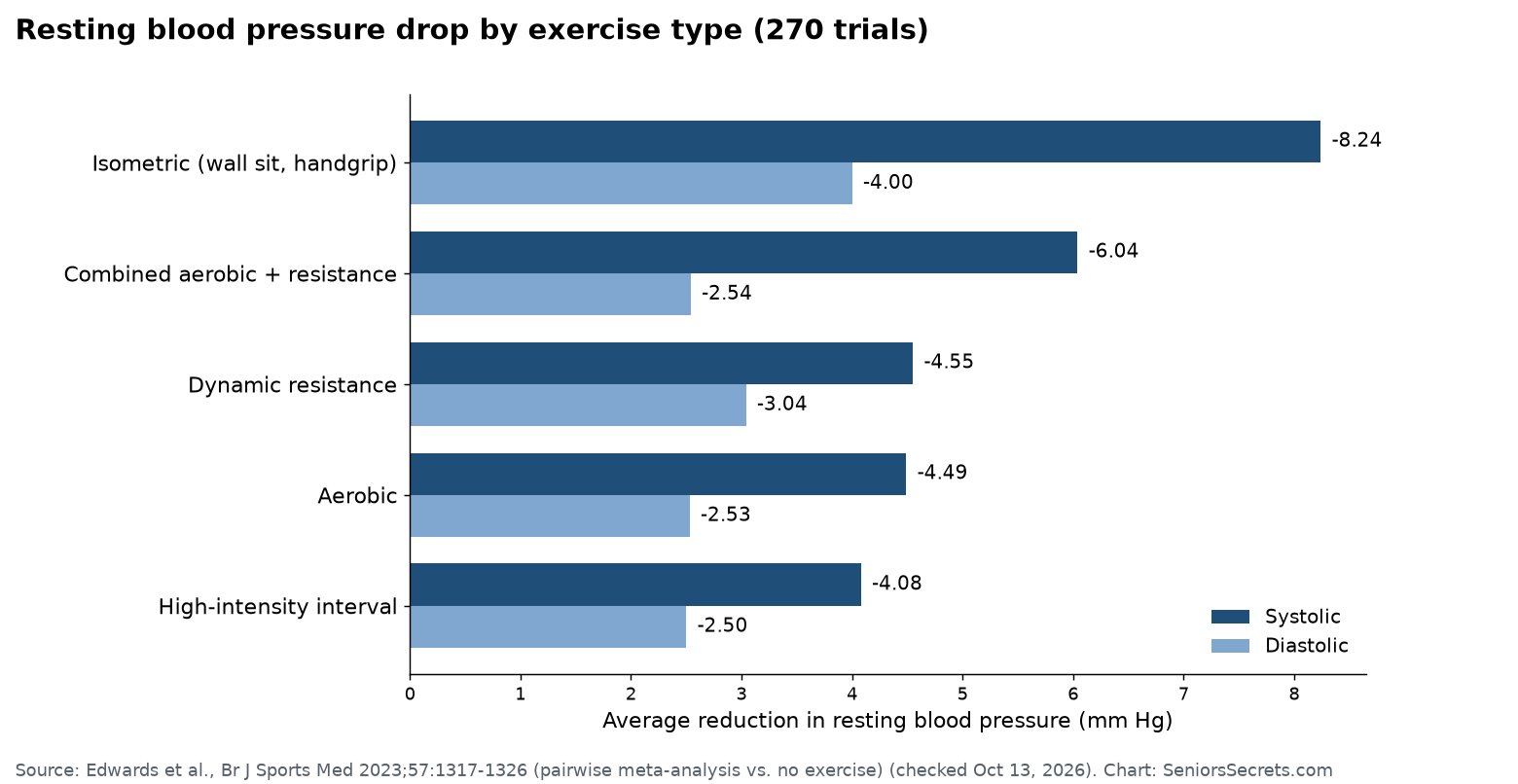
| Exercise type | Average drop (systolic / diastolic, mm Hg) |
|---|---|
| Isometric exercise training (wall sits, handgrip and similar) | 8.24 / 4.00 |
| Combined aerobic + resistance training | 6.04 / 2.54 |
| Dynamic resistance training (weights, bands) | 4.55 / 3.04 |
| Aerobic exercise (walking, cycling and similar) | 4.49 / 2.53 |
| High-intensity interval training | 4.08 / 2.50 |
When the researchers compared individual exercises, isometric wall squats ranked first for lowering systolic pressure and running ranked first for diastolic.
A few honest caveats:
- These are averages across many small trials, mostly in younger and middle-aged adults. Your result may be bigger, smaller or none.
- Studies usually ran a few weeks to a few months. Long-term data are thinner.
- The trials compared exercise to no exercise, not exercise to medication.
Research in older adults is starting to catch up. A small 2026 trial in 30 older women (average age about 69) who were already taking blood pressure medicine found a single session of six 2-minute wall squat sets lowered systolic pressure for up to an hour afterward. A shorter session of four 2-minute sets didn’t (Journal of Hypertension, 2026). That’s one session, in a small group, so treat it as encouraging rather than proof.
How the studies usually did it
Many wall squat trials used a pattern like this: four 2-minute holds with about 2 minutes of rest between them, three times a week, with knee angle set so the effort felt hard by the end of each hold. That’s 8 minutes of work per session.
Most people over 65 shouldn’t start there. Build up to it.
How to do a wall sit safely
- Stand with your back flat against a smooth wall. Feet about hip-width apart, roughly 1 1/2 to 2 feet from the wall. Wear shoes with grip, and don’t do it on a slippery floor or in socks.
- Slide down only a little at first, a few inches, so your knees are just slightly bent. Your knees should stay behind your toes and point the same way as your feet.
- Breathe the whole time. Count out loud if it helps. Holding your breath while straining (the Valsalva maneuver) spikes blood pressure, which is the opposite of what you want.
- Hold for 20 to 30 seconds, then slide back up using the wall, and rest.
- Repeat 2 to 4 times. Stop if you feel knee pain, chest discomfort, dizziness or shortness of breath.
Keep a sturdy chair right in front of you or next to you so you can grab it or sit down if needed.
A gentle 8-week build-up
| Weeks | Depth | Hold | Sets | Rest between |
|---|---|---|---|---|
| 1–2 | Slight knee bend | 20–30 sec | 2–3 | 1–2 min |
| 3–4 | A bit lower | 45–60 sec | 3 | 2 min |
| 5–6 | Lower, still comfortable for knees | 60–90 sec | 3–4 | 2 min |
| 7–8 | Hard but doable by the end of each hold | Up to 2 min | 4 | 2 min |
Do it 2 or 3 days a week, not daily, at first. You never need to go down to a 90-degree “chair” position. The studies set depth by effort, and a shallower sit that feels hard by the last few seconds still counts. This is a practical progression I put together from the study protocols, not a medical prescription.
Can’t do it standing? Isometric handgrip training (squeezing a handgrip at moderate effort for 2-minute holds) also lowered blood pressure in the review and doesn’t load the knees. Ask your doctor or a physical therapist which suits you.
Who should check with a doctor first
- Your blood pressure is high and not controlled, or you’ve recently had a heart attack, heart surgery, stroke or heart failure symptoms.
- You have serious knee or hip arthritis, a recent joint replacement, or knee pain that gets worse when you bend.
- You get chest pain, unusual shortness of breath or dizziness with exertion.
- You have glaucoma or a recent eye surgery, since straining raises eye pressure as well.
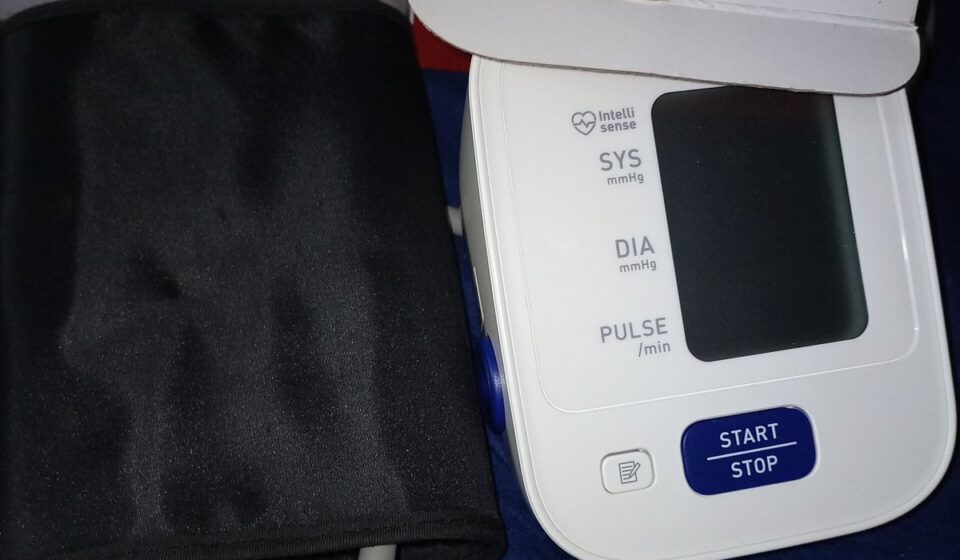
Keep taking your blood pressure medicine as prescribed. If you check your pressure at home, check it at the same time each day, not right after exercise. My guide to high blood pressure after 65 covers current targets and home monitoring.
Where wall sits fit in your week
Wall sits are a supplement, not a whole workout. The CDC’s activity guidelines for adults 65 and older still call for about 150 minutes a week of moderate aerobic activity, muscle-strengthening activities at least 2 days a week, and balance activities (CDC guidelines for older adults). A wall sit counts as leg-strengthening, but it doesn’t train balance or the muscles you use to climb and rise from a chair. Pair it with moves like step-ups, calf raises and chair exercises. For a full plan, see my exercise guide for seniors over 75.
Common questions
Do wall sits really lower blood pressure?
In a 2023 review of 270 trials, isometric exercise lowered resting blood pressure by about 8/4 mm Hg on average, the most of any exercise type, and wall squats ranked first for systolic pressure. Results vary from person to person.
How long should a senior hold a wall sit?
Start with 20 to 30 seconds at a shallow depth, 2 or 3 times. Many studies built up to four 2-minute holds, three times a week, but work up to that gradually.
Are wall sits safe for bad knees?
A shallow wall sit with knees behind the toes is easier on many knees than squats, but stop if it hurts. People with serious arthritis or a recent knee replacement should ask their doctor or physical therapist first.
Should I hold my breath during a wall sit?
No. Breathe steadily the whole time. Holding your breath while straining raises blood pressure sharply.
Can wall sits replace my blood pressure medicine?
No. They can be a helpful addition. Don’t change or stop medication without talking to your doctor.
Written by Khasim Basha Shaik. I research health topics for older adults using peer-reviewed studies and official guidelines. I’m not a doctor, physical therapist or trainer, and this isn’t medical advice. Check with your clinician before starting a new exercise if you have a heart condition or uncontrolled blood pressure. Last reviewed October 13, 2026.
Related guides