Skip to content
Seniors Secrets Seniors Secrets

Secrets Every American 60+ Should Know

Seniors Secrets Seniors Secrets

Secrets Every American 60+ Should Know

  • Medicare
    • Medicare Advantage
    • Benefits & Coverage
    • Drug Savings
    • Free Screenings
    • Appeals
    • Free Medicare Checklist
  • Money & Benefits
  • Health
    • Neuropathy
  • Fitness
  • Nutrition
  • Living
  • About
  • Medicare
    • Medicare Advantage
    • Benefits & Coverage
    • Drug Savings
    • Free Screenings
    • Appeals
    • Free Medicare Checklist
  • Money & Benefits
  • Health
    • Neuropathy
  • Fitness
  • Nutrition
  • Living
  • About
Close

Search

Grid of eight resistance band moves for seniors: seated row, chest press, bicep curl, knee extension, sit-to-stand, side steps, hip abduction, overhead press
Balance & Fitness

Resistance Band Exercises for Seniors: 8 Moves, an 8-Week Plan and How to Choose a Band

Photo of Khasim Basha Shaik
By Khasim Basha Shaik
June 5, 2026 6 Min Read
0
Home » Balance & Fitness » Resistance Band Exercises for Seniors: 8 Moves, an 8-Week Plan and How to Choose a Band

Getting out of a low chair, carrying groceries in from the car and climbing stairs all depend on muscle strength. We lose it gradually with age unless we work to keep it. Strength training is the main way to slow that loss, and you don’t need a gym or heavy weights to do it. A set of elastic bands, a sturdy chair and about 20 minutes, two or three times a week, is enough to start.

Bands suit older bodies well. They’re light, cheap and easy to store. The resistance builds smoothly as you stretch them, so joints don’t take a sudden jolt, and most moves can be done sitting down.

I’m a researcher, not a physical therapist. If you have heart disease, uncontrolled blood pressure, a recent joint replacement, a hernia or osteoporosis, check with your doctor before you start.

Table of Contents

Toggle
  • What the research shows
  • Choosing a band
  • The 8 moves
    • 1. Seated row (upper back, posture)
    • 2. Chest press (chest, shoulders, triceps)
    • 3. Bicep curl (arms, grip)
    • 4. Seated knee extension (quadriceps)
    • 5. Banded sit-to-stand (legs, hips)
    • 6. Side steps (hips, balance)
    • 7. Standing hip abduction (balance, steady walking)
    • 8. Seated overhead press (shoulders)
  • How many reps, and how to progress
  • Safety rules
  • Fitting bands into your week
  • FAQ
    • Are resistance bands as good as weights for seniors?
    • How often should seniors use resistance bands?
    • Which band should a beginner start with?
    • Can I do band exercises sitting down?
    • Are bands safe with arthritis?
  • Related guides

What the research shows

A 2024 systematic review in PLOS One pooled 28 studies of elastic-band training in adults 60 and older, with about 1,700 participants. It found improvements in upper-body strength, flexibility, endurance, balance and cardiopulmonary function. The effect on mood was less consistent.

Strength matters beyond daily tasks, too. In the large international PURE study published in The Lancet (Leong et al., 2015), which followed about 140,000 adults in 17 countries, each 5 kg drop in grip strength was linked to a 16% higher risk of death from any cause. That’s an association, not proof that building grip strength extends life. It does show that strength is a useful marker of health.

The federal Physical Activity Guidelines recommend muscle-strengthening activity on at least 2 days a week for older adults, working all the major muscle groups. For why this matters so much after 65, see my guide to sarcopenia and strength training.

Choosing a band
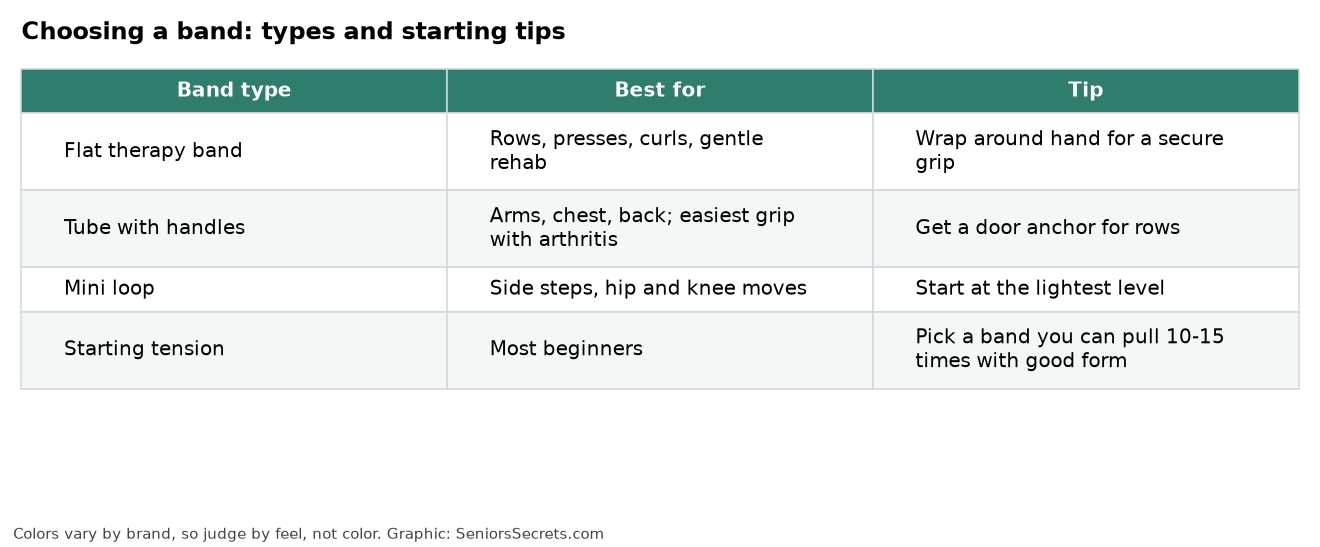
Table comparing flat therapy bands, tube bands with handles and mini loops, with tips for choosing starting tension
Colors vary by brand, so choose by feel. Graphic: SeniorsSecrets.com.
  • Flat therapy bands are versatile and cheap. Wrap the end around your hand for a secure grip.
  • Tube bands with handles are easiest to hold if you have arthritis in your hands. A door anchor lets you do rows and presses.
  • Mini loops are for side steps and hip and knee moves.
  • Starting tension: pick a band you can pull 10 to 15 times with good form, where the last few reps feel moderately hard. Most people should start lighter than they think. Colors aren’t standard across brands, so judge by feel.

The 8 moves
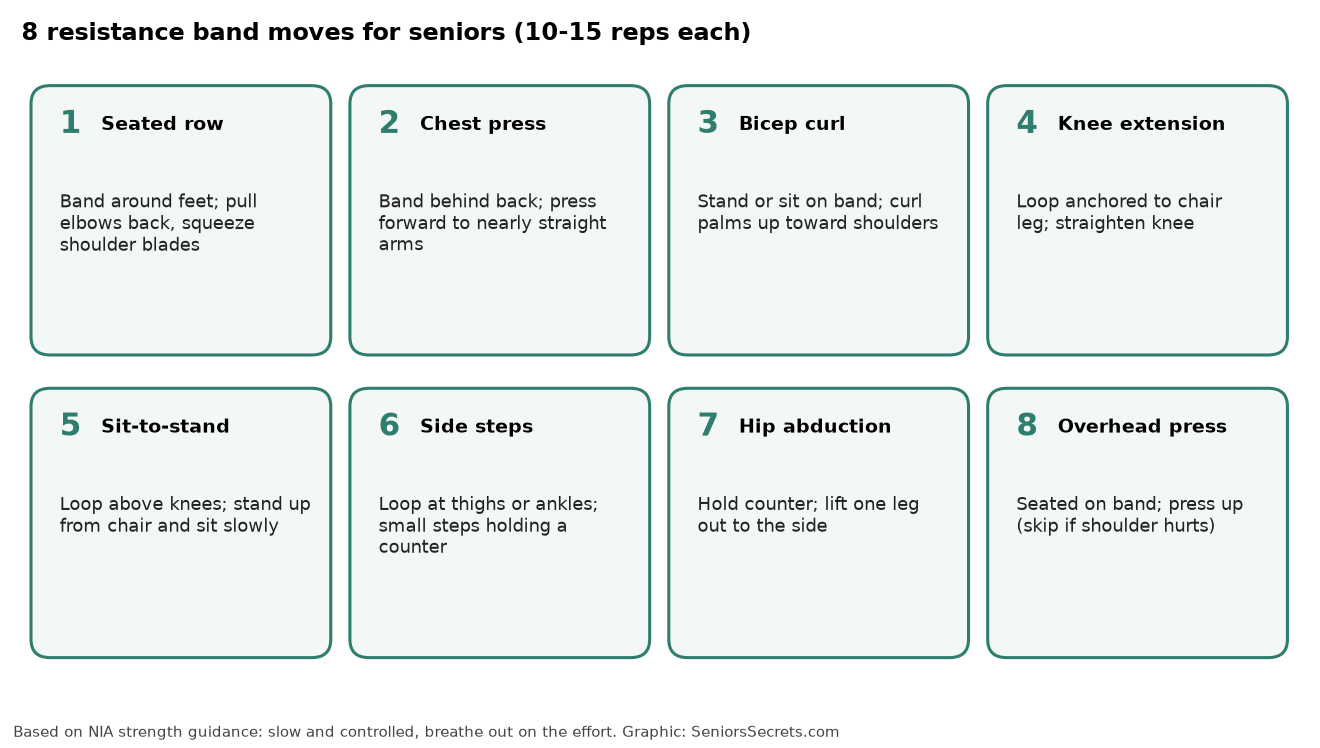
Grid of eight resistance band moves for seniors: seated row, chest press, bicep curl, knee extension, sit-to-stand, side steps, hip abduction, overhead press
Do each move slowly: about 2 seconds to pull, 3 seconds to return. Graphic: SeniorsSecrets.com.

1. Seated row (upper back, posture)

Sit tall with your legs out in front. Loop the band around your feet, and hold one end in each hand. Pull your elbows straight back past your ribs, squeeze your shoulder blades together, and then return slowly. This counters a rounded upper back.

2. Chest press (chest, shoulders, triceps)

Wrap the band around your upper back and under your arms. Hold an end in each hand at chest level, and press forward until your arms are nearly straight. This builds the pushing strength you use to get up from a chair or open heavy doors.

3. Bicep curl (arms, grip)

Sit or stand on the middle of the band, holding the ends with palms up. Keep your elbows at your sides, and curl your hands toward your shoulders. Lower slowly. This helps with lifting and carrying.

4. Seated knee extension (quadriceps)

Tie a loop band around a chair leg and your ankle, or have it anchored behind you. Straighten your knee against the band, then lower it slowly. Strong quadriceps make standing up and climbing stairs easier.

5. Banded sit-to-stand (legs, hips)

Place a loop just above your knees. Sit at the front of a sturdy chair, lean forward slightly, and stand up while gently pressing your knees outward against the band. Sit back down slowly. Use your hands if needed at first.

6. Side steps (hips, balance)

Put a loop band around your thighs or ankles, and stand next to a counter. Take 5 to 10 small steps sideways, then come back. This strengthens the hip muscles that keep you steady when you step to the side.

7. Standing hip abduction (balance, steady walking)

Hold a counter with the band around your ankles. Keeping your body upright, lift one leg out to the side, then lower it slowly. Switch legs. Pair this with my balance exercises.

8. Seated overhead press (shoulders)

Sit on the middle of the band, or step on it. Hold the ends at shoulder height, and press up until your arms are nearly straight. Skip this one if overhead movement hurts your shoulder. Do my shoulder exercises instead.

How many reps, and how to progress
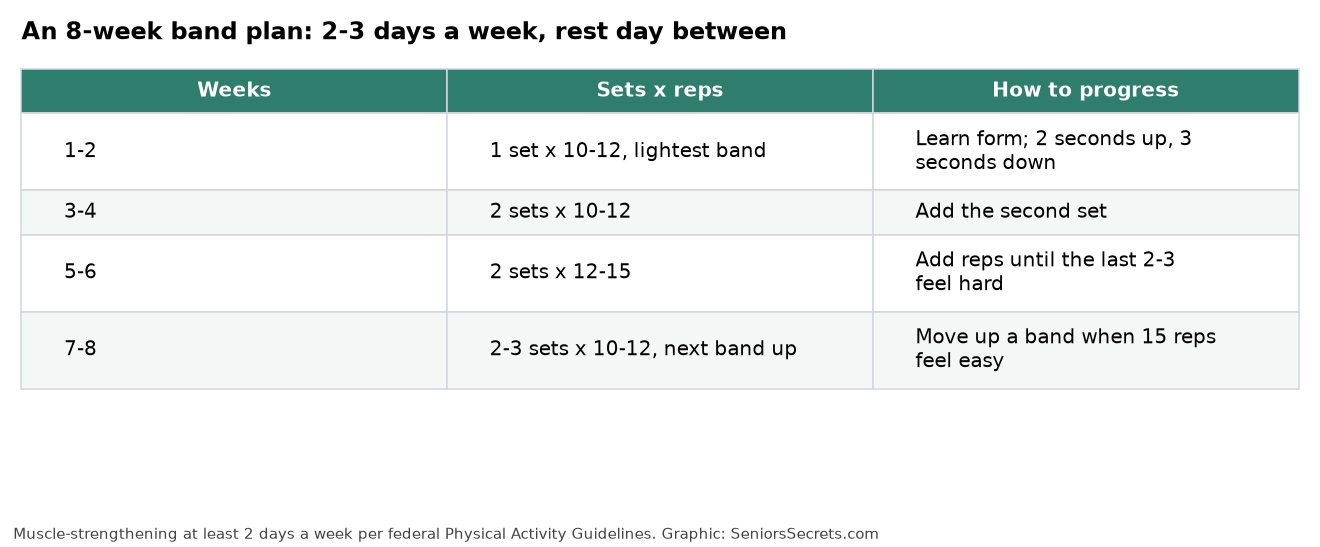
Eight-week resistance band plan table: weeks 1 to 2 one set of 10 to 12, building to 2 to 3 sets and a heavier band by weeks 7 to 8
Train 2 to 3 non-consecutive days a week. Graphic: SeniorsSecrets.com.
  • Frequency: 2 to 3 days a week, with a rest day between sessions.
  • Reps: 10 to 15 per exercise. The National Institute on Aging notes that one set of 8 to 12 reps is effective, and two or three sets may be more effective.
  • Pace: about 2 seconds to pull, 3 seconds to return. The slow return builds a lot of strength.
  • Progression: when 15 reps feel easy, add a set or move up to the next band. Shorten the band slightly by gripping closer for a little more resistance.

Safety rules

  • Check the band for nicks, cracks or sticky spots before each session. Replace worn bands, because a snapping band stings.
  • Anchor securely. Close the door on a door anchor on the hinge side, and pull away from the door.
  • Control the return. Never let the band snap back.
  • Breathe out on the effort. Never hold your breath, which spikes blood pressure.
  • Stay near support for standing moves.
  • Warm up with 3 to 5 minutes of marching or arm circles.
  • Stop for sharp joint pain, dizziness, chest pressure or unusual shortness of breath. Call 911 for chest pain.

Fitting bands into your week

A balanced week might include two band sessions, walking or another activity to reach 150 minutes of moderate exercise, and short daily balance and stretching sessions. If you have a Medicare Advantage plan, a fitness benefit like SilverSneakers may include free strength classes. See my senior fitness guide for the full picture.

FAQ

Are resistance bands as good as weights for seniors?

For most everyday strength goals, yes. A 2024 review found band training improves strength, balance and endurance in older adults. Bands are also easier on joints and safer to use at home.

How often should seniors use resistance bands?

At least two non-consecutive days a week, with 10 to 15 reps per exercise, building up to 2 or 3 sets.

Which band should a beginner start with?

The lightest band that lets you do 10 to 15 controlled reps with the last few feeling moderately hard. Don’t go by color alone, because it varies by brand.

Can I do band exercises sitting down?

Yes. Rows, chest presses, curls, knee extensions and overhead presses all work well seated in a sturdy armless chair.

Are bands safe with arthritis?

Usually. Bands provide smooth, adjustable resistance. Use light tension, stay in a pain-free range, and ask a physical therapist for modifications if a joint flares.

Khasim Basha Shaik
Founder & editor · Researcher, not a licensed agent

Khasim Basha Shaik is the founder and editor of Seniors Secrets. He spends his time digging through Medicare plan documents, government sources and the fine print, so readers can compare their options without the jargon. Every guide here links to its sources, and we update posts when the rules or numbers change. Seniors Secrets offers research and education, not licensed insurance or medical advice, so please confirm plan details with Medicare.gov or a licensed advisor before enrolling. About Seniors Secrets →

Related guides

Older athletes with medals at the Huntsman World Senior Games in Utah
Balance & Fitness
Exercise Variety and Longevity: Why Mixing Activities May Cut Death Risk 19% After 60
Older woman practicing a seated yoga stretch in a living room
Balance & Fitness
Chair Yoga for Seniors: What the Studies Show, 8 Safe Seated Moves, and How to Start
Table of below-average 30-second chair stand scores by age for men and women
Balance & Fitness
Chair Exercises for Seniors: A 15-Minute Seated Strength Routine and a 30-Second Leg Strength Test

Tags:

2026fall preventionresistance band exercises for seniorssarcopeniasenior fitnessseniorsstrength training seniors
Photo of Khasim Basha Shaik
Author

Khasim Basha Shaik

Khasim Basha Shaik is the founder and editor of Seniors Secrets. He spends his time digging through Medicare plan documents, government sources and the fine print, so readers can compare their options without the jargon. Every guide here links to its sources, and we update posts when the rules or numbers change. Seniors Secrets offers research and education, not licensed insurance or medical advice, so please confirm plan details with Medicare.gov or a licensed advisor before enrolling.

Follow Me
Other Articles
A bowl of cooked oatmeal on a table
Previous

High-Fiber Foods for Seniors: How Much You Need and the Best Everyday Sources

Senior woman with curly hair putting on her glasses while looking at a laptop
Next

Medicare Part D 2027: The $2,400 Cap, New Premiums, and How to Pick a Drug Plan

No Comment! Be the first one.

    Leave a Reply Cancel reply

    Your email address will not be published. Required fields are marked *

    Khasim Basha Shaik
    Founder & editor · Researcher, not a licensed agent

    Khasim Basha Shaik is the founder and editor of Seniors Secrets. He spends his time digging through Medicare plan documents, government sources and the fine print, so readers can compare their options without the jargon. Every guide here links to its sources, and we update posts when the rules or numbers change. Seniors Secrets offers research and education, not licensed insurance or medical advice, so please confirm plan details with Medicare.gov or a licensed advisor before enrolling.

    About Seniors Secrets →

    Popular guides

    • Table of Social Security and SSI payment dates from October 2026 through December 2027, by birthday group, SSI and 3rd-of-month recipientsSocial Security Payment Dates for 2026 and 2027: Your Exact Day by Birthday, SSI Dates and Holiday Shifts
    • Senior woman reviewing Medicare Part D 2027 plan options and prescription costs at a kitchen tableMedicare Part D 2027: New $2,400 Cap, Costs & Enrollment
    • Bar chart of 2026 monthly income limits for QMB, SLMB and QI for a single person and a married coupleMedicare Savings Programs 2026: QMB, SLMB, QI and QDWI Limits, What They Pay and How to Apply
    • Senior couple at home checking finance on credit card from aboveMedicare Plan G 2027 Rates: How Premiums Work and How to Shop by ZIP
    • Older woman talking on the phone while sitting at a table with a laptop10 Medicare Benefits Most Seniors Never Claim (2027 Open Enrollment Guide)

    Browse topics

    • Senior Health129
    • Nutrition62
    • Medicare47
    • Balance & Fitness44
    • Medicare Benefits43
    • Financial Assistance for Seniors41
    • Neuropathy17
    • Senior Tips14
    • Free Preventive Screenings12
    • Medicare Advantage10

    Topics

    • Medicare
    • Money & Benefits
    • Health
    • Fitness
    • Nutrition

    About us

    • About
    • Editorial Guidelines
    • Contact
    • Author

    Legal

    • Privacy Policy
    • Terms & Conditions
    • Medical Disclaimer
    • Advertising Disclosure
    Copyright 2026 — Seniors Secrets. All rights reserved.