10 Stretching Exercises for Seniors: A Gentle Daily Routine (Including a Morning Bedside Version)

Tight calves and hips change the way you walk. A stiff upper back and chest pull your shoulders forward. A neck that won’t turn makes checking your blind spot harder. Flexibility tends to slip quietly with age, and it affects everyday tasks long before it feels like a “fitness” problem.
The National Institute on Aging lists flexibility as one of the four types of exercise older adults need, alongside endurance, strength and balance. Moving more freely makes it easier to tie your shoes or unload the dishwasher.
Below are ten gentle stretches, how long to hold them, a simple daily schedule, and a bedside version for stiff mornings. All you need is a sturdy chair and a wall.
I’m a researcher, not a physical therapist. If you’ve had recent surgery, a fracture, a joint replacement, or have osteoporosis, ask your doctor or therapist which stretches to avoid.
How long and how often: what the guidance says
The American College of Sports Medicine’s position stand on exercise (Garber et al., 2011) recommends:
- Flexibility exercises at least 2 to 3 days a week. Daily is fine.
- Holding each stretch 10 to 30 seconds for most adults. Older adults may benefit from longer holds of 30 to 60 seconds.
- About 60 seconds total per stretch. For example, two 30-second holds.
- Stretching to the point of mild tightness, not pain.
The NIA adds two practical rules: stretch when your muscles are warmed up, and don’t stretch so far that it hurts.
Safety rules
- Warm up first. Walk or march in place for 5 minutes, or stretch after a walk or a warm shower.
- Go to gentle tension, never pain. Sharp, burning or shooting pain means back off.
- Breathe. Exhale as you ease into the stretch. Don’t hold your breath.
- Don’t bounce. Slow, steady holds are safer for older muscles and tendons.
- Use support. Keep a chair or wall within reach for anything done standing.
- Osteoporosis: avoid deep forward bends and forceful twisting of the spine. Ask your doctor which moves are safe for you.
- Hip replacement: follow your surgeon’s movement precautions, which may rule out crossing your legs (including the figure-four stretch).
The 10 stretches
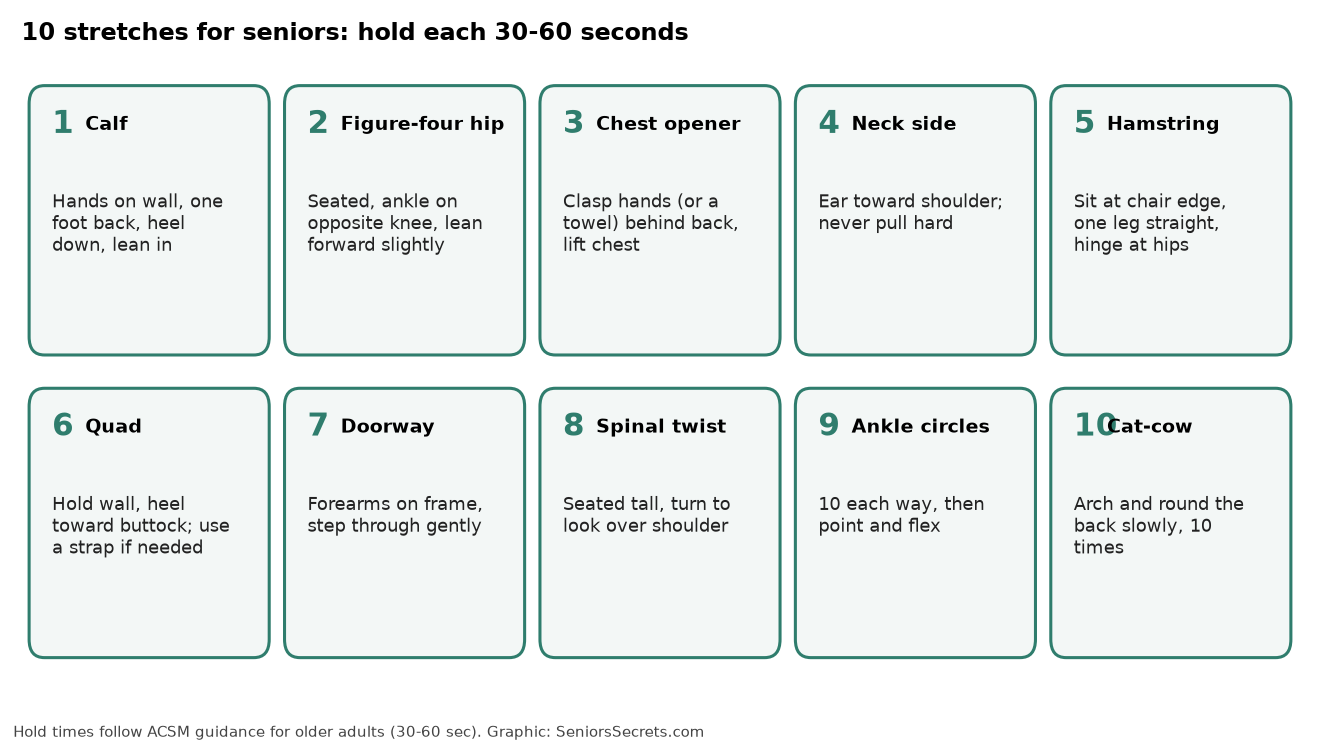
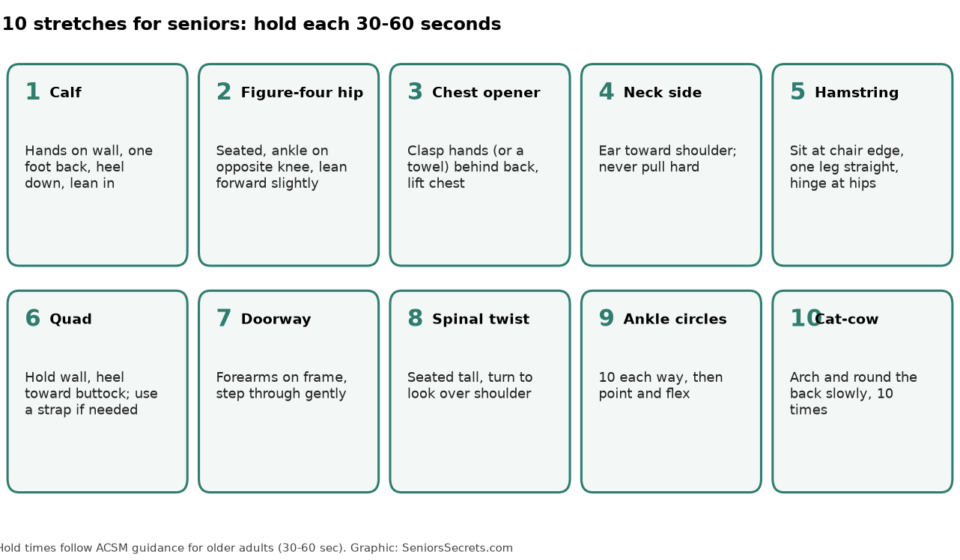
1. Standing calf stretch
Face a wall with your hands on it. Step one foot back, keeping that heel flat and the knee straight. Lean forward until you feel a stretch in the back of your lower leg. Hold 30 seconds per side. Flexible ankles help your stride and balance.
2. Seated figure-four hip stretch
Sit in a sturdy chair. Cross one ankle over the opposite knee. Sit tall and lean forward slightly until you feel a stretch in the buttock and outer hip. Hold 30 to 60 seconds per side. Skip this one if you have hip-replacement precautions.
3. Chest opener
Sit or stand tall. Clasp your hands behind your back, or hold a small towel between them if your hands don’t meet. Squeeze your shoulder blades together and lift your chest. Hold 30 seconds. This counters the hunched posture that comes from sitting.
4. Neck side stretch
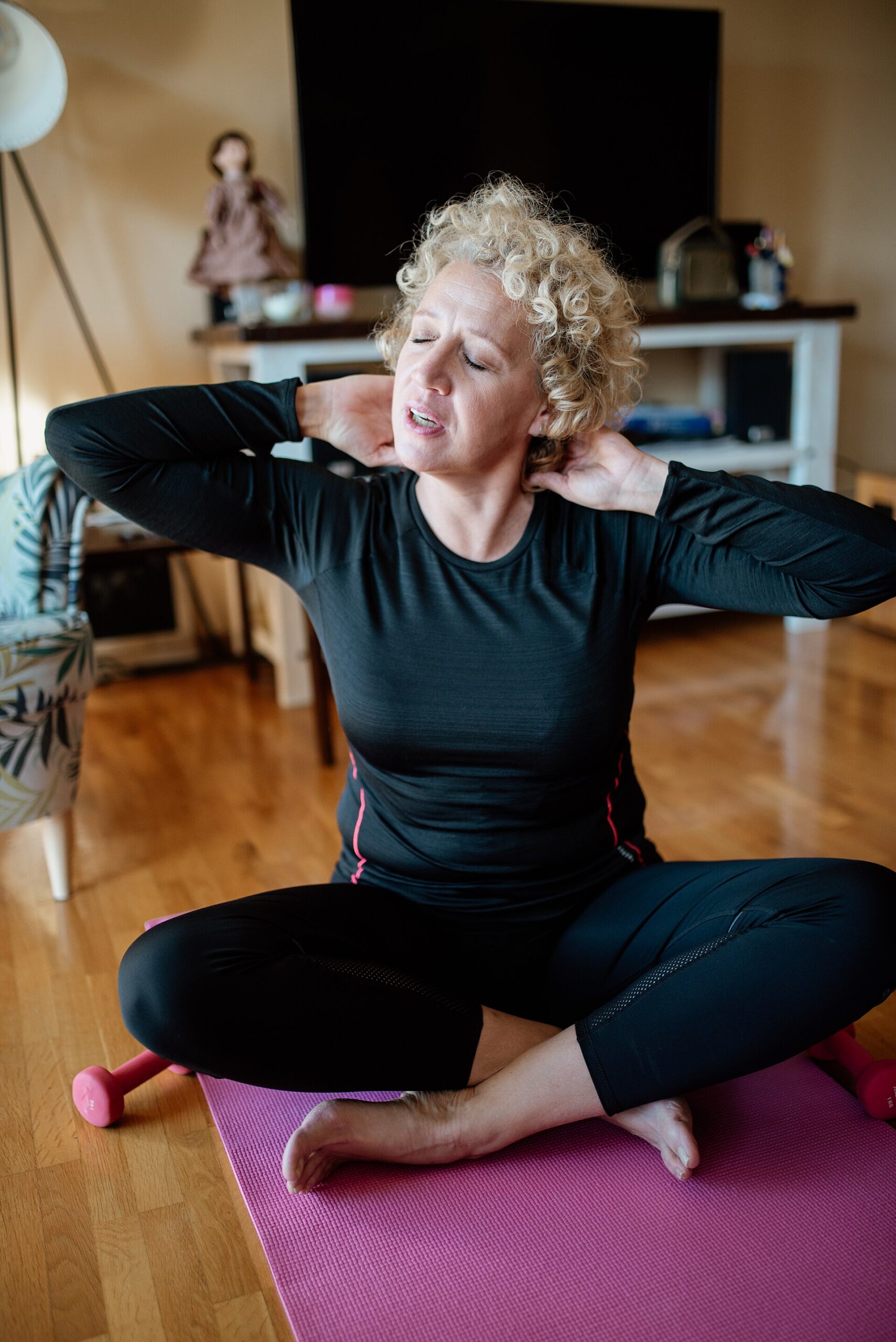
Sit tall with relaxed shoulders. Slowly tilt your right ear toward your right shoulder until you feel a stretch on the left side of your neck. You can rest your hand lightly on your head, but never pull. Hold 30 seconds, then switch. Avoid neck circles if they make you dizzy.
5. Seated hamstring stretch
Sit at the front edge of a chair. Straighten one leg with the heel on the floor and toes up. Keep your back flat and hinge forward from the hips until you feel a stretch behind the thigh. Hold 30 to 60 seconds per side. Tight hamstrings often add to low-back discomfort.
6. Standing quad stretch
Stand beside a wall or the back of a chair and hold on. Bend one knee and bring your heel toward your buttock, holding your ankle. If you can’t reach your ankle, loop a towel or strap around it. Keep your knees together. Hold 30 seconds per side.
7. Doorway shoulder stretch
Place your forearms on a door frame at shoulder height. Step one foot through until you feel a stretch across your chest and the front of your shoulders. Hold 30 seconds. My guide to shoulder exercises for seniors adds strengthening moves.
8. Seated spinal twist
Sit tall with your feet flat. Put your right hand on the outside of your left knee and your left hand on the chair back. Gently turn your torso to the left, and look over your shoulder. Hold 20 to 30 seconds, then switch. Keep it gentle, and skip it if you have osteoporosis unless your doctor says it’s OK.
9. Ankle circles and point-and-flex
Sit and lift one foot slightly. Circle the ankle 10 times each way, then point and flex the foot 10 times. Switch feet. This is a good one to do in bed before you stand up.
10. Seated cat-cow
Sit at the edge of the chair with your hands on your knees. Breathe in as you gently arch your back and lift your chest. Breathe out as you round your spine and tuck your chin. Flow slowly between the two, 10 times.
A 15-minute daily schedule
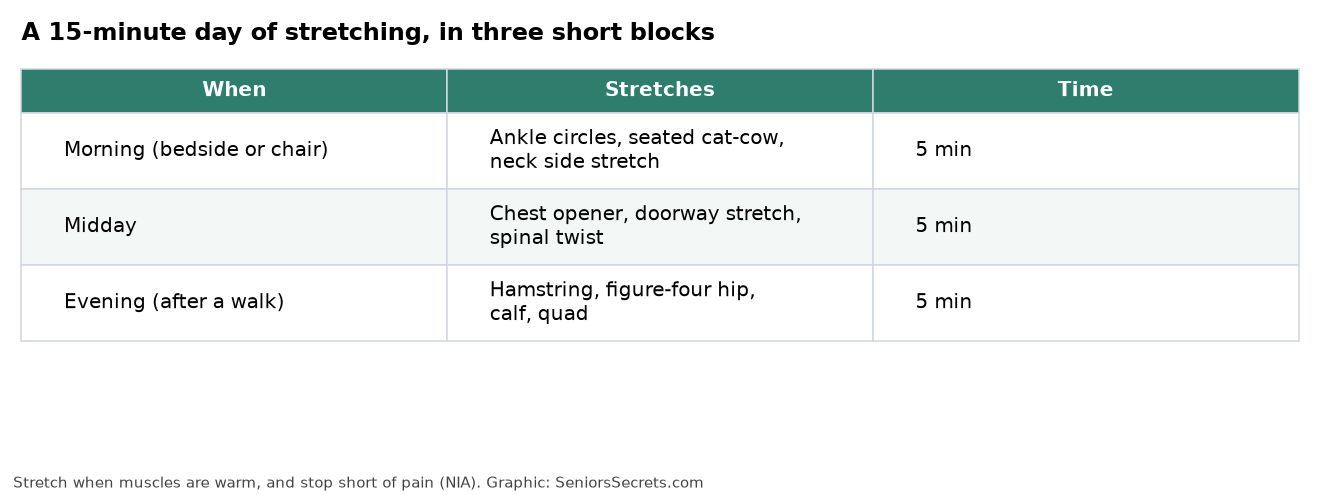
You don’t have to do all ten at once. Spreading them out works well:
- Morning (5 minutes): ankle circles, seated cat-cow, neck side stretch
- Midday (5 minutes): chest opener, doorway stretch, spinal twist
- Evening (5 minutes): hamstring, figure-four hip, calf and quad. Muscles are warmest after a walk.
The morning bedside routine for stiff wake-ups
If you wake up stiff, this 10-minute version uses only the bed edge and a chair:
- In bed, before standing (1 minute): ankle circles and point-and-flex. This also helps you avoid dizziness when you first get up.
- Sit on the bed edge (2 minutes): shoulder rolls, 5 forward and 5 back, then the chest opener.
- Still seated (2 minutes): neck side stretch and seated cat-cow.
- Seated (2 minutes): spinal twist and hamstring stretch, one leg at a time.
- Standing, holding the chair back (3 minutes): calf stretch, gentle hip circles (5 each way), and 10 slow heel raises (rise onto your toes, hold for a breath, lower).
Stand up slowly. If you take blood pressure medicine or feel lightheaded in the morning, sit on the bed edge for a minute first.
How to make stretching a habit
- Tie it to something you already do, like right after brushing your teeth or while the coffee brews.
- Keep a chair by the bed as a visual cue.
- Start with three stretches if ten feels like too much, and add more later.
- Track it with an X on a calendar.
- Stretch with your spouse or a friend.
Where stretching fits in
Stretching keeps you moving freely, but it doesn’t build muscle or prevent falls by itself. Federal Physical Activity Guidelines recommend that older adults get 150 minutes a week of moderate activity, do muscle-strengthening at least 2 days a week, and include balance training.
Good next steps:
- balance exercises
- strength training for sarcopenia
- chair yoga, which combines flexibility and balance
If stiffness or pain is limiting daily life, a physical therapist can design a program for you. Medicare Part B covers medically necessary outpatient therapy. See Medicare physical therapy coverage.
FAQ
How long should seniors hold a stretch?
ACSM guidance suggests 10 to 30 seconds for most adults, and notes that older adults may benefit from 30 to 60 seconds. Aim for about 60 seconds total per stretch.
How often should seniors stretch?
At least 2 to 3 days a week, per ACSM. Daily gentle stretching is fine and helps many people with stiffness.
Is it better to stretch in the morning or at night?
Either works. Muscles are warmer later in the day or after a walk. A gentle morning routine helps many people with wake-up stiffness.
Should stretching hurt?
No. Stretch to mild tension. Sharp or shooting pain means you’ve gone too far.
Can stretching prevent falls?
Not on its own. Calf and ankle flexibility helps your gait, but balance and strength training are what reduce falls. Combine them.
Related guides