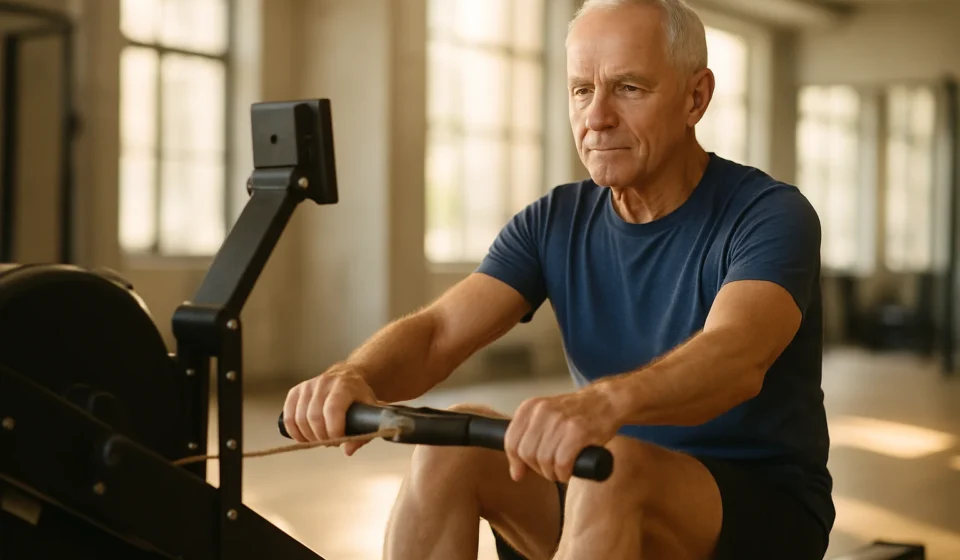

A rowing machine for seniors solves a puzzle that stumps many exercise plans after 65: how do you train the heart, the back, the legs, and the arms at once — without pounding a single joint? Rowing works roughly 86% of your muscles per stroke, you do it seated, and the resistance meets you at whatever effort you give. Cardiologists like it because it builds aerobic capacity efficiently; physical therapists like it because the pulling motion counteracts the rounded-forward posture that creeps in with age. I have coached readers through starting programs on bikes, in pools, and on trails, and the rower is the machine I see most wrongly dismissed as “too intense.” Used correctly, it is one of the gentlest full-body options in the gym. Here is the senior-safe way in.
Table of Contents
- What the Research Shows
- Form First: The 4-Step Stroke
- Your First 4 Weeks
- 5 Mistakes That Cause Back Pain
- Who Should Modify or Skip Rowing
- Frequently Asked Questions
What the Research Shows
Rowing checks an unusual number of boxes for aging bodies. Studies of older adults put on indoor rowing programs report improvements in aerobic capacity (VO2 max), leg and trunk strength, and — notably — trunk extensor endurance, the muscle system that keeps you upright and resists falls. Research on veteran rowers in their 60s and 70s shows cardiovascular fitness comparable to much younger sedentary adults. Because each stroke is about 60% legs, 20% core, and 20% arms, you get meaningful lower-body strengthening — the strongest predictor of independent living — inside a cardio workout. It slots naturally beside stationary cycling and swimming as joint-safe cardio, but adds a pulling pattern neither provides. One honest caveat: like swimming, rowing is not weight-bearing, so it does not build bone — pair it with standing strength work such as knee strengthening moves for the full package described in our senior fitness guide.
Form First: The 4-Step Stroke
Nearly every rowing injury traces to sequence errors, not the machine. The stroke has four positions, and the order is everything: legs, then body, then arms — and reverse on the way back.
| Phase | What Moves | Senior Cue |
|---|---|---|
| 1. Catch | Knees bent, shins vertical, arms long | Sit tall — “proud chest,” no slumping |
| 2. Drive | Push with legs first | Think leg press, not arm pull |
| 3. Finish | Lean back slightly, pull handle to lower ribs | Lean from hips only ~10–15 degrees |
| 4. Recovery | Arms out, hinge forward, knees bend last | Slide back slowly — recovery should take twice as long as the drive |
Set the damper (the air-vent lever on the flywheel) between 3 and 4 — not 10. A high damper setting makes every stroke feel like heavy lifting and loads the lower back; 3–4 mimics a light, quick boat and is what experienced rowers actually use. Keep stroke rate modest, around 18–22 strokes per minute.
Your First 4 Weeks
Week 1: three sessions of 5–8 minutes at conversational effort — you should pass the talk test the whole time. Week 2: three sessions of 10–12 minutes, adding one 60-second slightly-brisker surge per 5 minutes. Week 3: three to four sessions of 15 minutes with three surges. Week 4: 20 minutes continuous, or two 10-minute blocks with a stretch break. From there, 20–30 minutes three times weekly puts you at the aerobic dose most guidelines target, and brief vigorous surges deliver the longevity bonus described in our exercise snacks article. Stop for the day if you feel chest pressure, unusual breathlessness, or lightheadedness, and clear a new program with your doctor first if you have heart disease, uncontrolled blood pressure, or a recent fall history.
Two setup details make the first session far more comfortable. Getting on and off the low seat is the hardest part of rowing for many older adults — position the machine next to a sturdy chair or wall you can push off, or look for “raised seat” models that sit several inches higher. And use foot straps snugly across the widest part of your shoes; loose straps force your shins and toes to grip during the recovery, which tires the legs early and disturbs the rhythm. A folded towel on the seat solves most comfort complaints, and padded cycling shorts solve the rest.
5 Mistakes That Cause Back Pain
First, pulling with the arms before the legs finish — the classic error that shifts load to the lumbar spine. Second, slumping at the catch; a rounded back under load is exactly what an aging spine dislikes. Third, over-leaning at the finish, turning a 10-degree hip hinge into a 45-degree situp. Fourth, cranking the damper to 10 and grinding slow, heavy strokes. Fifth, rushing the recovery so every stroke becomes frantic; slow slides protect both rhythm and back. If you have osteoporosis with prior vertebral fracture, the repeated forward flexion at the catch deserves specific caution — see the next section.
Who Should Modify or Skip Rowing
Modify: knee replacement patients (shorten the slide until flexion is comfortable — a rower is otherwise excellent rehab cardio), hip replacement patients (confirm your flexion precautions with your surgeon; a raised-seat rower helps), and anyone with shoulder impingement (limit the layback and keep the pull low). Be cautious or skip: significant osteoporosis with prior spine fracture (the loaded flexion at the catch is the issue — an upright stationary bike sidesteps it), unstable heart disease, and acute sciatica or disc flare-ups. For blood pressure specifically, pairing rowing with the isometric exercises shown to lower BP covers both the aerobic and isometric levers.
Frequently Asked Questions
Is rowing safe for seniors with arthritis?
Usually yes — rowing is non-impact and the seated position unloads hips and knees while still moving them through range, which arthritic joints generally reward. Shorten the slide on flared days and keep resistance light. Ask your doctor or physical therapist if a specific joint is unstable.
How long should a 70-year-old row per session?
Build toward 20–30 minutes at conversational effort, three times weekly. Beginners should start with 5–8 minutes and add a few minutes each week. Duration at easy effort beats short, exhausting sessions for both safety and consistency.
Does rowing build bone density?
Not meaningfully — it is not a weight-bearing exercise. Treat rowing as your heart-and-muscle workout and add standing strength training, brisk walking, or stair climbing for the skeleton. The combination covers what neither does alone.
Water rower, air rower, or magnetic — which is best for seniors?
Magnetic rowers are quietest and easiest to fine-tune at low resistance — a good home default. Air rowers (gym standard) scale resistance naturally with your effort. Water rowers feel smooth and boat-like but run heavier and pricier. Prioritize a stable frame, a comfortable seat height for getting on and off, and a clear display.
Does Medicare pay for rowing machines or gym access?
Original Medicare does not buy exercise equipment. But many Medicare Advantage plans include SilverSneakers or similar fitness benefits giving free access to gyms with rowers — check your plan’s supplemental benefits before buying a machine.
Related Articles You May Find Helpful
- Stationary Bike for Seniors 2026: Joint-Safe Cardio
- Swimming for Seniors 2026: Strokes, Benefits & Safe Start
- Isometric Exercises for Seniors 2026: Lower Blood Pressure
- Knee Strengthening Exercises for Seniors 2026: 7 Safe Moves
- Exercise Snacks for Seniors 2026: 4 Minutes to Longevity
Sources
- National Institute on Aging — Exercise and Physical Activity
- CDC — Physical Activity Guidelines for Older Adults
- NIH / PubMed — Indoor Rowing Training in Older Adults
This article is educational and not medical advice — clear new exercise with your physician. See our medical disclaimer.
Related guides