Does Medicare Cover Walk-In Tubs in 2026? The Real Answer and 6 Ways to Pay
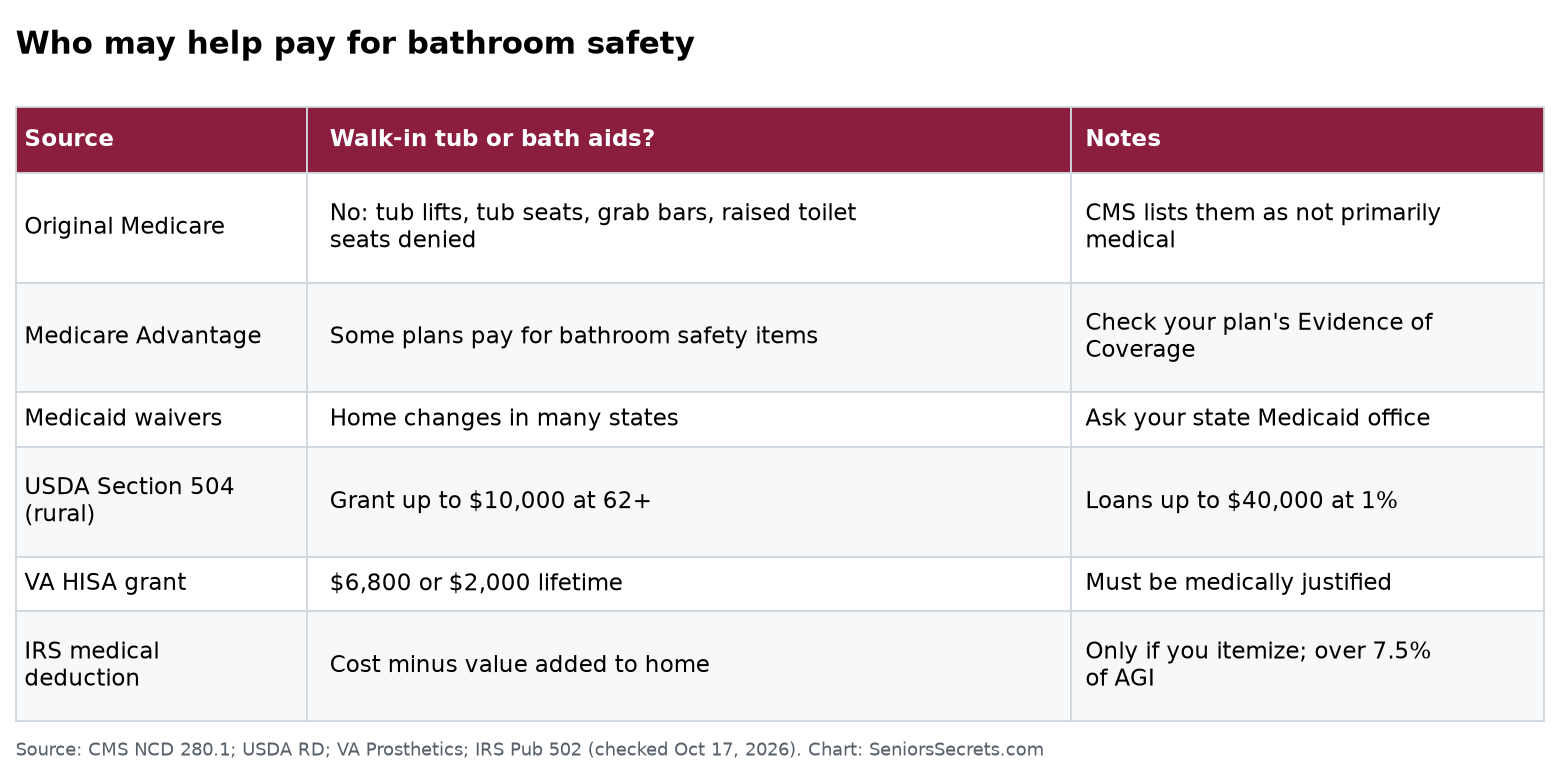
No. Original Medicare does not pay for walk-in tubs in 2026. It doesn’t pay for most bathroom safety items either. CMS’s official equipment list marks bathtub lifts, bathtub seats, grab bars and raised toilet seats as “deny,” calling them convenience or self-help items that are “not primarily medical in nature” (CMS National Coverage Determination 280.1). A walk-in tub is a home fixture, so it falls even further outside the rules.
That’s the bad news. The good news is that other programs can help. Below are the ones that actually pay, plus the sales tactics to watch for.
Why Original Medicare says no
Medicare Part B covers durable medical equipment (DME). Medicare.gov defines DME as equipment that is durable, used for a medical reason, typically only useful to someone who is sick or hurt, used in your home and expected to last at least 3 years (Medicare.gov DME).
A walk-in tub fails that test. Healthy people use bathtubs too, and a tub is built into the house. CMS’s list is blunt about the smaller items as well:
- Bathtub lifts: deny, convenience item
- Bathtub seats: deny, comfort or convenience item
- Grab bars: deny, self-help device
- Raised toilet seats: deny, convenience item
Even a doctor’s prescription won’t change those answers under Original Medicare. If a seller tells you “Medicare will cover it with a doctor’s note,” that’s a red flag.
What Original Medicare can cover: a bedside commode when you’re confined to your bedroom, plus walkers, canes and wheelchairs when you meet the rules. You pay 20% after the $283 ($292 in 2027) Part B deductible. Our Medicare walkers and wheelchairs guide explains how to get them.
When a Medicare Advantage plan may help
Since 2019, CMS has let Medicare Advantage plans offer extra benefits that help with daily health and safety. Some plans use this to cover bathroom safety devices, like grab bars, shower chairs or handheld shower heads. A few go further. It’s rare for a plan to pay for a whole walk-in tub, and when it does, there’s usually a dollar cap.
Some plans for people with chronic conditions also offer “special supplemental benefits” that can include home changes. These vary by plan and by county.
How to check:
- Open your plan’s Evidence of Coverage and search for “bathroom safety,” “home modification” or “safety devices.”
- Call the member services number on your card. Ask if there’s a dollar limit and which vendors you must use.
- If you’re shopping now, use Medicare’s Plan Finder during Open Enrollment, October 15 to December 7, 2026. Changes start January 1, 2027.
If your plan gives you a spending card, our Medicare flex card guide explains what it can and can’t buy.
Medicaid waivers
If you have Medicaid, ask about home and community-based services (HCBS) waivers. Many states use them to pay for “environmental modifications,” like grab bars, roll-in showers, ramps and sometimes tub conversions. The goal is to help you stay at home instead of moving to a nursing home.
Each state sets its own list and limits, and many have waiting lists. Start with your state Medicaid office or local Area Agency on Aging. Our Medicaid waiver programs guide has the details. People with both Medicare and Medicaid may also get bathroom safety items through a D-SNP plan.
USDA Section 504 grants (rural homeowners)
The USDA’s Section 504 Home Repair program helps people in rural areas (USDA Rural Development):
- Grants up to $10,000 for homeowners 62 or older with very low income, used to remove health and safety hazards
- Loans up to $40,000 at a fixed 1% rate for 20 years
- Grants and loans can be combined for up to $50,000
- The grant must be repaid if you sell the home within 3 years
A bathroom change that removes a fall hazard can qualify. You must own and live in the home, and the address must be in an eligible rural area. Applications are taken all year at local USDA offices. For more programs like this, see our free home repair programs for seniors.
VA grants for veterans
The VA’s Home Improvements and Structural Alterations (HISA) grant helps veterans make medically needed changes, including bathroom changes (VA Prosthetics). It’s a lifetime benefit:
- $6,800 for a service-connected disability, or for veterans rated 50% or more
- $2,000 for other veterans enrolled in VA health care
HISA won’t pay for a spa, hot tub or Jacuzzi, so a whirlpool-style tub may be trimmed back to the basic medical need. Veterans with severe service-connected disabilities may qualify for larger housing grants. Talk to the prosthetics office at your VA medical center.
The tax deduction
The IRS lets you count some home changes as medical expenses (IRS Publication 502). It lists “installing railings, support bars, or other modifications to bathrooms” and “adding handrails or grab bars anywhere.”
There are limits. If the change raises your home’s value, you can deduct only the cost minus that added value. You must itemize, and only medical costs above 7.5% of your adjusted gross income count. Keep your doctor’s note and receipts.
The “free walk-in tub” sales trap
Walk-in tubs are often sold in the home, with high-pressure pitches. Here’s what I’d watch for:
- “Medicare approved” or “Medicare will pay.” Original Medicare won’t, as shown above.
- A price that drops fast if you “sign today.”
- Financing with a big balance and a long term.
- No written quote that splits the tub, the install, plumbing, electrical and any permit.
Get at least 3 written quotes. Ask how long it takes the tub to fill and drain, since you sit in it while it does, and you can get cold. Ask if your water heater is big enough. The FTC’s Cooling-Off Rule usually gives you 3 days to cancel a sale made in your home, and some states give more. The seller must give you a cancellation form.
Cheaper options that may work as well
A walk-in tub isn’t always the best fix. An occupational therapist can look at your bathroom and suggest what you really need. Options include a transfer bench, a handheld shower, grab bars put in by a handyman and a non-slip mat. These cost far less, and some Medicare Advantage plans cover them. If you mostly shower, a curbless shower may serve you better than a tub you have to wait for.

Common questions
Will Medicare pay for a walk-in tub with a doctor’s prescription?
No. Original Medicare doesn’t cover walk-in tubs even with a prescription. Some Medicare Advantage plans may help with bathroom safety items, but rarely a full tub.
Does Medicare cover grab bars or shower chairs?
Original Medicare doesn’t. CMS lists grab bars and bathtub seats as not primarily medical. Some Medicare Advantage plans cover them as an extra benefit.
Can Medicaid pay for a walk-in tub?
Sometimes. Many state Medicaid waivers pay for home modifications, and a few include tub or shower changes. Rules and waiting lists vary by state.
Is a walk-in tub tax deductible?
Part of the cost may be. The IRS allows bathroom changes made for medical reasons, minus any increase in home value, if you itemize and your medical costs top 7.5% of your income.
What grant helps seniors with bathroom changes?
Rural homeowners 62 and older with very low income may get a USDA Section 504 grant of up to $10,000. Veterans may qualify for a VA HISA grant of $2,000 or $6,800.
2027 amounts added Nov 18, 2026 from the CMS 2027 Parts A and B fact sheet.
Written by Khasim Basha Shaik. I research and compare Medicare coverage rules for readers. I am not a licensed insurance agent, tax advisor or contractor. This article summarizes CMS, Medicare.gov, USDA, VA and IRS materials and is not tax or legal advice. Last reviewed October 17, 2026.