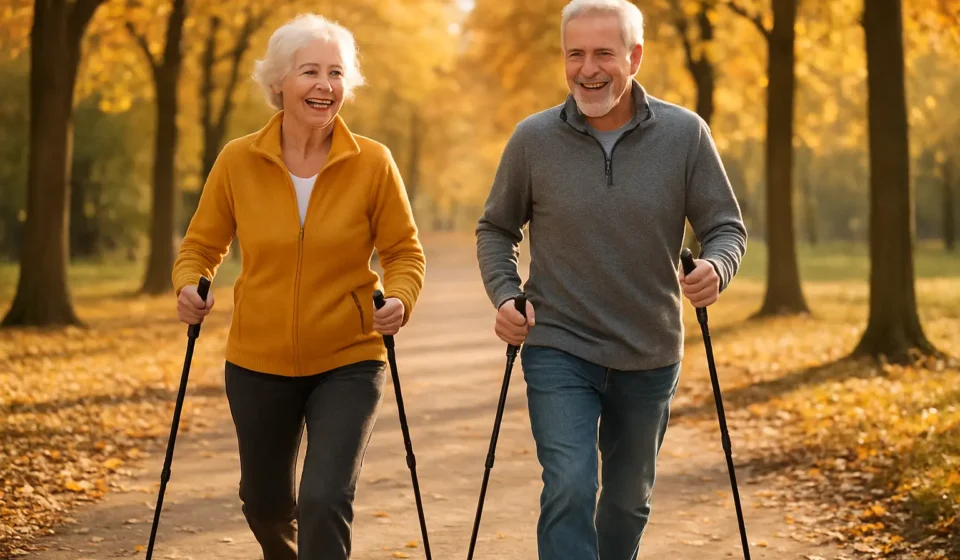

Nordic walking for seniors turns an ordinary stroll into a full-body workout — and the research behind it is more impressive than most people expect. By adding two specially designed poles and a simple push-off technique, you recruit the muscles of your arms, shoulders, chest, and core that regular walking leaves idle, while the poles give you two extra points of contact with the ground. For older adults, that combination means a higher-intensity cardiovascular session that often feels easier, plus a built-in stability aid that can reduce the fear of falling. As a senior health writer, I find few activities offer this much return for so little risk, and the evidence base has grown substantially.
Table of Contents
- What Nordic Walking Is
- What the Research Shows for Older Adults
- Key Benefits at a Glance
- How to Do It: Technique and Pole Setup
- A Safe Starting Plan
- Frequently Asked Questions
What Nordic Walking Is
Nordic walking grew out of off-season training for cross-country skiers and has become a mainstream fitness activity worldwide. You walk with two poles, planting them in rhythm with the opposite foot and pushing backward against the ground with each step. That push engages the upper body and core, so instead of using mostly your legs, you are working close to 90% of your skeletal muscles. Studies consistently show that Nordic walking burns more energy and raises heart rate more than regular walking at the same pace — by some measures up to roughly 18–25% more — yet many people report it feeling no harder, because the effort is spread across more muscle groups.
What the Research Shows for Older Adults
The clinical literature on Nordic walking in older adults is genuinely strong. A 2025 systematic review and meta-analysis of 22 studies found that Nordic walking reduced systolic blood pressure, LDL (“bad”) cholesterol, triglycerides, body-fat percentage, and waist circumference, while improving VO₂ max (a key measure of aerobic fitness) — with a notable improvement in diastolic blood pressure among people over 65. A separate randomized clinical trial found that just eight weeks of Nordic walking produced measurable gains in balance, walking speed, and overall quality of life in older participants.
The benefits extend to people managing chronic conditions. In cardiac rehabilitation, adding Nordic walking to standard rehab improved exercise capacity and dynamic balance more than conventional rehab alone. Trials in coronary artery disease, prediabetes and diabetes, Parkinson’s disease, and COPD have reported gains in fitness, body composition, and function. A 2025 analysis even linked Nordic walking to improvements in executive function — the planning and multitasking abilities that tend to decline with age. This is a remarkably consistent track record for such a low-tech activity.
Key Benefits at a Glance
| Benefit Area | What the Evidence Suggests |
|---|---|
| Cardiovascular fitness | Higher VO₂ max; lower systolic and diastolic blood pressure |
| Cholesterol & metabolism | Reduced LDL cholesterol and triglycerides; improved glucose markers |
| Body composition | Lower body-fat percentage, BMI, and waist circumference |
| Balance & mobility | Improved balance, walking speed, and locomotor ability |
| Joints | Poles offload the knees and hips; low-impact on the spine |
| Brain & mood | Better executive function and quality of life |
Crucially for older adults, the two poles widen your base of support, which improves stability and can ease the anxiety that keeps many seniors from exercising outdoors at all.
How to Do It: Technique and Pole Setup
Get the right poles and height
Use purpose-made Nordic walking poles (not trekking poles, which are held differently), fitted with removable rubber tips for pavement. As a starting guide, set pole length so that when the tip is on the ground beside your foot, your elbow bends to about 90 degrees — roughly 68% of your height. Adjustable poles let you fine-tune this.
The basic movement
Walk naturally with a slightly longer stride. Swing your arms from the shoulder so the opposite arm and leg move together — left pole with right foot, and vice versa. Plant the pole tip at an angle behind you and push back against it, opening your hand at the end of the stroke so the pole trails from the wrist strap. Keep your posture tall and your shoulders relaxed. The push-back is what activates your upper body; if your poles are just along for the ride, you are simply walking with sticks.
A Safe Starting Plan
Begin conservatively, especially if you are returning to exercise. A reasonable progression for most older beginners:
- Frequency: 3 sessions per week to start, building toward most days.
- Duration: 15–20 minutes at first, progressing to 30 minutes, on the way to the recommended 150 minutes of moderate activity per week.
- Intensity: a “talk test” pace — you can speak in short sentences but not sing.
- Form first: a single lesson from a certified Nordic walking instructor pays off quickly; many parks and senior centers offer group sessions.
- Warm up and cool down, and choose flat, even surfaces until your technique is steady.
If you have heart disease, balance problems, recent surgery, or significant joint disease, check with your doctor before starting — and remember that the poles are an asset for stability, not a license to skip that conversation.
One underrated advantage of Nordic walking for older adults is how well it sticks. Activities that feel safe, can be done outdoors with a friend, and produce visible fitness gains tend to become lasting habits rather than abandoned resolutions. The poles lower the intimidation factor for people who have grown nervous about falling, and the social, club-friendly nature of Nordic walking groups adds accountability and connection — both of which matter for mental health and longevity in later life. If you have tried and quit other exercise routines, the combination of low impact, real intensity, and built-in stability is worth a fresh look.
Frequently Asked Questions
Is Nordic walking better than regular walking for seniors?
For most people, it offers more: it engages the upper body and core, burns more calories and raises heart rate more at the same pace, and improves balance through the added points of contact. Regular walking is still excellent — Nordic walking simply adds intensity and stability.
Do I need special poles, or will trekking poles work?
Use dedicated Nordic walking poles. They have angled straps and removable rubber tips designed for the push-off technique, which trekking poles lack. Proper poles make the upper-body workout possible and reduce the chance of poor form.
Is Nordic walking safe if I have arthritis or knee pain?
It is often a good fit because the poles offload some weight from the knees and hips, making it lower-impact than unaided walking. Start gently, use rubber tips on hard surfaces, and clear it with your doctor if you have significant joint disease.
Does Medicare cover Nordic walking or the poles?
Original Medicare does not pay for exercise equipment or gym fees, but some Medicare Advantage plans include fitness benefits such as SilverSneakers that may cover classes. The poles themselves are an inexpensive one-time purchase.
Related Articles You May Find Helpful
- Senior Fitness & Exercise Guide 2026
- Walking for Seniors 2026: How Many Steps You Need
- Balance Exercises for Seniors Over 70: 8 Proven Moves
- Tai Chi for Seniors 2026: Better Balance, Fewer Falls
- Peripheral Artery Disease in Seniors 2026: PAD Warning Signs
Sources
- National Library of Medicine (PubMed) — Th