
The $6,000 Senior Tax Deduction for 2025 to 2028: Who Qualifies and How to Claim It

If you’re 65 or older, you can deduct up to $6,000 more from your taxable income for each tax year from 2025 through 2028. A married couple who both qualify can deduct up to $12,000. The deduction shrinks once your modified adjusted gross income (MAGI) passes $75,000, or $150,000 for joint filers. You can take it whether you itemize or use the standard deduction (IRS).
The IRS calls it the “enhanced deduction for seniors.” It came from the tax law signed on July 4, 2025. It is on top of the extra standard deduction older adults already get.
Who qualifies
According to the IRS, you must (IRS):
- be 65 or older by the last day of the tax year. For 2026, the draft Schedule 1-A says that means born before January 2, 1962 (IRS).
- include a valid Social Security number for each person claiming it
- file jointly if you’re married. Married people filing separately can’t claim it.
You do not need to be on Social Security or retired. Working people 65 and older qualify too.
How much you can deduct: the phase-out
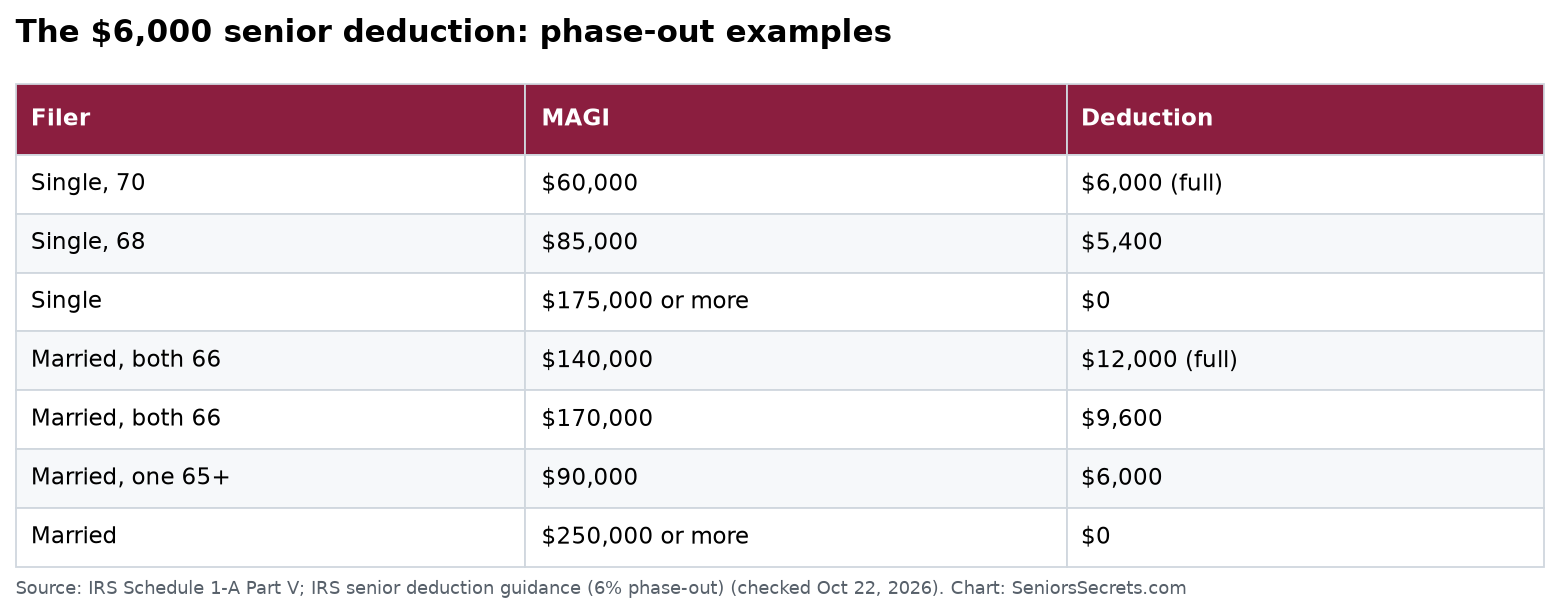
The full $6,000 per person is available if your MAGI is $75,000 or less ($150,000 or less on a joint return). Above that, the deduction drops by 6% of the amount over the limit (IRS). For most retirees, MAGI is close to adjusted gross income (line 11 of Form 1040).
Example 1: Single, age 70, MAGI of $60,000. Under $75,000, so the full $6,000.
Example 2: Single, age 68, MAGI of $85,000. That’s $10,000 over. 6% of $10,000 is $600. Deduction: $5,400.
Example 3: Married, both 66, MAGI of $170,000. That’s $20,000 over $150,000. 6% is $1,200, so each spouse gets $4,800. Deduction: $9,600.
Example 4: Married, one spouse 67 and one 63, MAGI of $90,000. Only the older spouse qualifies: $6,000.
The deduction is gone entirely at $175,000 of MAGI for a single filer and $250,000 for a couple.
How it stacks with your other deductions in 2026
For tax year 2026 (the return you file in 2027), the IRS set these amounts (IRS):
- Standard deduction: $16,100 single; $32,200 married filing jointly
- Extra standard deduction for age 65 or older: $2,050 if single; $1,650 per qualifying spouse if married (IRS Rev. Proc. 2025-32)
- Enhanced senior deduction: up to $6,000 per qualifying person
Single, 67, MAGI under $75,000: $16,100 + $2,050 + $6,000 = $24,150 that isn’t taxed.
Married, both over 65, MAGI under $150,000: $32,200 + $3,300 + $12,000 = $47,500 that isn’t taxed.
For many retirees living mostly on Social Security and a modest pension or IRA withdrawal, that means owing little or no federal income tax.
What it does not change
- How Social Security is taxed. The rules that decide how much of your Social Security is taxable did not change. The new deduction lowers your taxable income afterward. If part of your benefits is taxable, the deduction may offset that, but the formula is the same. See our guide to how Social Security is taxed.
- Your MAGI. It doesn’t lower the income used for things like Medicare’s high-income premium surcharge (IRMAA).
- State taxes. Your state may or may not follow the federal rule. Check your state tax agency.
- It’s temporary. Unless Congress extends it, the deduction ends after the 2028 tax year.
How to claim it
- Fill out Schedule 1-A, Part V, “Enhanced Deduction for Seniors.” Tax software does this when you enter your birth date.
- The amount carries to Form 1040 or 1040-SR, line 13b (IRS Publication 6142).
- Make sure each qualifying person’s Social Security number is on the return.
Free help: the IRS’s free Volunteer Income Tax Assistance (VITA) and Tax Counseling for the Elderly (TCE) programs help people 60 and older. AARP Foundation Tax-Aide is part of TCE. Search “VITA TCE locator” on IRS.gov.

Smart moves and mistakes to avoid
- Check your withholding. If you have tax withheld from Social Security, a pension or IRA withdrawals, you may now be over-withholding. You can change Social Security withholding with Form W-4V and pension withholding with Form W-4P.
- Watch the phase-out zone. Between $75,000 and $175,000 of MAGI (single), each extra $1,000 of income also cuts the deduction by $60. If you’re near the line, the timing of big IRA withdrawals or Roth conversions matters. Talk to a tax professional.
- Married filing separately loses it. If you file separately for another reason, compare both ways first.
- Don’t miss 2025. If you filed your 2025 return without it, you can file an amended return (Form 1040-X).
- Ignore scam calls. The IRS doesn’t call to “activate” a senior deduction or ask for payment to claim it.
My take: the people most likely to miss this are those who still do paper returns, or who stopped filing because their income is low. If you have a filing requirement, or had tax withheld, file and claim it.
If you’re still working past 65, our working while collecting Social Security guide covers the earnings test. For the full list of help you may be missing, see 8 government benefits seniors often miss. And our 2027 COLA guide shows how much your benefit rises next year.
Common questions
Who qualifies for the $6,000 senior deduction?
People who are 65 or older by the end of the tax year, have a valid Social Security number and file jointly if married. The full amount goes to those with MAGI up to $75,000 (single) or $150,000 (joint).
Do I have to itemize to get the senior deduction?
No. The IRS says it’s available whether you itemize or take the standard deduction.
How long does the $6,000 senior deduction last?
It applies to tax years 2025 through 2028 unless Congress changes the law.
Does the senior deduction mean no tax on Social Security?
Not exactly. The rules for how much of your Social Security is taxable didn’t change. The deduction lowers your taxable income, which may reduce or wipe out tax for many retirees.
Where do I claim the senior deduction?
On Schedule 1-A, Part V. The total carries to line 13b of Form 1040 or 1040-SR.
Written by Khasim Basha Shaik. I research Social Security, Medicare and tax rules that affect seniors and compare plans for readers. I am not a tax professional, lawyer or licensed insurance agent. This article summarizes IRS guidance and is not tax advice. Last reviewed October 22, 2026.
Related guides

2027 Social Security COLA Is 3.6%: What It Means for Your Check, SSI and Medicare

The $90 Medicare Part B Rebate: Who Gets It, When It Arrives, and What to Watch For

my Social Security Account in 2026: How to Sign In With Login.gov or ID.me, Fix Common Problems and Stay Safe