8 Government Benefits Seniors Often Miss in 2026: Limits, Amounts and How to Apply

Millions of older adults qualify for help they never claim. The biggest ones to check are Medicare Savings Programs (which can pay your $202.90 monthly Part B premium), Extra Help with drug costs, SNAP food benefits, SSI, and help with phone and energy bills. Many people assume their income is too high or their house counts against them. Often neither is true.
Below are 8 programs, the official limits and the fastest way to apply. Limits change every year, so always check the source link.
1. Medicare Savings Programs (pay your Part B premium)
These state-run programs use Medicaid money to pay Medicare costs. The QMB program pays Part B premiums, deductibles and coinsurance. SLMB and QI pay the Part B premium.
2026 federal limits (Medicare.gov):
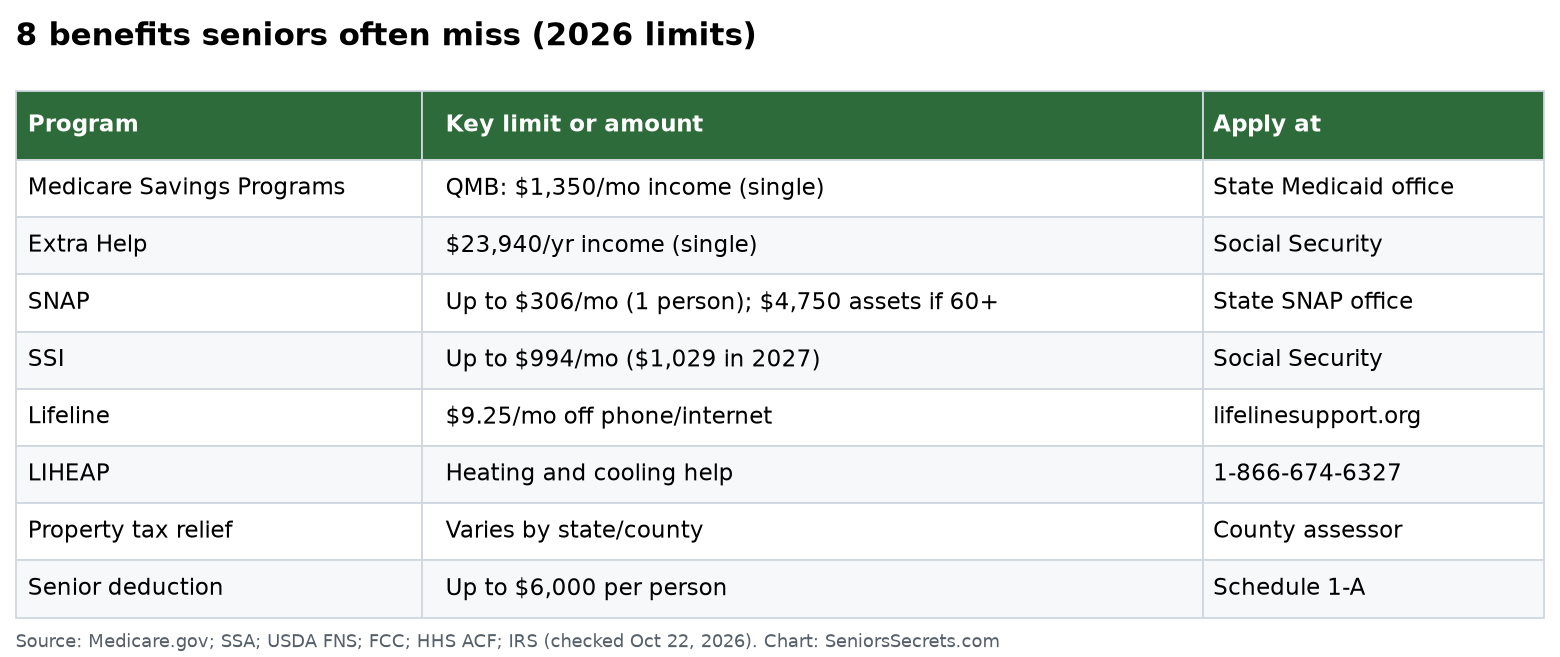
- QMB: monthly income up to $1,350 (single) or $1,824 (couple); resources up to $9,950 or $14,910
- QI: monthly income up to $1,816 (single), same resource limits
Worth: at least the $202.90 Part B premium, or $2,434.80 a year. If you qualify for any of these, you also get Extra Help automatically.
Gotcha: some states have higher limits or don’t count assets at all. Apply even if you’re a little over. See our Medicare Savings Programs guide.
2. Extra Help with Medicare drug costs
Extra Help lowers Part D premiums, deductibles and copays. 2026 limits (Medicare.gov):
- Income: up to $23,940 a year (single) or $32,460 (couple)
- Resources: up to $18,090 (single) or $36,100 (couple)
People in a Medicare Savings Program get Extra Help automatically. Apply through Social Security. See our Extra Help guide.
3. SNAP food benefits
SNAP helps buy groceries. For Oct. 1, 2026 to Sept. 30, 2027, the maximum benefit for one person is $306 a month (USDA FNS).
Rules that favor people 60 and older:
- Households can have $4,750 in countable resources if someone is 60 or older (versus $3,000 for others). Your home doesn’t count.
- You can deduct medical costs over $35 a month that insurance doesn’t pay, including Medicare premiums.
- Households with an older or disabled member get special income rules, so you may qualify even above the usual gross income limit of $1,729 a month for one person.
Mistake to avoid: many people think they’ll only get the minimum. Deducting medical and housing costs often raises the amount. See our SNAP for seniors guide.
4. Supplemental Security Income (SSI)
SSI pays up to $994 a month for one person in 2026 and $1,029 starting January 2027 (SSA). You must be 65 or older (or blind or disabled) with countable resources under $2,000 ($3,000 for a couple). Your home and one car don’t count (SSA).
Even a small SSI payment often opens the door to Medicaid. See our SSI guide.
5. Lifeline phone and internet discount
Lifeline takes up to $9.25 a month off phone or internet service. You qualify with household income at or below 135% of the federal poverty guidelines, or if you get SNAP, Medicaid, SSI, federal public housing help or a Veterans Pension (FCC).
Apply through the National Verifier at lifelinesupport.org, or call 1-800-234-9473. Only one Lifeline benefit per household, and you must recertify every year.
6. LIHEAP energy help
The Low Income Home Energy Assistance Program helps with heating and cooling bills, shutoff notices and some repairs (HHS ACF). Each state sets its own rules and opens applications at different times, often in the fall.
Call the National Energy Assistance Referral line at 1-866-674-6327 or visit EnergyHelp.us to find your local office. Apply early. Funds can run out. A related program, the Weatherization Assistance Program, pays for insulation and repairs.

7. Property tax relief
Most states and many counties offer property tax breaks for older homeowners: exemptions, freezes, credits or deferrals. These are local programs, so check with your county assessor. Many require you to apply, and some require you to reapply each year.
8. The new $6,000 senior tax deduction
For tax years 2025 through 2028, people 65 and older can claim an extra deduction of up to $6,000 each ($12,000 for a married couple who both qualify). It phases out above $75,000 of modified adjusted gross income ($150,000 for joint filers), and you can claim it whether or not you itemize (IRS).
Gotcha: it’s easy to miss if you do your own taxes on paper. It goes on Schedule 1-A. See our senior tax deduction guide.
The fastest way to check them all
- BenefitsCheckUp.org, a free screening tool from the nonprofit National Council on Aging, checks you for many programs at once (BenefitsCheckUp).
- Eldercare Locator: 1-800-677-1116 connects you with your local Area Agency on Aging, which can help you fill out forms (Eldercare Locator).
- Your State Health Insurance Assistance Program (SHIP) gives free one-on-one help with Medicare Savings Programs and Extra Help.
My take: start with the Medicare Savings Program application at your state Medicaid office. It’s the one with the biggest dollar value for most people, and approval often brings Extra Help with it.
Mistakes that cost people benefits
- Assuming your home counts. For SSI, SNAP and most Medicare help, your home doesn’t count as an asset.
- Not applying because you’re “a little over.” States can use higher limits and ignore some income.
- Missing renewals. Most programs require yearly paperwork. Open your mail.
- Falling for “benefit finder” scams. Real programs never charge a fee to apply. Never give your Medicare or Social Security number to an unsolicited caller.
Common questions
What benefits are seniors entitled to that they don’t know about?
Medicare Savings Programs, Extra Help with drug costs, SNAP, SSI, Lifeline, LIHEAP energy help, local property tax relief and the new $6,000 senior tax deduction are the most commonly missed.
What is the income limit for a Medicare Savings Program in 2026?
For QMB, the federal limit is $1,350 a month for one person and $1,824 for a couple, with resources up to $9,950 and $14,910. Some states allow more.
Does my house count against benefits for seniors?
Usually no. Your home doesn’t count for SSI, SNAP, Extra Help or Medicare Savings Programs.
How much SNAP can a senior get?
Up to $306 a month for one person from October 2026 through September 2027. Your amount depends on income and allowed deductions like medical and housing costs.
Where can I check all the benefits I qualify for?
BenefitsCheckUp.org from the National Council on Aging screens you for many programs at once. Your local Area Agency on Aging can also help.
Written by Khasim Basha Shaik. I research Medicare and senior benefit programs and compare plans for readers. I am not a lawyer, tax professional or licensed insurance agent. This article summarizes Medicare.gov, SSA, USDA, FCC, HHS and IRS information and is not legal or tax advice. Last reviewed October 22, 2026.
Related guides

2027 Social Security COLA Is 3.6%: What It Means for Your Check, SSI and Medicare

The $90 Medicare Part B Rebate: Who Gets It, When It Arrives, and What to Watch For

my Social Security Account in 2026: How to Sign In With Login.gov or ID.me, Fix Common Problems and Stay Safe