Ashwagandha for Seniors 2026: Sleep and Stress Benefits, Dose and Who Should Avoid It
Ashwagandha may help with stress and sleep, but older adults need to be careful with it. The NIH Office of Dietary Supplements says studies show it can lower stress and improve sleep, with the clearest sleep benefit at about 600 mg a day for at least 8 weeks (NIH ODS). It seems well tolerated for up to about 3 months, but long-term safety is unknown. There are rare reports of liver injury, it can change thyroid levels, and it may interact with diabetes, blood pressure, sleep and immune medicines.
Ashwagandha is sold as a natural way to calm down, sleep better and feel stronger. Some of that has support. Some does not. And “natural” does not mean harmless, especially if you take several medicines. This guide gives you the balanced picture.
What ashwagandha is
Ashwagandha (Withania somnifera) is a plant used for centuries in India’s Ayurvedic medicine. Most supplements use an extract from the root. Some mix root and leaf. It is called an adaptogen, which means it is thought to help the body handle stress.
Its Latin name, somnifera, comes from the word for sleep. That hints at what it is best known for.
What the evidence supports
| Claim | Strength of evidence | What studies show |
|---|---|---|
| Stress and anxiety | Fair | Lower stress scores and lower cortisol in several short trials |
| Sleep | Fair | Small improvement; best at about 600 mg a day for 8+ weeks, mostly in people with insomnia |
| Memory and thinking | Early | Small studies hint at gains; not proven |
| Muscle strength | Early | Some gains when paired with exercise, mostly in younger men |
| Long-term safety | Unknown | Most trials last 3 months or less |
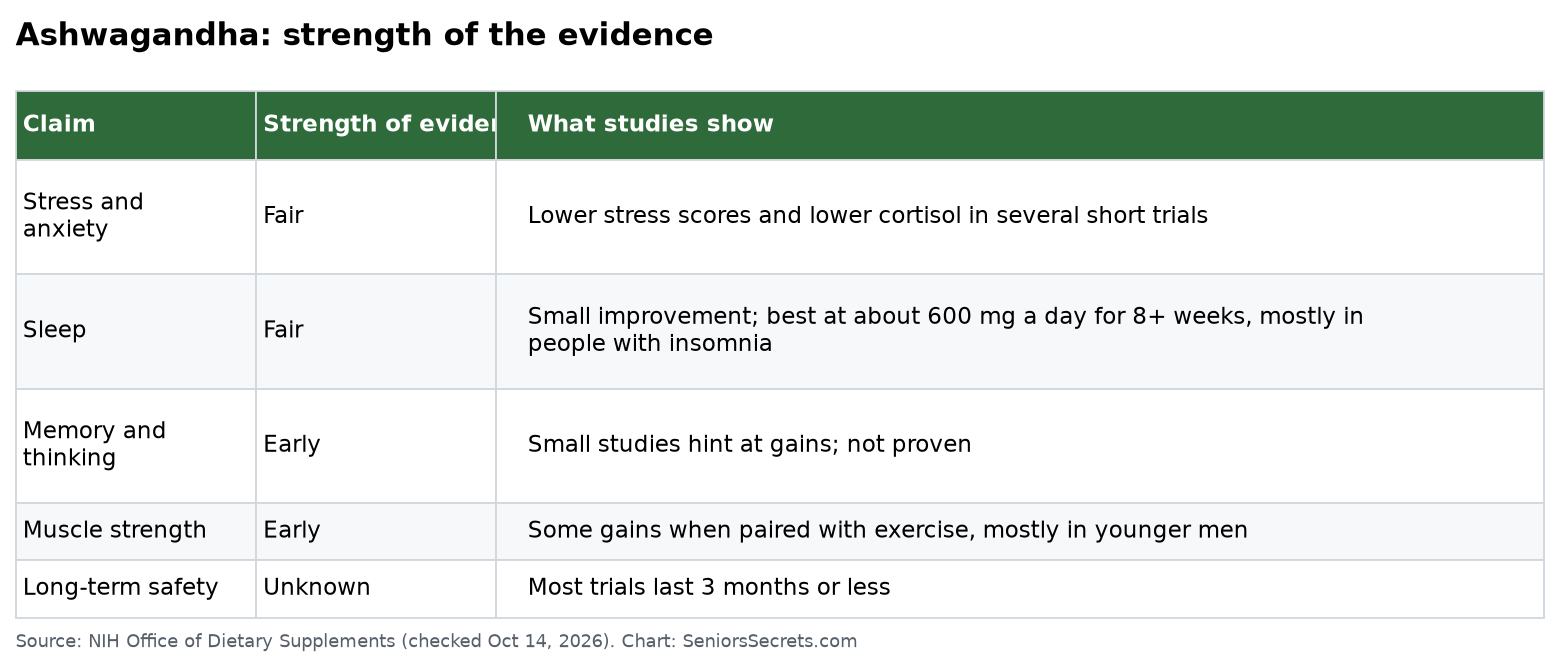
Studies used a wide range of doses, from 240 to 1,250 mg a day of extract. Few studies focused on people over 65. So results in older adults are less certain.
Bottom line: ashwagandha is most believable as a mild aid for stress and sleep. It is not a treatment for anxiety disorders, depression or dementia.
Safety concerns for older adults
Liver
NIH notes a few reports of liver injury linked to ashwagandha. Signs include yellow skin or eyes, itching, dark urine, nausea and belly pain. Most people got better after stopping. Some products in those cases contained other ingredients too. Stop and call your doctor if you notice these signs.
Thyroid
Ashwagandha can raise thyroid hormone levels. In one small trial, it lowered TSH and raised T3 and T4. There are case reports of an overactive thyroid, including in a woman in her 70s. If you take levothyroxine or have a thyroid condition, ask your doctor first and get your levels checked.
Medicine interactions
NIH says ashwagandha might interact with:
- Diabetes medicines, possibly lowering blood sugar too much
- Blood pressure medicines, possibly lowering pressure too much
- Sleep and anxiety medicines (like benzodiazepines), adding drowsiness
- Immune-suppressing medicines, such as those after a transplant
- Thyroid hormone medicines
Many older adults take at least one of these. That is why a pharmacist check matters.

Who should avoid it
- People with liver disease or a past liver problem
- People with thyroid disease or on thyroid medicine, unless their doctor agrees
- Men with hormone-sensitive prostate cancer (some experts advise against it)
- People with autoimmune diseases like rheumatoid arthritis or lupus, unless their doctor agrees
- Anyone having surgery soon. Stop at least 2 weeks before, since it may add to anesthesia drowsiness
- People who take several sedating medicines or have had falls
Side effects
Common side effects are usually mild:
- Upset stomach
- Loose stools
- Nausea
- Drowsiness
For older adults, drowsiness deserves extra care. Feeling sleepy or unsteady at night can lead to falls. Take your first doses at bedtime and see how you feel.
Dose, timing and quality
| Item | What studies used |
|---|---|
| Form | Root extract |
| Common dose | 300 mg twice a day, or 600 mg once |
| Time to work | 6 to 8 weeks |
| Length of use | Up to about 3 months studied |
Tips for buying:
- Look for USP, NSF or ConsumerLab seals. Supplements are not approved by the FDA before sale.
- Avoid blends with many herbs. It is harder to know what caused a side effect.
- Start low, like 300 mg at bedtime, and see how you feel.
- Take a break after 3 months and check with your doctor.
Better first steps for sleep and stress
Before a supplement, try what has stronger evidence:
- Keep a steady sleep schedule, even on weekends.
- Get morning daylight and move during the day.
- Limit caffeine after noon and alcohol in the evening.
- Try CBT for insomnia (CBT-I). It is the first-choice treatment for long-term insomnia in adults.
- Review your medicines. Some cause poor sleep.
Medicare Part B covers mental health visits, including counseling, with the $283 ($292 in 2027) deductible and usually 20% in 2026. Medicare does not pay for supplements.
What to tell your doctor
Bring the bottle to your visit and share:
- The brand, dose and part of the plant (root or leaf) on the label
- When you started and how often you take it
- All your other medicines and supplements
- Any new symptoms, like sleepiness, upset stomach or a racing heart
How to try it safely
- Show the bottle to your doctor or pharmacist.
- Get liver and thyroid blood tests if your doctor advises.
- Start at 300 mg a day.
- Keep a simple sleep and mood log for 8 weeks.
- Stop right away if you have yellowing skin, a racing heart or new dizziness.
Common questions
Is ashwagandha safe for seniors?
It seems well tolerated for up to about 3 months in studies, but older adults with liver or thyroid problems, or who take certain medicines, should ask a doctor first.
How much ashwagandha should a senior take?
Studies often used 600 mg a day of root extract. Starting at 300 mg is a cautious choice.
Does ashwagandha help with sleep?
Studies show a small improvement, mostly at 600 mg a day for 8 weeks or more, and in people with insomnia.
Can ashwagandha affect the thyroid?
Yes. It can raise thyroid hormone levels. People with thyroid disease should talk to their doctor first.
Does ashwagandha interact with blood pressure medicine?
It might. NIH lists blood pressure and diabetes medicines among possible interactions.
Can ashwagandha damage the liver?
Rarely. NIH reports a few cases of liver injury. Stop and see a doctor if you notice yellow skin or eyes.
2027 amounts added Nov 18, 2026 from the CMS 2027 Parts A and B fact sheet.
Written by Khasim Basha Shaik. I research senior health for readers and summarize official sources and published studies. I’m not a doctor, pharmacist or licensed health professional. Talk with your doctor before starting any supplement. Last reviewed October 14, 2026.