
The brain exercise with the best long-term evidence is speed-of-processing training, done with booster sessions. In the ACTIVE study, older adults who did this training and at least one booster had about a 25% lower risk of being diagnosed with dementia over 20 years (Alzheimer’s & Dementia, PubMed 41669119). Memory and reasoning training did not lower that risk.
But puzzles and apps are only one piece. Physical activity, blood pressure control, hearing and social life matter just as much. This guide covers what works and gives you a simple weekly plan.
What the ACTIVE study found
ACTIVE (Advanced Cognitive Training for Independent and Vital Elderly) is one of the largest brain training trials ever run. It started in the late 1990s. Older adults were randomly placed into one of four groups:
- Speed training: computer tasks that ask you to spot and react to things on a screen faster and faster, often while paying attention to two things at once.
- Memory training: strategies for remembering lists and stories.
- Reasoning training: finding patterns and solving problems.
- No training (the comparison group).
Each group got about 10 sessions over 5 to 6 weeks. Some people also got booster sessions later.
In 2026, researchers linked the results to Medicare claims for 2,021 people in traditional Medicare, covering 1999 to 2019 (PubMed 41669119):
- Speed training plus at least one booster: about 25% lower risk of a dementia diagnosis.
- Speed training with no booster: no lower risk.
- Memory or reasoning training: no effect on dementia diagnosis.
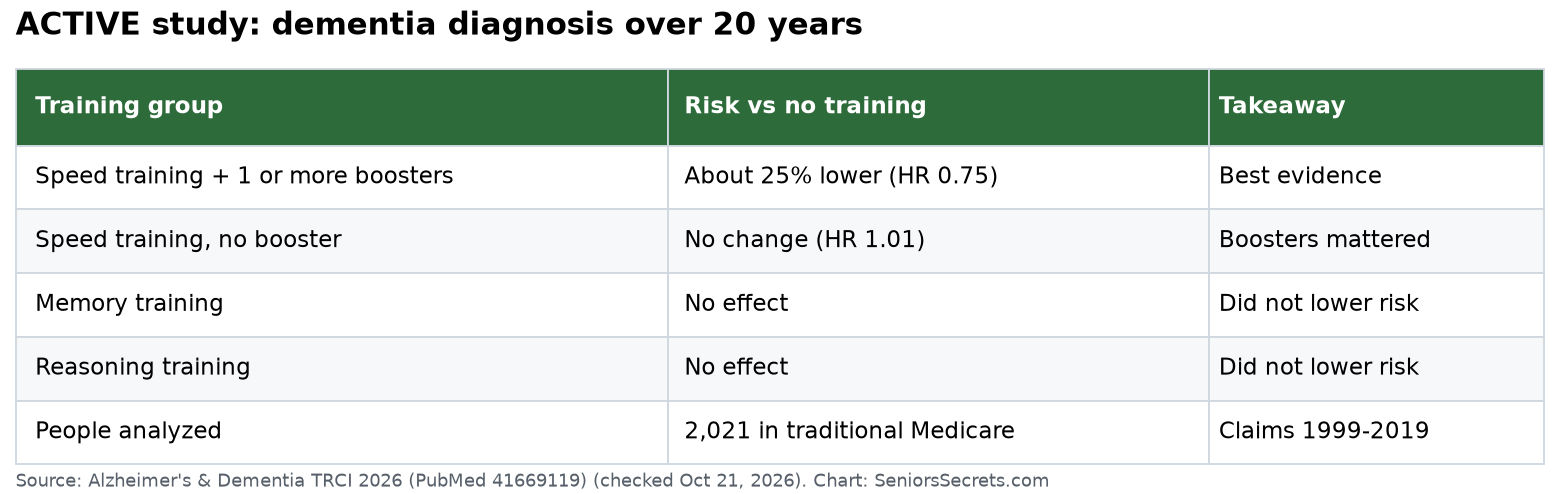
Two honest caveats. First, this is diagnosed dementia in Medicare claims, not a full brain exam. Second, the effect only showed up with booster sessions. That suggests you need to keep training, not do it once.
Do brain-training apps work?
Many apps claim to be based on research like ACTIVE. The National Institute on Aging says there is not enough evidence that commercial computer-based brain-training apps have the same effect as the ACTIVE training (NIA).
My take: if you enjoy a speed-of-processing game, play it a few times a week. It may help, and it won’t hurt. Don’t pay for a pricey subscription expecting it to prevent dementia. And don’t let screen time replace moving and seeing people.
Activities that challenge your brain
Learning something new and hard seems to matter more than repeating what you already know. NIA points to a study where older adults who learned quilting or digital photography had more memory improvement than those who only socialized or did easier tasks (NIA).
Good options:
- Learn a skill: a musical instrument, a language, painting, woodworking or photography.
- Take a class: community colleges and senior centers often offer free or low-cost classes for older adults.
- Play strategy games with others: bridge, chess or mahjong. You get a mental workout plus social time.
- Crosswords and sudoku: fine for fun. Once they get easy, switch to something harder.

Physical exercise: brain exercise in disguise
Moving your body helps your brain. NIA lists physical activity as one of the main steps for cognitive health. The CDC goal for adults 65 and older is 150 minutes a week of moderate activity, like brisk walking, plus muscle strength and balance work.
Ways to fit it in:
- A 30-minute walk 5 days a week. Nordic walking adds an upper-body workout.
- Dancing, which mixes movement, memory and social time.
- Strength work twice a week, such as resistance band exercises.
Protect your brain through your health
Some of the strongest brain protection comes from treating health problems.
- Blood pressure. In the SPRINT MIND study, people 50 and older who lowered their top number to under 120 had a lower risk of mild cognitive impairment over 5 years (NIA). Ask your doctor what target is right for you.
- Hearing. Hearing loss is one of 14 changeable dementia risk factors named by a 2024 expert report. See our dementia prevention guide.
- Sleep. Untreated sleep apnea harms memory and focus. Our sleep apnea guide lists the signs.
- Medicines. Some drugs fog thinking, such as certain sleep aids, bladder pills and allergy pills. Ask for a review.
- Mood. Depression affects memory. It is treatable.
Stay social
Regular contact with others keeps your brain busy. You have to listen, remember names, follow conversation and respond. Join a club, volunteer, sing in a choir or set up weekly calls. Combining social time with something new (like a group class) gets two benefits at once.
A simple weekly brain plan
| Day | Activity |
|---|---|
| Monday | 30-minute walk + 15 minutes of a new skill |
| Tuesday | Strength exercises + call a friend |
| Wednesday | Group class or club (cards, choir, language) |
| Thursday | 30-minute walk + speed or strategy game (15 min) |
| Friday | Strength exercises + practice your new skill |
| Weekend | Dancing, gardening or an outing with family |
| Every day | Sleep 7 to 8 hours; take medicines as prescribed |
Start small. Pick one new habit this week and add another next month.
When memory slips are worth a doctor visit
Everyone forgets names or where they put their keys. See a doctor if you notice:
- Getting lost in familiar places
- Repeating the same questions
- Trouble managing bills or medicines
- Changes in mood or personality that others notice
Many causes are treatable, such as low B12, thyroid problems, depression, sleep problems and medicine side effects.
What Medicare covers
- Annual Wellness Visit: includes a check for signs of memory problems. You pay $0 if your provider accepts assignment. Our wellness visit guide explains what to expect.
- Cognitive assessment and care plan visit: a longer visit if you or your family notice changes. You pay 20% after the $283 Part B deductible (Medicare.gov).
- Brain-training apps and classes are not covered by Original Medicare. Some Medicare Advantage plans include fitness programs with brain games or classes.
If a diagnosis is made, our guide to new Alzheimer’s treatments explains current options.
Common questions
What is the best brain exercise for seniors?
Speed-of-processing training with booster sessions has the best long-term evidence. Learning a new, challenging skill and regular physical exercise also help.
Do crossword puzzles prevent dementia?
There is no proof they do. They are fine for fun, but new and harder skills seem to give the brain more of a workout.
Are brain-training apps worth it?
NIA says there isn’t enough evidence that commercial apps match the training used in the ACTIVE study. Don’t count on them to prevent dementia.
How long do I need to do brain training?
In ACTIVE, the benefit only showed up in people who had booster sessions. Keep training over time rather than doing it once.
Does exercise help memory in older adults?
Yes. Physical activity is one of the main steps NIA lists for brain health. Aim for 150 minutes a week of moderate activity.
Written by Khasim Basha Shaik. I research and compare Medicare plans and health topics for readers. I am not a doctor or licensed insurance agent. This article summarizes the National Institute on Aging, Medicare.gov and the ACTIVE study and is not medical advice. Last reviewed October 21, 2026.
Related guides