
Social Security’s New Names for Ages 62, 67 and 70: What the Claiming Age Clarity Act Changes
A new law, the Claiming Age Clarity Act, tells Social Security to rename its three key claiming ages. Age 62 becomes the “minimum monthly benefit age.” Full retirement age becomes the “standard monthly benefit age.” Age 70 becomes the “maximum monthly benefit age.” The law became Public Law 119-144 on Nov 20, 2026. It changes words only. Your benefit, your full retirement age and the rules for waiting stay the same (Congress.gov, H.R. 5284).

I read the full text of the law and checked each number below against Social Security’s own pages. Here is what the new names mean, why Congress made the change, and how to use them to pick your age.
What the law says, in plain words
The law is short. It tells the Social Security Administration (SSA) to change the words it uses in its rules, letters, guides and website:
- “Early eligibility age” becomes “minimum monthly benefit age.” This is 62, the first age you can claim.
- “Full retirement age” and “normal retirement age” become “standard monthly benefit age.” This is 66 to 67, based on your birth year.
- SSA must stop using the term “delayed retirement credit.” When it talks about age 70 as the age where those raises stop, it must say “maximum monthly benefit age.”
SSA has until the later of Jan 1, 2027 or 12 months after the law was signed. That means Nov 20, 2027. So during 2027 you may see old and new names mixed on SSA letters and web pages.
The bill passed the House by voice vote in December 2025 and the Senate by unanimous consent in September 2026. It had backing from both parties. AARP, Bipartisan Policy Center Action and AMAC Action supported it, according to the sponsor’s Nov 21 release.

Why Congress changed the names
Many people hear “full retirement age” and think it is the age they “should” retire. Some think claiming at 62 is “early” in a way that will be fixed later. It is not. The cut for claiming at 62 lasts for life.
The new names point at the one thing that changes with your age: the size of your monthly check. Minimum, standard and maximum say that plainly. They do not tell you which age is best for you. That still depends on your health, your savings, your job and your spouse.
What does not change
This is the part that matters most for your money. Nothing in the law changes how SSA figures your benefit.
- Your full retirement age. It is 67 if you were born in 1960 or later. It is 66 and 10 months if you were born in 1959 (SSA).
- The cut for claiming early. If your full age is 67 and you claim at 62, you get about 70% of your full amount for life.
- The raise for waiting. Each year you wait past full retirement age adds 8%, up to age 70. Waiting until 70 gets you 124% of your full amount (SSA delayed retirement credits).
- Medicare at 65. Medicare still starts at 65. Social Security’s new names do not move it.
2027 is also a milestone year. People born in 1960 turn 67 in 2027. They are the first group whose full retirement age is a full 67.
What each age pays, using 2027 numbers
Social Security uses a simple example: a person whose benefit at full retirement age would be $1,000 a month. Here is what that person gets at each age, if their full age is 67.

For people with top earnings, SSA lists the highest possible 2027 checks (SSA maximum benefit examples):
- At 62 (minimum monthly benefit age): $3,094 a month.
- At 67 (standard monthly benefit age): $4,188 a month.
- At 70 (maximum monthly benefit age): $5,358 a month.
Most people get far less. The average retired worker will get about $2,170 a month after the 3.6% raise in January 2027 (SSA 2027 COLA fact sheet).
The catches the new names do not tell you
“Maximum” means the biggest monthly check, not the most money overall. If you claim at 70, you get more each month but for fewer years. Using the $1,000 example and ignoring raises and taxes:
- Claim at 62 instead of 67: you collect $42,000 before 67. The person who waited catches up at about age 78 and 8 months.
- Claim at 70 instead of 67: you give up $36,000 while you wait. You catch up at about age 82 and 6 months.
If you expect to live past those ages, waiting usually pays. If your health is poor or you need the money now, claiming sooner can make sense. This is simple math to show the idea, not a plan for you.
Waiting past 70 adds nothing. The raises stop at 70. If you are 70 and have not applied, apply now. SSA can pay up to six months back, but not for months before full retirement age (SSA).
Your spouse’s check stops growing at full retirement age. A spouse benefit can be at most half of your full-age amount. Waiting past full age raises your own check, but not your spouse’s benefit on your record. A spouse who claims at 62 gets as little as 32.5% of your full amount if their full age is 67 (SSA). See our guide to Social Security spousal benefits.
Your survivor can gain when you wait. If you die first, your widow or widower’s check is based on the amount you were getting, raises for waiting included. For a married higher earner, waiting can protect the spouse who lives longer. Survivors also have their own full age, between 66 and 67 (SSA survivor benefits). Our guide to survivor benefits covers the details.
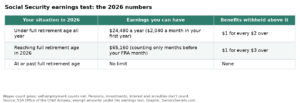
Working before your standard age can hold back checks. In 2027, if you are under full retirement age all year, SSA holds back $1 for every $2 you earn above $25,560. In the year you reach full age, it holds back $1 for every $3 above $67,920, counting only months before your birthday month (SSA 2027 COLA fact sheet). Read more in working after retirement and Social Security.
Do not wait on Medicare. If you put off Social Security past 65, you still need to sign up for Medicare on time. Your first chance runs for 7 months around your 65th birthday (Medicare.gov). Miss it without other job-based coverage and you can pay a Part B late penalty for life, on top of the 2027 base premium of $209.40 a month.
My take: I like the new names. “Minimum” and “maximum” make the trade-off plain in a way “early” and “delayed” never did. But do not let the word “standard” make you think 67 is the normal or right choice. For a married higher earner in good health, waiting toward 70 is often worth a hard look. For a single person with health problems and little savings, 62 or 63 can be the honest choice.
Watch out for scams using the new law
Any news about Social Security brings scam calls and texts. SSA will not call you to “move you to the new benefit age” or ask you to pay a fee or “verify” your Social Security number because of this law. Nothing you have to do changes. If you get a call like that, hang up and call SSA at 1-800-772-1213 yourself.
What to do now
- Look up your full retirement age by birth year. If you were born in 1960 or later, it is 67.
- Sign in to your my Social Security account and check your estimates at 62, full age and 70.
- If you are married, compare both of your records before either of you claims.
- Sign up for Medicare on time at 65, even if you wait on Social Security.
- Expect the new names on SSA letters and web pages by Nov 20, 2027. The dollar amounts will not change because of the new names.
For a deeper look at age 67, see our guide to full retirement age 67.
Common questions
What is the Claiming Age Clarity Act?
It is a law signed on Nov 20, 2026 (Public Law 119-144). It tells Social Security to rename age 62, full retirement age and age 70 as the minimum, standard and maximum monthly benefit ages.
Does the Claiming Age Clarity Act change my Social Security benefit?
No. It changes only the words Social Security uses. Your full retirement age, the cut for claiming early and the raise for waiting stay the same.
What is the standard monthly benefit age?
It is the new name for full retirement age. It is 67 for people born in 1960 or later, and 66 and 10 months for people born in 1959.
When will Social Security start using the new names?
Social Security must switch by Nov 20, 2027. You may see old and new names mixed on letters and web pages during 2027.
Is age 70 still the latest age to get a bigger check?
Yes. Your check grows 8% for each year you wait past full retirement age, until 70. Waiting past 70 adds nothing.
Does the maximum monthly benefit age mean I get the most money overall?
Not always. Claiming at 70 gives the biggest monthly check, but you get it for fewer years. Whether it pays off depends on how long you live.
Khasim Basha Shaik researches Social Security and Medicare rules for readers of SeniorsSecrets.com. He is not a licensed financial planner, attorney or insurance agent. This article is general information, not personal advice. Facts checked against the text of H.R. 5284 on Congress.gov, Social Security’s retirement planner pages, the SSA 2027 COLA fact sheet and Medicare.gov on Nov 27, 2026. For your own numbers, use your my Social Security account or call SSA at 1-800-772-1213.
Related guides

Social Security Survivor Benefits 2026: What Widows and Widowers Get, and the 2027 Raise

How Much Can You Earn on Social Security? 2026 and 2027 Earnings Limits, Worked Examples and What Happens at Full Retirement Age