

Plan G is the Medigap letter most new enrollees look at after Plan F closed to people new to Medicare. The benefits are set by federal rules. The premium is not. Two Plan G policies in the same ZIP can cost very different amounts for the same coverage.
This guide is about rates and rating methods: how insurers price Plan G, how to compare quotes without inventing a national average, and how Open Enrollment for Advantage/Part D differs from Medigap Open Enrollment. For the G-versus-N decision, see Plan G vs Plan N for 2027.
I’m a researcher, not a licensed insurance agent or financial advisor. I cannot quote your premium or underwrite you. Confirm numbers with Medicare.gov, the insurer, or your free SHIP counselor.

What Plan G covers (same for every company)
According to Medicare.gov’s Compare Medigap Plan Benefits chart, Plan G covers:
- Part A coinsurance and hospital costs up to an additional 365 days after Medicare benefits are used
- Part B coinsurance or copayment
- First three pints of blood
- Part A hospice coinsurance or copayment
- Skilled nursing facility care coinsurance
- Part A deductible
- Part B excess charges
- Foreign travel emergency at 80%, up to plan limits
Plan G does not cover the Part B deductible. For 2026 that deductible is $283. As of October 4, 2026, CMS has not announced the 2027 Part B premium or deductible. The last published standard Part B premium is $202.90 a month for 2026 (CMS fact sheet). When 2027 figures post, your once-a-year Part B deductible under Plan G will move with that announcement.
Plans F and G also offer a high-deductible option in some states. Medicare.gov’s footnote: you must pay up to $2,950 in 2026 for Medicare-covered costs (coinsurance, copayments, and deductibles) before the high-deductible policy pays anything. CMS updates that high-deductible amount yearly (CMS F, G & J deductible announcements).
Why I will not publish a “national average” Plan G premium
Medicare is clear on this: Medigap premiums vary widely by company, plan, and where you live. On Get Medigap Costs, Medicare says the benefits in each lettered plan are the same no matter which company sells it; the price is the only difference between policies with the same letter.
That is why this post does not invent “$130–$175 at age 65” national averages. Those figures look precise and are usually wrong for your ZIP. What you need is:
- Quotes for Plan G vs Plan G (same letter) in your ZIP
- The insurer’s rating method
- Any discounts and the company’s rate-increase history
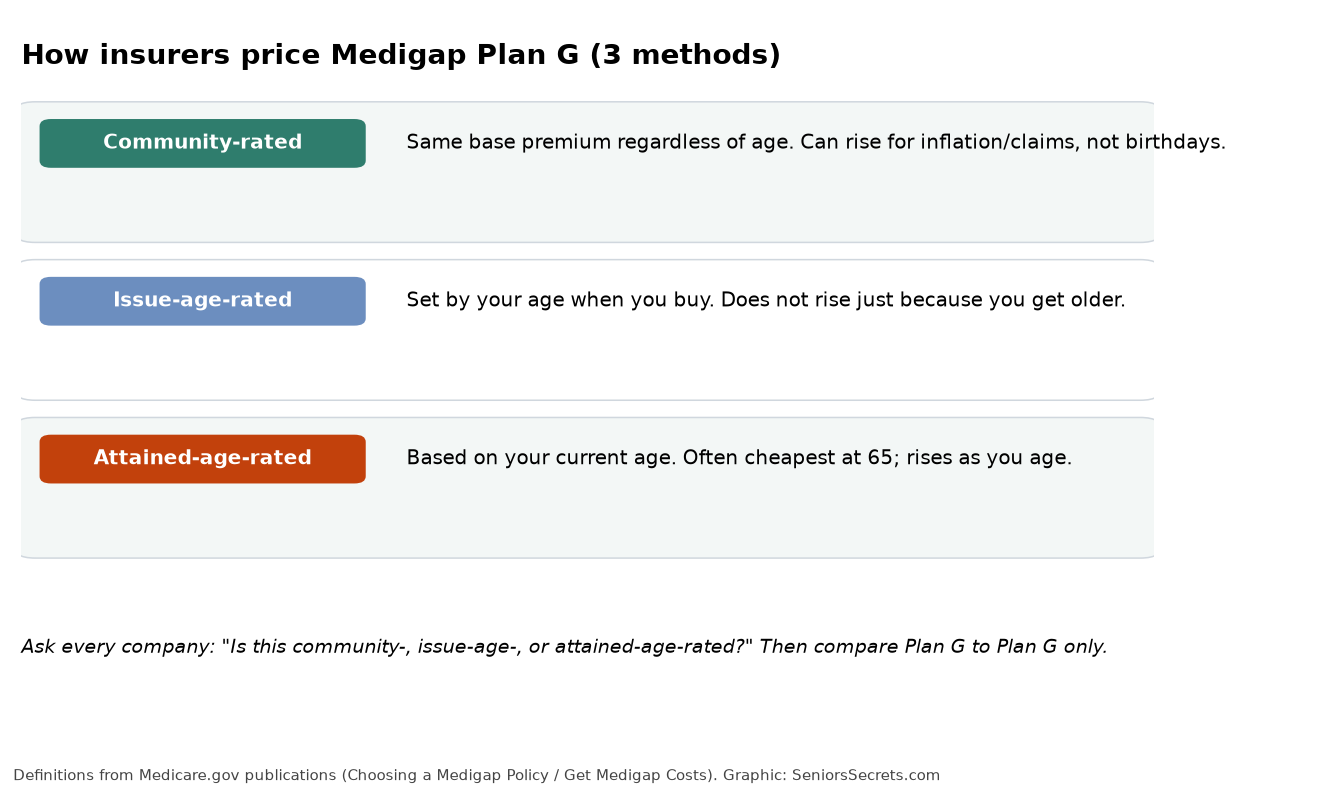
The three ways insurers set Plan G premiums
Medicare’s Medigap guides describe three pricing methods. Ask every company which one applies before you compare dollars.
1. Community-rated (also called no-age-rated)
Generally the same base premium is charged to everyone who has that policy, regardless of age. Premiums can still rise for inflation and claims experience, but not because you had a birthday.
2. Issue-age-rated (also called entry-age-rated)
The premium is based on your age when you buy the policy. It does not increase just because you get older. General rate increases can still apply.
3. Attained-age-rated
The premium is based on your current age, so it goes up as you get older, on top of other rate changes. These quotes often look cheapest at 65 and less attractive in your 70s and 80s.
Medicare’s Choosing a Medigap Policy guide tells you to ask: “Do you price this Medigap policy using community-rating, issue-age-rating, or attained-age-rating?” If it is attained-age, also ask how often the premium increases due to age.
Some states require community rating for Medigap. Rules change, so verify with your state insurance department or SHIP rather than relying on an old blog list. Massachusetts, Minnesota, and Wisconsin also standardize Medigap differently than the letter plans used in most states; check Medicare.gov’s state pages if you live there.
High Deductible Plan G: lower premium, higher upfront risk
High Deductible Plan G (sometimes called HDG) uses the same benefit package as standard Plan G after you meet the high deductible. In 2026 that deductible is $2,950 before the policy pays for Medicare-covered costs. Monthly premiums are usually much lower than standard Plan G from the same company.
Rough decision frame (not a quote):
- If you expect little care and can absorb a large deductible, HDG’s lower premium can win on total yearly cost.
- If you have frequent specialists, planned procedures, or a tight cash reserve, standard Plan G often wins even with the higher premium.
Always compare standard Plan G quotes to HDG quotes separately. Do not mix them in one “cheapest Plan G” sort.
Open Enrollment for Advantage is not Medigap Open Enrollment
People mix these up every fall.
| Window | Dates (for 2027 coverage) | What it is for |
|---|---|---|
| Annual Enrollment Period (AEP) | Oct 15 – Dec 7, 2026 | Join, switch, or drop Medicare Advantage or Part D; move between Advantage and Original Medicare |
| Medigap Open Enrollment | 6 months starting the first month you are 65+ and enrolled in Part B | Best federal window to buy Medigap with guaranteed-issue protections |
AEP lets you land on Original Medicare. It does not automatically give you a free pass to buy Plan G without underwriting. Outside Medigap Open Enrollment, insurers in most states can use medical underwriting unless you have a separate guaranteed-issue right. A few states add year-round or birthday-rule protections. Confirm yours with SHIP before you drop Advantage. Our notes on switching from Medicare Advantage to Original Medicare and Open Enrollment for 2027 cover that trap.
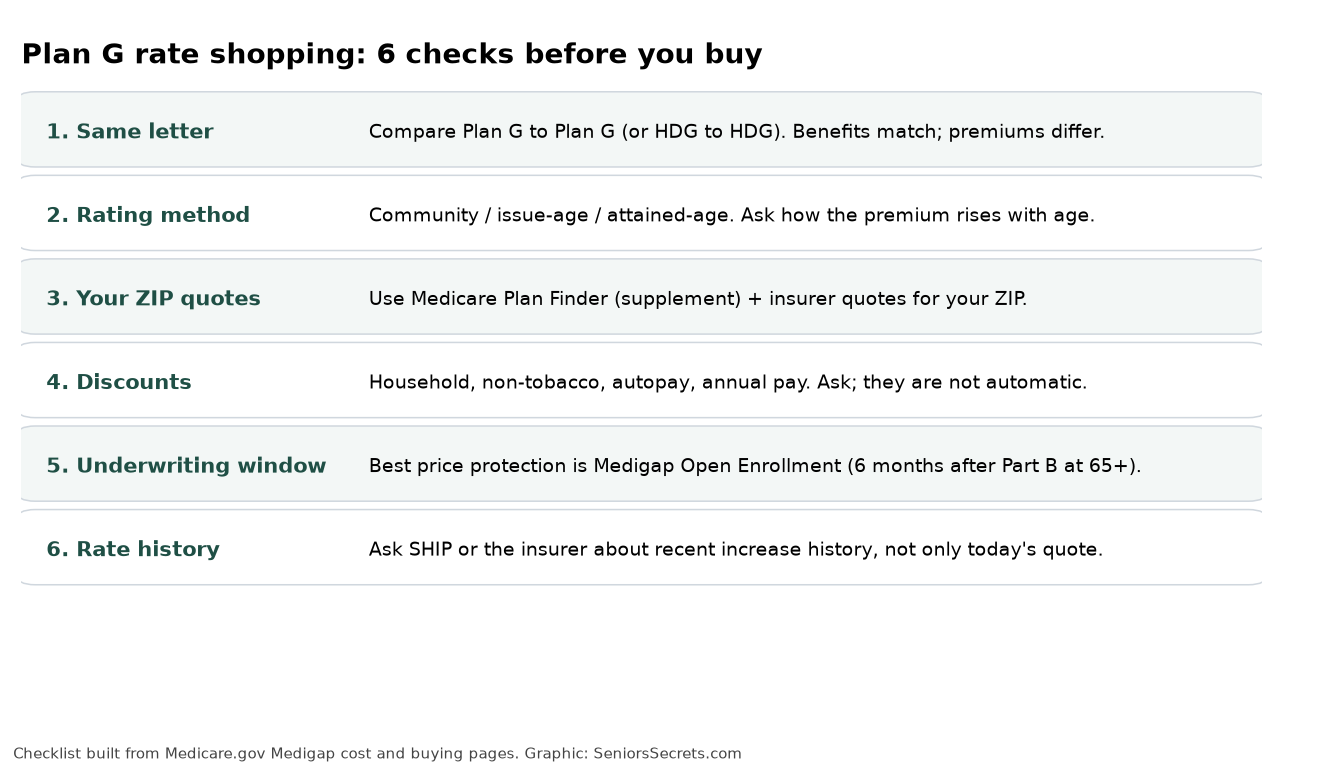
How to compare Plan G rates by ZIP (practical steps)
- Decide the letter first. If you are still choosing between G and N, finish that decision with the G vs N guide. Then shop one letter across companies.
- Use Medicare Plan Finder. At Medicare.gov/plan-compare, enter your ZIP and choose the supplement (Medigap) path. You will see estimated costs; Medicare says to contact the company for a more accurate price.
- Call at least three insurers licensed in your state for official quotes for your age, tobacco status, and ZIP.
- Ask the rating-method question for every quote, plus household, non-tobacco, autopay, and annual-pay discounts (Medicare.gov Medigap costs).
- Ask SHIP whether your state publishes a Medigap rate comparison guide, and whether you have guaranteed-issue rights now.
- Look past today’s premium. A slightly higher issue-age or community-rated quote can beat a rock-bottom attained-age quote five years later.
You still pay your Part B premium to Medicare (or via Social Security withholding). Medigap is a separate premium to the private insurer. Medicare does not pay Medigap premiums.
Plan G vs Plan N, in one paragraph
Both leave the Part B deductible to you. Plan G covers Part B excess charges; Plan N does not. Plan N can charge up to $20 for some office visits and up to $50 for ER visits when you are not admitted. Premiums for Plan N are often lower, which is why healthy people who see assignment-accepting doctors sometimes prefer it. Full side-by-side: Plan G vs Plan N for 2027.

Frequently asked questions
Will Plan G rates go up in 2027?
Private Medigap insurers set and file their own premiums. There is no single CMS “Plan G rate” announcement. Expect company-level increases, and shop your ZIP rather than a national rumor. Separately, the Part B deductible you pay before Plan G helps with Part B costs will change when CMS publishes 2027 Part B amounts.
Is Plan G worth it if I’m already on Medicare?
If you are past Medigap Open Enrollment, “worth it” depends on whether you can buy Plan G at a price you accept after underwriting (or under a state/guaranteed-issue right). Do that homework before you leave a Medicare Advantage plan during AEP.
Does Open Enrollment (Oct 15–Dec 7) lock in Plan G?
No. That window is for Advantage and Part D. Medigap uses its own six-month open enrollment tied to Part B at age 65+, plus limited guaranteed-issue situations. See Medicare’s how to buy a Medigap policy page.
What about “best states” for Plan G?
State rules on rating methods, guaranteed issue, and which companies compete matter more than a viral “best state” list. A cheap attained-age quote in one state can age badly. Ask SHIP what protections apply where you live.
Sources
- Medicare.gov: Compare Medigap Plan Benefits
- Medicare.gov: Get Medigap Costs
- Medicare.gov: How do I buy a Medigap policy?
- CMS: 2026 Medicare Parts A & B Premiums and Deductibles
- CMS: Medigap F, G & J deductible announcements ($2,950 high-deductible amount for 2026)
- SHIP – free local counseling