UTIs in Seniors: Real Warning Signs, What Actually Prevents Them, and When Antibiotics Help

Urinary tract infections become more common with age, especially in women. They also cause a lot of confusion, in both senses. Many families have been told that a sudden change in an older relative’s behavior “must be a UTI.” Sometimes it is. Often it isn’t, and treating the wrong problem with antibiotics carries real risks.
This guide covers the signs that point to a true infection, what to do when confusion is the only symptom, the prevention strategies with real evidence behind them (and a popular one that doesn’t hold up), and when to get urgent care.
I’m a researcher, not a doctor. Use this to have a better conversation with your clinician, not to diagnose or treat yourself.
Why UTIs become more common with age
- After menopause, lower estrogen changes the vaginal and urethral tissue and its protective bacteria.
- Incomplete bladder emptying. In men, this is often from an enlarged prostate. In anyone, it can come from nerve problems, constipation or some medicines.
- Urinary catheters are a major cause of infections in hospitals and nursing homes.
- Diabetes and a weaker immune response.
- Incontinence and difficulty with hygiene. See my guide to urinary incontinence treatments.
Most UTIs are caused by E. coli from the bowel. The NIDDK has a good plain-language overview.
The signs: what points to a real UTI
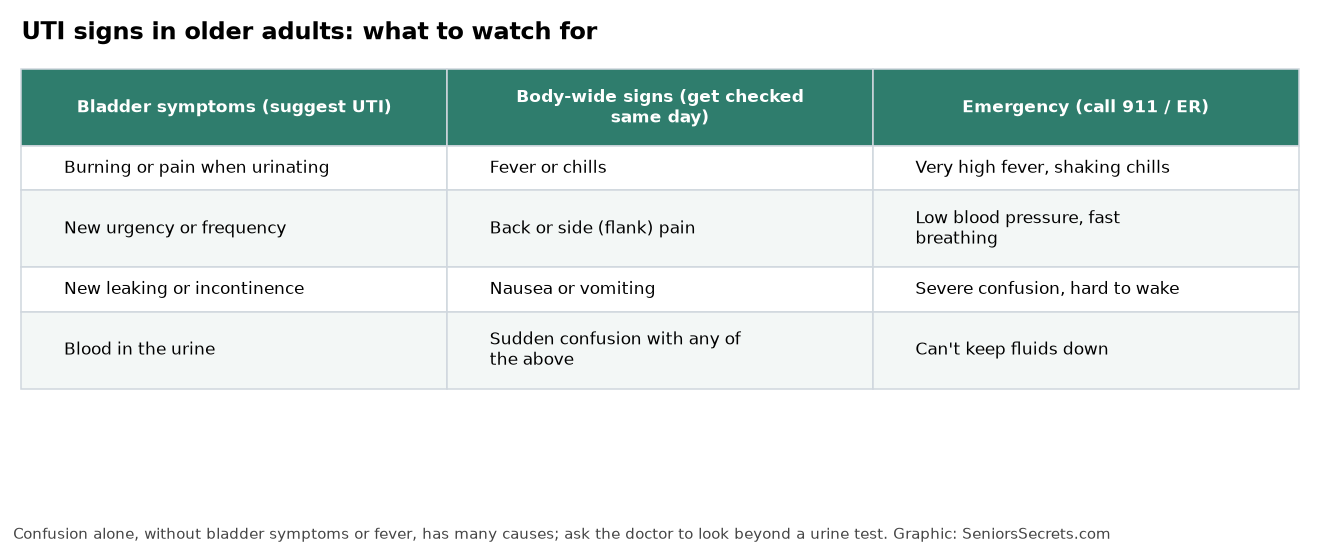
Bladder symptoms that suggest a UTI:
- burning or pain when urinating
- a new, strong urge to go, or going much more often
- new or worse leaking
- blood in the urine
- pain low in the belly
Signs the infection may have spread (get checked the same day):
- fever or chills
- pain in the back or side, below the ribs
- nausea or vomiting
Go to the ER or call 911 for a very high fever with shaking chills, low blood pressure, fast breathing, severe confusion or difficulty waking, or if the person can’t keep fluids down. These can be signs of sepsis.
Confusion: the most misunderstood “symptom”
Older adults with a serious infection can become confused or delirious, and a kidney infection or sepsis can certainly do that. But confusion on its own is not a reliable sign of a bladder infection. Dehydration, constipation, poor sleep, pain, low sodium, a new medicine, or another infection like pneumonia can all cause it.
That’s why the Infectious Diseases Society of America’s guideline on asymptomatic bacteriuria (2019) advises a careful look for other causes in an older person who is confused or has fallen but has no bladder symptoms and no fever or other signs of infection, rather than simply treating a positive urine test.
What to ask for: “Can we check for other causes too, like fluids, medicines, constipation and other infections, before deciding it’s a UTI?” My guides on dehydration in seniors and dangerous drug combinations cover two common culprits.
Bacteria without symptoms usually shouldn’t be treated
Many older adults, especially women over 80 and people in nursing homes, carry bacteria in their urine without any infection. This is called asymptomatic bacteriuria. A dipstick or culture will come back “positive,” but there’s nothing to treat.
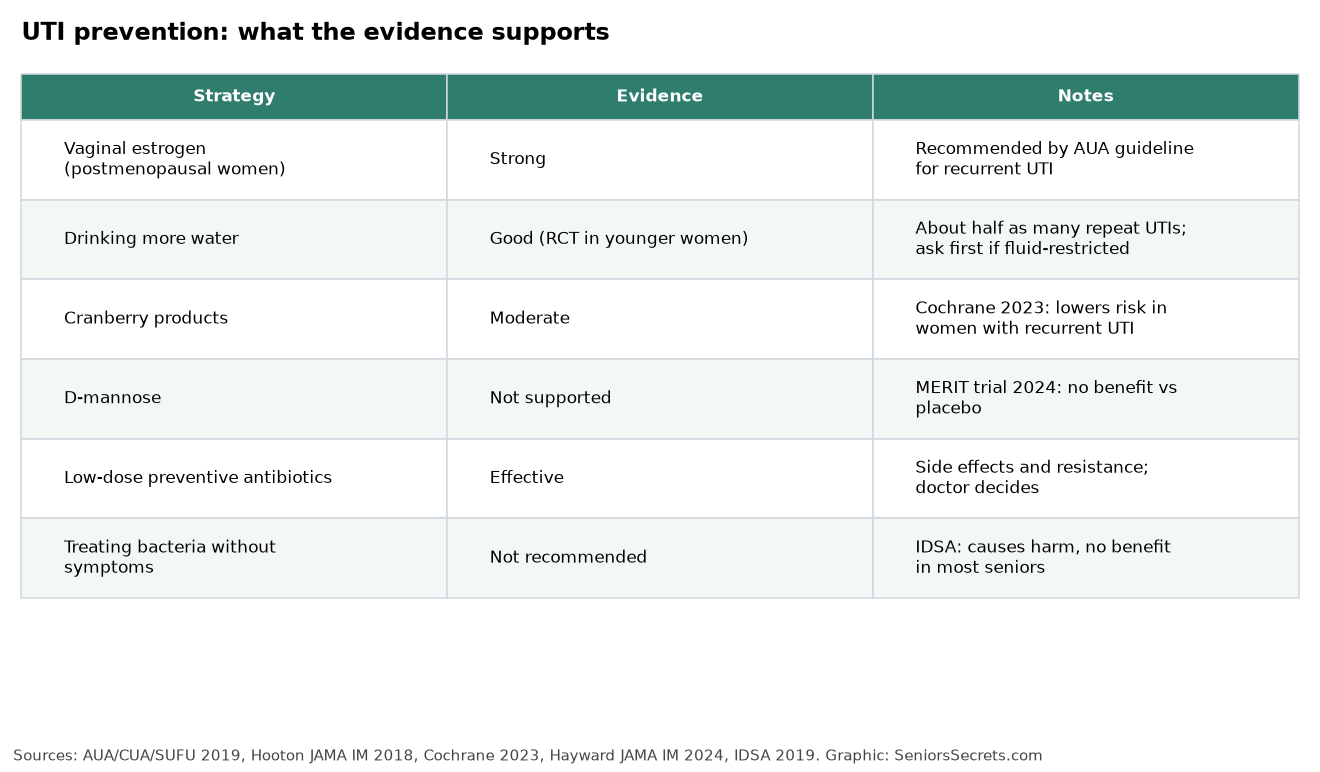
The IDSA recommends against screening for or treating asymptomatic bacteriuria in older adults living in the community or in long-term care. Unnecessary antibiotics don’t prevent future infections. They can cause diarrhea, including C. difficile, allergic reactions and antibiotic resistance, which makes the next real infection harder to treat. Fluoroquinolones such as ciprofloxacin carry extra warnings for older adults, including tendon rupture and confusion.
Prevention: what the evidence supports
Vaginal estrogen (postmenopausal women)
This is one of the best-supported options for women who get repeated UTIs. Low-dose vaginal estrogen (cream, tablet or ring) helps restore protective bacteria and tissue. The American Urological Association’s 2019 recurrent-UTI guideline recommends it for peri- and postmenopausal women with recurrent UTIs. Very little is absorbed into the body, but ask your doctor whether it’s right for you.
Drink more water, unless you’ve been told to limit fluids
In a 2018 randomized trial in JAMA Internal Medicine (Hooton et al.), women who got frequent UTIs and drank about 1.5 extra liters of water a day had roughly half as many repeat infections over a year. The trial was in premenopausal women, but the principle applies broadly. If you have heart failure or kidney disease, ask your doctor how much fluid is safe.

Cranberry products
A 2023 Cochrane review found that cranberry products reduce the risk of symptomatic UTIs in women with recurrent infections. The evidence is weaker for older adults in nursing homes. Capsules avoid the sugar in juice. If you take warfarin, check with your doctor first.
D-mannose: not supported by the best trial
D-mannose is widely sold for UTI prevention. But in the 2024 MERIT trial, a randomized, placebo-controlled study of 598 women with recurrent UTIs published in JAMA Internal Medicine, D-mannose did not reduce UTIs compared with placebo (51% vs 56% had a medically treated suspected UTI, which wasn’t a significant difference). The authors concluded it shouldn’t be recommended for prevention in primary care.
Everyday habits
- Don’t hold urine. Go every 3 to 4 hours during the day.
- Double-void: after urinating, wait a few seconds and try again.
- Wipe front to back.
- Treat constipation, which can stop the bladder from emptying fully.
- Keep diabetes well controlled.
- Change incontinence pads promptly.
- Catheters: use one only when truly needed, and follow care instructions closely.
Preventive antibiotics
For people with frequent infections despite these steps, a doctor may suggest a daily low-dose antibiotic, or one taken after sex. It works, but it has the same downsides as any antibiotic use, so it’s a decision to make with your doctor.
Treatment basics
A urine culture confirms the infection and shows which antibiotic will work. Simple bladder infections are often treated with a short course of 3 to 7 days, depending on the drug and on your sex. Kidney infections and complicated cases need longer treatment, and sometimes hospital care. Take the full course as prescribed. If symptoms aren’t improving within 48 hours, call your doctor.
Medicare Part B covers doctor visits and urine tests, and Part D covers antibiotics. For minor follow-ups, a telehealth visit can be quicker, but get seen in person for fever, back pain or confusion.
FAQ
Does sudden confusion in an elderly person mean a UTI?
Not necessarily. Infections can cause confusion, but so can dehydration, medicines, constipation and other illnesses. Without bladder symptoms or fever, ask the doctor to look for other causes before blaming a positive urine test.
Should bacteria in the urine always be treated?
No. If there are no symptoms, guidelines recommend not treating it in most older adults, because antibiotics cause harm without benefit.
Does cranberry juice prevent UTIs?
Cranberry products modestly reduce repeat UTIs in women prone to them, according to a 2023 Cochrane review. Capsules avoid the sugar in juice.
Does D-mannose work?
The largest placebo-controlled trial (MERIT, 2024) found no benefit for preventing recurrent UTIs in women.
When is a UTI an emergency?
When there’s a high fever with shaking chills, back or side pain with vomiting, low blood pressure, rapid breathing, or severe confusion. Go to the ER or call 911.
Related guides