Exercise With Diabetes After 60: What the Guidelines Actually Say (and What Medicare Covers)

If your doctor told you to “get more exercise” for your diabetes and left it at that, you’re in good company. It’s one of the most common pieces of advice in medicine. It’s also one of the least explained.
So I went to the source documents. I read the American Diabetes Association’s 2026 Standards of Care, the CDC’s activity guidelines for adults 65 and older, and Medicare’s own coverage pages. Below is what they actually say, in plain English, plus a few details most articles skip.
One thing before we start. I’m a researcher, not a doctor or a diabetes educator. Use this to have a better conversation with your care team, not to replace it.
The short version
According to the ADA’s Standards of Care in Diabetes 2026, most adults with type 2 diabetes should aim for:
- 150 minutes a week of moderate activity, like brisk walking, spread over at least 3 days.
- No more than 2 days in a row without being active.
- 2 to 3 strength sessions a week, on days that aren’t back to back.
- Balance and flexibility work 2 to 3 times a week if you’re an older adult.
- Getting up at least every 30 minutes when you’ve been sitting a long time.
That’s the target. If you’re nowhere near it today, the ADA’s advice is simply to do more than you’re doing now and build from there. Short walks count.
What exercise actually does to blood sugar
When your muscles work, they pull sugar out of your bloodstream for fuel. That’s why a walk can lower your number in real time.
Over months, the effect adds up. The ADA’s 2026 Standards point to a meta-analysis in which structured exercise programs of at least 8 weeks lowered A1C by 0.66% in people with type 2 diabetes, even when they didn’t lose weight. Combining walking-type exercise with strength training may work better than either one alone.
There’s more to it than the A1C number, too. In the studies the ADA reviewed, people with higher activity levels had lower rates of heart disease and fewer small-blood-vessel complications, the kind that affect eyes, kidneys and nerves. Even lower amounts of activity were linked to some benefit.
How much exercise do you need after 60?
Here’s how the two main sets of guidelines line up. I like seeing them side by side, because it shows they mostly agree.
| ADA (adults with diabetes) | CDC (all adults 65+) | |
|---|---|---|
| Aerobic activity | 150+ minutes a week, over at least 3 days | 150 minutes a week of moderate activity (for example, 30 minutes, 5 days a week) |
| Strength | 2 to 3 sessions a week, not on back-to-back days | At least 2 days a week, working all major muscle groups |
| Balance | 2 to 3 times a week, plus flexibility | Balance activities each week |
| Sitting | Break it up at least every 30 minutes | Be as active as your abilities allow |
The CDC’s guidelines for older adults add one line I wish more people heard: if you can’t meet the recommendations, be as active as your abilities and conditions allow. Some activity is better than none.
What does “moderate” feel like?
You’re breathing harder, but you can still talk in full sentences. If you can sing, speed up a little. If you can’t get a sentence out, slow down.
The 10-minute walk after meals
This is my favorite finding in the research, because it’s so easy to act on.
In a 2016 study published in Diabetologia, 41 adults with type 2 diabetes tried two routines. In one, they walked 30 minutes once a day, whenever they liked. In the other, they walked 10 minutes after each main meal.
Same total time. Different timing.
The after-meal walks lowered blood sugar after eating by 12% overall compared with the single daily walk. After dinner, the drop was 22%. That makes sense. Dinner is often the biggest meal, and it’s usually followed by the couch.
It’s one study, and a small one. But it costs nothing to try, and it fits neatly into the ADA’s advice to break up long stretches of sitting.

A sample week that meets the targets
Guidelines are easier to follow when you can see them on a calendar. Here’s one way a week could look. It’s a template, not a prescription.
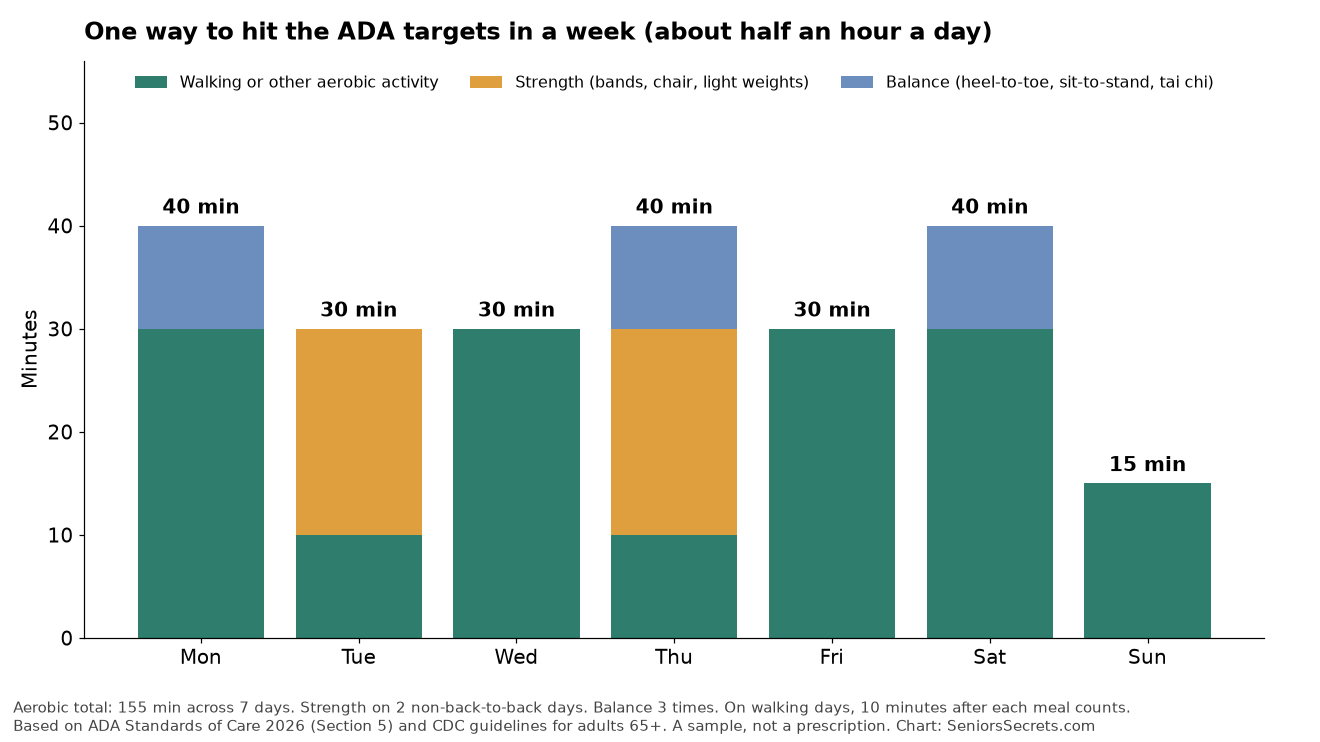
- Monday: 10-minute walk after each meal, plus 10 minutes of balance work (heel-to-toe walking, standing on one foot near a counter).
- Tuesday: 20 minutes of strength work with resistance bands or a sturdy chair, plus a short walk after dinner.
- Wednesday: 30 minutes of walking, water aerobics or a stationary bike.
- Thursday: Strength again, plus balance, plus the after-dinner walk.
- Friday: Three 10-minute walks after meals.
- Saturday: 30 minutes of something you enjoy, like dancing, gardening at a good pace or a longer walk with a friend, plus balance work.
- Sunday: An easy 15-minute stroll, so you never go two days without moving.
That adds up to 155 minutes of aerobic activity, two strength days that aren’t back to back and three balance sessions. If you want ideas for the balance part, our guide to balance exercises for seniors over 70 has step-by-step moves, and tai chi is another good option.
Avoiding lows: the part that matters most if you take insulin or a sulfonylurea
Here’s a detail that gets lost in a lot of exercise advice. The ADA says exercise-related low blood sugar is mostly a concern for people taking insulin or medicines that push your body to release more insulin, like sulfonylureas (glipizide, glimepiride and glyburide are common ones). If you’re not on those, lows during exercise aren’t common.
If you are on them, the ADA’s guidance includes these points:
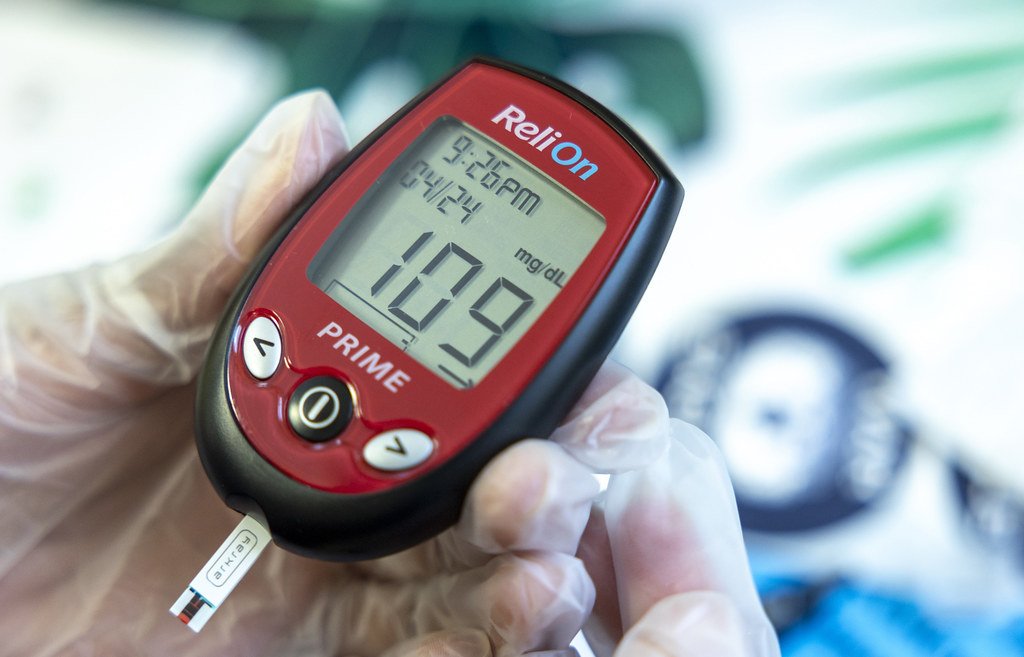
- Check before you start. People on these medicines may need some carbohydrate first if their reading is under 90 mg/dL. Exactly how much depends on your dose, the time of day and how hard you’ll work, so settle the details with your doctor.
- Watch for lows later. Your body can stay more sensitive to insulin for hours after exercise, so a low can show up well after you’ve finished.
- Know the 15-15 rule. The ADA defines a low as under 70 mg/dL. Eat 15 grams of fast-acting carbohydrate (glucose tablets, 4 ounces of juice), wait 15 minutes, then check again.
- Carry something with you. Glucose tablets fit in a pocket. Walking with a friend helps too.
What about readings that are too high to exercise? The ADA’s exercise position statement gives specific cutoffs for people with type 1 diabetes, built around testing for ketones at 250 mg/dL and above. For type 2, there isn’t one universal number. Ask your doctor what your personal “skip it today” reading is, and write it down.
One more from that same position statement: older adults with diabetes should avoid exercising outdoors on very hot or humid days. Mall walking exists for a reason.
Check with your doctor first if any of these apply
The ADA flags a few conditions that change what kind of exercise is safe:
- Diabetic eye disease. If you have proliferative or severe nonproliferative retinopathy, vigorous exercise and heavy lifting may be off the table because of the risk of bleeding in the eye. Your eye doctor should weigh in first.
- Nerve damage in your feet. Moderate walking in proper shoes doesn’t appear to raise the risk of foot ulcers, according to the ADA. But check your feet every day, and if you have an open sore, switch to activities that keep weight off your feet, like swimming or chair exercises.
- Autonomic neuropathy. This kind of nerve damage can affect your heart rate and blood pressure response. The ADA recommends a heart checkup before you start anything more intense than you’re used to.
If you’re managing several of these at once, our overview of the 2026 ADA standards for seniors is a good companion read.
What Medicare covers (the fine print)
This is the part I enjoy digging into, because several of these benefits only kick in if you ask. Here’s what I found on Medicare.gov.

Diabetes self-management training. Part B covers up to 10 hours of initial training (1 hour one-on-one and 9 hours in a group), then up to 2 hours of follow-up training each calendar year after that. It covers exercise, eating, blood sugar checks and medications. You need an order from your doctor, and you pay 20% after the Part B deductible (Medicare.gov). It’s easy to miss, because nothing happens until your doctor writes that order.
Foot exams. If you have diabetic nerve damage with loss of protective sensation, Part B covers a foot exam and treatment once every 6 months. More on that in our guide to Medicare podiatry and foot care coverage.
Therapeutic shoes. If you have diabetes and severe diabetes-related foot disease, Part B covers one pair of extra-depth or custom-molded shoes each calendar year, plus 2 or 3 extra pairs of inserts. The doctor treating your diabetes has to certify the need, and a podiatrist or other qualified doctor has to order them.
Gym memberships. Original Medicare doesn’t pay for gyms or fitness programs (Medicare.gov). Some Medicare Advantage plans, and some Medigap plans, do include a fitness benefit. Our post on Medicare gym coverage and SilverSneakers explains how those programs work.
That last one is worth acting on right now. Medicare Open Enrollment runs October 15 to December 7, 2026, and changes take effect January 1, 2027. If a fitness benefit matters to you, check your plan’s Annual Notice of Change to see whether it’s staying, and compare it against other plans before you switch.
What it costs in 2026. The Part B deductible is $283 and the standard Part B premium is $202.90 a month. As of October 1, 2026, Medicare hadn’t published the 2027 amounts yet. They usually come out in the fall, and I’ll update this post when they do.
Common questions
What’s the best exercise for a senior with diabetes?
The one you’ll keep doing. For most people that’s walking, plus some strength work twice a week. The ADA’s research summary suggests combining the two may lower blood sugar more than either alone.
How soon after eating should I exercise?
In the Diabetologia study, people walked shortly after each main meal, and the benefit was biggest after dinner. If you take insulin or a sulfonylurea, ask your doctor how meal timing and exercise should fit around your doses.
What blood sugar is too low to exercise?
For people on insulin or sulfonylureas, the ADA says you may need a snack first if you’re under 90 mg/dL. Anything under 70 mg/dL counts as a low and should be treated before you do anything else.
Is walking enough?
It’s a great start, but the guidelines also call for strength training 2 to 3 times a week and balance work for older adults. Our post on how many steps seniors actually need covers the walking side in more detail.
Does Medicare pay for SilverSneakers?
Original Medicare doesn’t. Some Medicare Advantage plans and some Medigap plans include SilverSneakers or a similar program. Call your plan or check its Evidence of Coverage to be sure.
Written by Khasim Basha Shaik. I’m not a licensed insurance agent or a medical professional. This article summarizes public guidance from the ADA, CDC and Medicare.gov and isn’t medical advice. Last reviewed October 1, 2026.
Related guides