Tart Cherry Juice for Seniors: What the Sleep and Gout Studies Really Show, How Much to Drink, and Who Should Be Careful

Tart cherry juice has some evidence behind it, but less than the marketing suggests. A few small trials found it modestly improved sleep in older adults with insomnia, and a study of people with gout found that eating cherries was linked to fewer flares. None of it is strong enough to replace proven treatments, and an 8-ounce glass carries roughly 140 to 150 calories and about 33 grams of natural sugar, which matters if you have diabetes or are watching your weight.
If you want to try it, the studies used 8 ounces (240 mL) of Montmorency tart cherry juice twice a day. Check with your doctor first if you have diabetes, kidney disease, or take medicine for gout.
What the research found
| Study | Who | What they took | What they found |
|---|---|---|---|
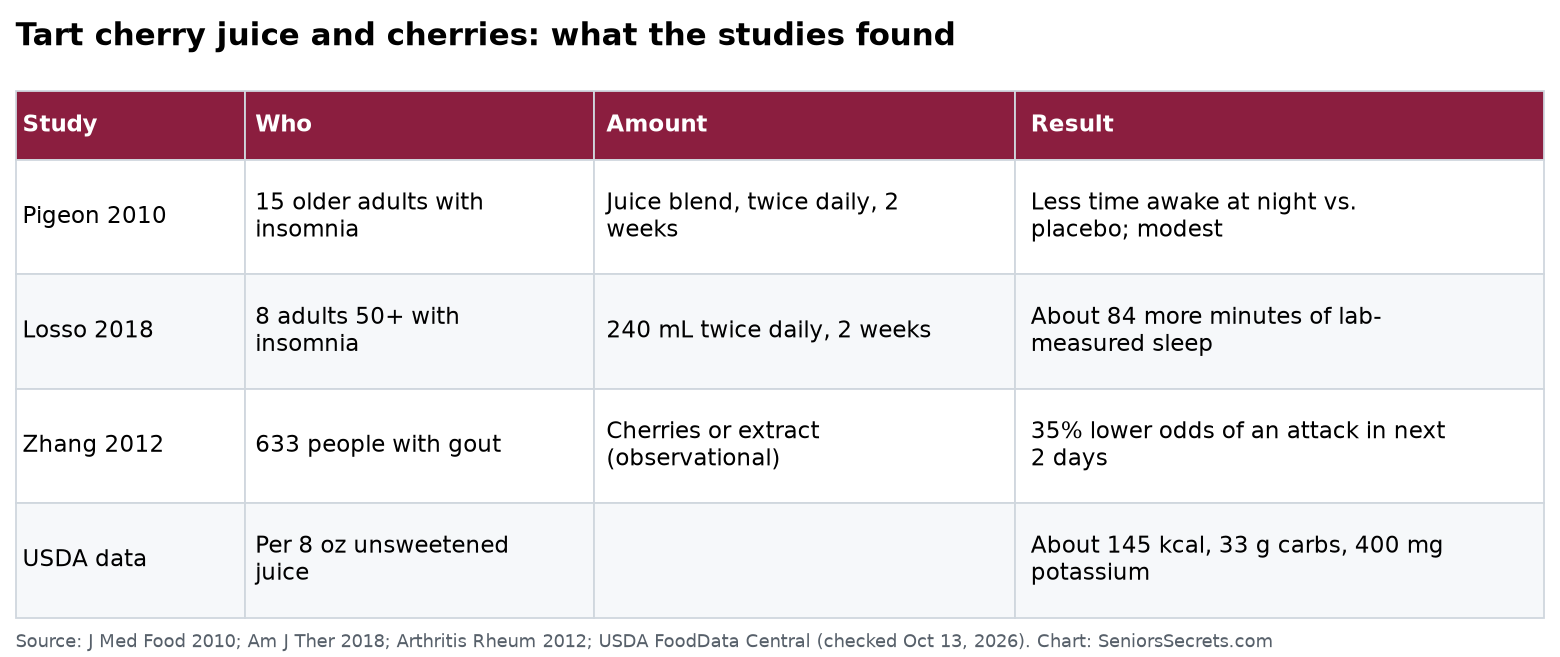
| Pigeon et al., 2010 | 15 older adults with chronic insomnia | Tart cherry juice blend, twice daily for 2 weeks, vs. placebo | Less time awake after falling asleep; no difference in time to fall asleep, total sleep or sleep efficiency vs. placebo |
| Losso et al., 2018 | 8 adults over 50 with insomnia (completers) | 240 mL Montmorency juice twice daily for 2 weeks, vs. placebo | About 84 more minutes of sleep measured in a sleep lab |
| Zhang et al., 2012 | 633 people with gout | Cherries or cherry extract (observational) | 35% lower odds of a gout attack over the next 2 days after eating cherries |
Sleep
The 2010 University of Rochester pilot study found the juice produced modest benefits, mainly less time awake during the night. The authors said the effects matched or exceeded valerian and some melatonin studies, but were considerably smaller than proven insomnia treatments like cognitive behavioral therapy for insomnia (CBT-I) and sleep medicines (Pigeon et al., J Med Food 2010).
The 2018 Louisiana State University study measured sleep with polysomnography and found about 84 more minutes of sleep, but only 8 people finished the study. Three volunteers were excluded because testing showed sleep apnea (Losso et al., Am J Ther 2018). That detail is worth remembering. If you sleep badly and snore, get checked for sleep apnea before reaching for a juice.
Researchers think the juice’s small amount of melatonin and compounds that affect tryptophan may play a role. Larger trials in older adults are still under way.
Gout
Boston University researchers followed 633 people with gout online for a year. Eating cherries over a 2-day period was linked to a 35% lower risk of a gout attack, and combining cherries with the gout drug allopurinol was linked to an even lower risk (Zhang et al., Arthritis Rheum 2012).
That was an observational study. It shows a link, not proof that cherries prevent attacks, and it mostly looked at whole cherries and cherry extract rather than juice. If you have gout, cherries are a reasonable addition, but don’t stop or skip allopurinol or other gout medicines for them. Fruit juices also contain fructose, which can raise uric acid, so keep portions modest.
Inflammation and muscle soreness
You’ll see claims about arthritis, heart health and exercise recovery. Most of that research is in young athletes or is too small to draw conclusions for older adults. I wouldn’t buy tart cherry juice for those reasons alone.
How much did the studies use?
- Amount: 8 ounces (240 mL) of tart cherry juice, twice a day: once in the morning and once 1 to 2 hours before bed.
- Type: Montmorency tart cherry juice, not sweet cherry juice and not “cherry juice cocktail” with added sugar.
- Length: 2 weeks in the sleep studies.
Concentrate is common. Most brands say to mix about 1 ounce of concentrate with water to make a serving. Follow the label, because concentrations vary.
Sugar, calories and potassium
Using USDA FoodData Central figures for unsweetened tart cherry juice (59 calories, 13.7 grams of carbohydrate and 161 mg of potassium per 100 grams), one 8-ounce glass works out to roughly:
| Per 8-ounce glass | About |
|---|---|
| Calories | 140–150 |
| Carbohydrate (mostly natural sugar) | 33–34 g |
| Potassium | About 400 mg |
Two glasses a day, the amount used in studies, doubles that: about 290 calories and 67 grams of carbohydrate. That’s a lot for someone with diabetes. A smaller serving (4 ounces) with a meal, or whole tart cherries, may be easier to fit in.
Who should check with a doctor first
- Diabetes or prediabetes. The sugar adds up fast. Check your blood sugar if you try it. My diabetes guide for seniors covers current targets.
- Chronic kidney disease. Two glasses add about 800 mg of potassium. If you’re on a potassium limit, ask first. See my kidney disease diet guide.
- Gout on medication. Use cherries alongside treatment, not instead of it.
- Blood thinners or several medicines. There’s no well-established interaction, but tell your doctor or pharmacist about any regular supplement or concentrated juice.
- Nighttime bathroom trips. A glass of anything an hour before bed can mean another trip to the bathroom, which is a fall risk at night.
Better first steps for sleep
If poor sleep is the reason you’re curious, these have stronger evidence:
- CBT-I, a short, structured therapy for insomnia that works better long term than sleeping pills. My insomnia guide explains how to find it.
- Same wake-up time every day, morning daylight, and limiting naps to 30 minutes or less, early in the day.
- Cutting caffeine after lunch and alcohol in the evening.
- Getting checked for sleep apnea if you snore loudly or wake up gasping.
If you’d like a fruit habit with broader benefits, whole fruits like cherries and blueberries give you fiber that juice doesn’t.
Common questions
Does tart cherry juice help seniors sleep?
Small studies found modest improvements, such as less time awake at night, in older adults with insomnia. The effect is smaller than CBT-I or sleep medicines.
How much tart cherry juice should I drink for sleep?
Studies used 8 ounces of Montmorency tart cherry juice twice a day, in the morning and 1 to 2 hours before bed. Ask your doctor first if you have diabetes or kidney disease.
Does tart cherry juice help gout?
An observational study linked eating cherries to 35% lower odds of a gout attack. It isn’t a replacement for gout medicines like allopurinol.
Is tart cherry juice high in sugar?
Yes. An 8-ounce glass of unsweetened tart cherry juice has about 33 grams of carbohydrate, mostly natural sugar, and roughly 140 to 150 calories.
Can people with kidney disease drink tart cherry juice?
An 8-ounce glass has about 400 mg of potassium. If you’re on a potassium restriction, check with your doctor or dietitian first.
Written by Khasim Basha Shaik. I research health and nutrition topics for older adults using peer-reviewed studies and USDA data. I’m not a doctor or dietitian, and this isn’t medical advice. Last reviewed October 13, 2026.