
RSV is easy to shrug off until it isn’t. For many healthy adults it feels like a bad cold. For older adults—and for people with heart, lung, or immune problems—it is a leading reason for fall and winter hospital stays.
The good news is narrower and more useful than a sales pitch: CDC recommends a single RSV vaccine for certain adults, three FDA-licensed shots are available, and Medicare Part D covers the RSV vaccine at $0 when you have drug coverage. This page updates those rules as of early October 2026.
I’m a researcher, not a doctor or a licensed Medicare agent. Vaccine timing and whether you qualify for a risk-based recommendation belong in a conversation with your clinician. Coverage details below come from Medicare.gov and CDC.
What CDC recommends right now
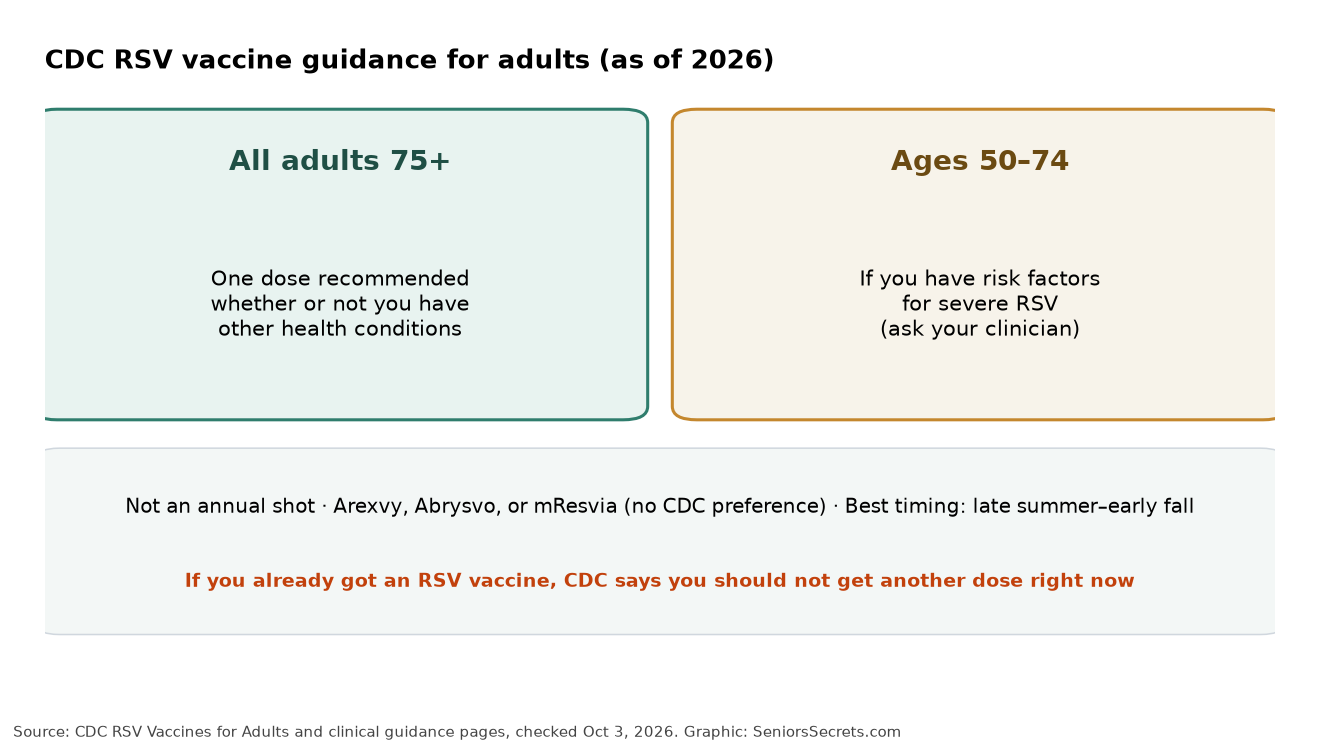
According to CDC’s RSV vaccines for adults page (updated February 20, 2026) and its clinical guidance for adults:
- Everyone ages 75 and older should get an RSV vaccine.
- Adults ages 50–74 should get one if they are at increased risk of severe RSV illness.
- The vaccine is not currently an annual shot. If you already received an RSV vaccine, CDC says you should not get another dose at this time.
- You can get it any time of year, but the best timing in most of the continental U.S. is late summer through early fall (roughly August–October), before RSV picks up in the community.
That age band matters. Older articles (including our earlier version of this page) often stopped at “60 and up.” CDC’s public guidance in 2026 starts the risk-based group at 50, not 60. Medicare.gov’s RSV shot coverage page uses the same framing: adults 75 and older, and adults 50–74 with certain conditions.
Risk factors CDC lists for ages 50–74
You do not need every condition on the list. CDC’s clinical guidance includes examples such as:
- Chronic heart disease (for example heart failure or coronary artery disease; isolated hypertension alone is not the point)
- Chronic lung disease (COPD, emphysema, asthma, and similar conditions)
- End-stage kidney disease or dialysis
- Diabetes with end-organ damage, or diabetes treated with insulin or an SGLT2 inhibitor
- Moderate or severe immune compromise
- Severe obesity (BMI at or above 40)
- Living in a nursing home
- Certain neurologic, liver, or blood conditions that raise risk for severe respiratory infection
CDC also notes that patient attestation can be enough for a risk factor—vaccinators should not refuse a shot only because paperwork is incomplete. When in doubt, ask your clinician whether you fall into the increased-risk group.
The three vaccines: Arexvy, Abrysvo, mResvia
FDA has licensed three RSV vaccines for adults:
| Vaccine | Manufacturer | Notes from CDC |
|---|---|---|
| Arexvy | GSK | Protein subunit vaccine |
| Abrysvo | Pfizer | Protein subunit vaccine |
| mResvia | Moderna | mRNA vaccine |
CDC says there is no preference among products for adults who are recommended to get vaccinated. Eligible adults should take whichever licensed vaccine is available. All are given as a single dose under current recommendations.
CDC summarizes effectiveness separately for each product; figures differ by study. For most readers: take an available recommended product before peak season if you can, and do not chase a second dose this year if you already completed vaccination.
How common is serious RSV in adults?
CDC’s RSV in adults page estimates that 110,000 to 180,000 adults ages 50 and older in the United States are hospitalized because of RSV each year. Risk generally rises with age and with the kinds of chronic conditions listed above.
Symptoms often look like other winter viruses: congestion, cough, fever, wheezing, or worsening of heart failure or COPD. That overlap is exactly why “I already got my flu shot” is not the whole answer.
Medicare coverage: Part D, usually $0
This is the money part people get wrong.
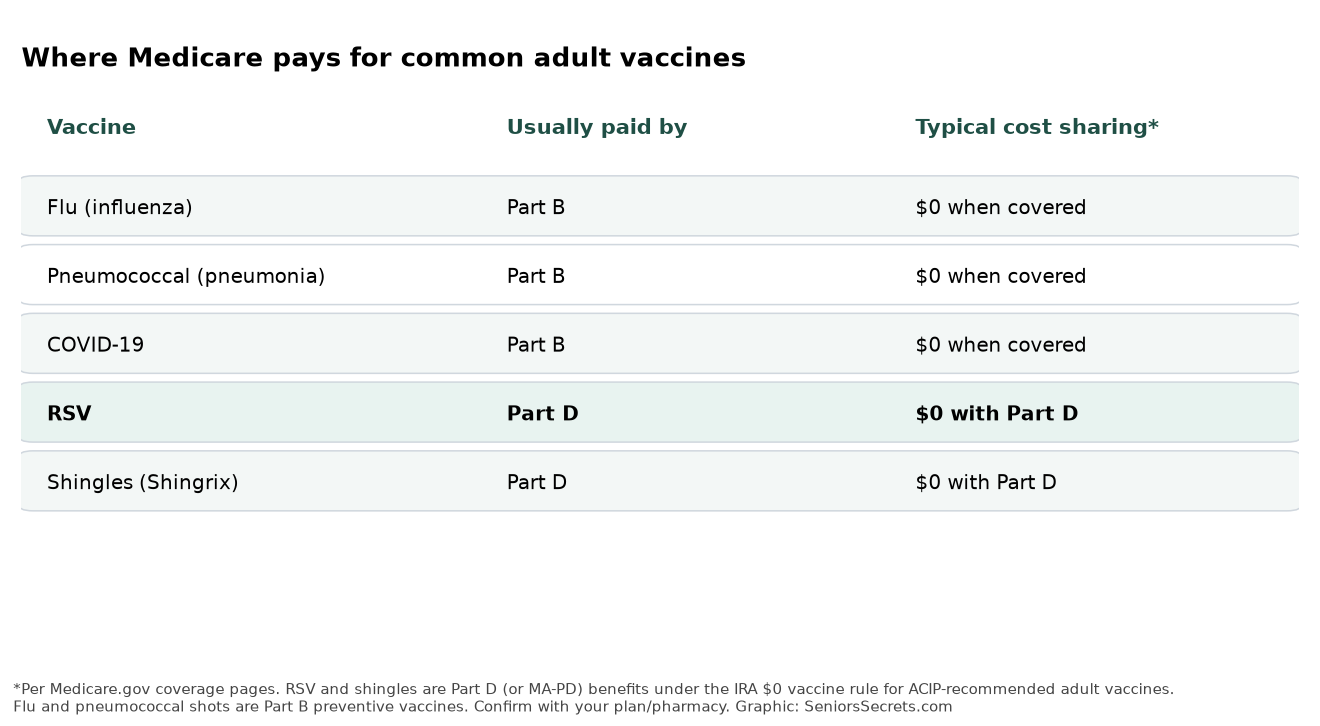
Per Medicare.gov’s RSV shot page:
- Medicare Part D covers the RSV vaccine.
- Medicare Advantage plans that include drug coverage cover it as a drug benefit too.
- You pay nothing for the RSV vaccine if you have Part D.
- Part D also covers other ACIP-recommended adult vaccines that are not under Part B (shingles is the other big example), with no copay and no deductible for those ACIP-recommended vaccines.
Flu and pneumococcal (pneumonia) vaccines are different: they are generally Part B preventive shots. Mixing those pathways is how people get a surprise bill at the pharmacy counter.
Before you roll up your sleeve, confirm you have Part D or an Advantage plan with drug coverage, and ask the pharmacy to bill RSV under Part D (not Part B). If a brand is missing from a formulary, CMS notes you can request a formulary exception. If you have only Part A and B with no drug benefit, the $0 Part D rule does not apply until you add coverage—worth fixing in Open Enrollment if you are unprotected.
Timing for fall 2026
If you are eligible and have never had an RSV vaccine, getting it in late summer or early fall is still the preferred window. Early October is not “too late,” but waiting until December means you may miss the early part of RSV season.
CDC allows RSV with other adult vaccines at the same visit; same-day shots can raise ordinary arm soreness or brief fatigue. Spacing them is a preference, not a ban.
Related guides:
- Flu shot for seniors 2026–27 — usually Part B
- Pneumonia vaccine for seniors — usually Part B
- Shingles vaccine and Medicare — Part D, like RSV, at $0 when covered
- Broader habits that support immune health: How to boost immunity after 65

Who should wait or talk with a clinician first
CDC says you should not get an RSV vaccine if you have ever had a severe allergic reaction to any component of that vaccine. Check the manufacturer package insert for Arexvy, Abrysvo, or mResvia if you have a complicated allergy history.
If you have a moderate or severe illness, wait until you recover. A mild cold is generally fine.
If you already received an RSV vaccine in a prior season, CDC’s current advice is clear: do not get another dose right now. Protection lasts more than one season for many people; CDC is still studying how long it lasts and whether extra doses will be recommended later.
Pregnant people follow a different Abrysvo recommendation aimed at protecting infants. That pathway is separate from the adult-aging recommendations on this page—ask your obstetric clinician if it applies to you.
Side effects
CDC lists mostly mild reactions: arm pain or swelling, fatigue, fever, headache, nausea, diarrhea, and muscle or joint pain. Seek emergency care for trouble breathing or swelling of the face or throat. Report possible side effects to VAERS; CDC also offers V-safe check-ins.
FAQ
I am 68 and healthy. Do I need an RSV vaccine?
Not under CDC’s routine “everyone” rule. The automatic recommendation starts at 75. Between 50 and 74, CDC recommends vaccination when you have risk factors for severe RSV. If you are unsure whether a condition counts, ask your clinician rather than guessing from a blog.
Is RSV the same as the flu shot?
No. Different virus, different vaccine, and usually a different Medicare payment pathway (Part D for RSV, Part B for flu). You may get both in one season if each is recommended for you.
Which brand is best—Arexvy, Abrysvo, or mResvia?
CDC does not prefer one adult product over the others. Availability at your pharmacy matters more than brand loyalty.
Why did a pharmacy quote me a price?
Ask whether they are billing Part D and whether you are enrolled in Part D (or an MA plan with drug coverage). Under Medicare.gov’s rules, ACIP-recommended Part D adult vaccines should be $0 when billed correctly. If something still looks wrong, call the plan’s member services number on your card before you pay.

Bottom line
For fall 2026: 75+, get the shot if you never have; 50–74, get it if you are at higher risk; one dose for now, not every year; Medicare Part D pays $0 when you have drug coverage. Pair it with your flu and pneumonia plans, finish Shingrix if you still need it, and let your clinician settle the edge cases.
Related guides

Does Medicare Cover Mammograms? Screening, Diagnostic, and What You’ll Pay
Pneumonia Vaccine for Seniors: Which Shot You Need After 50, and What Medicare Pays