Pneumonia Vaccine for Seniors: Which Shot You Need After 50, and What Medicare Pays

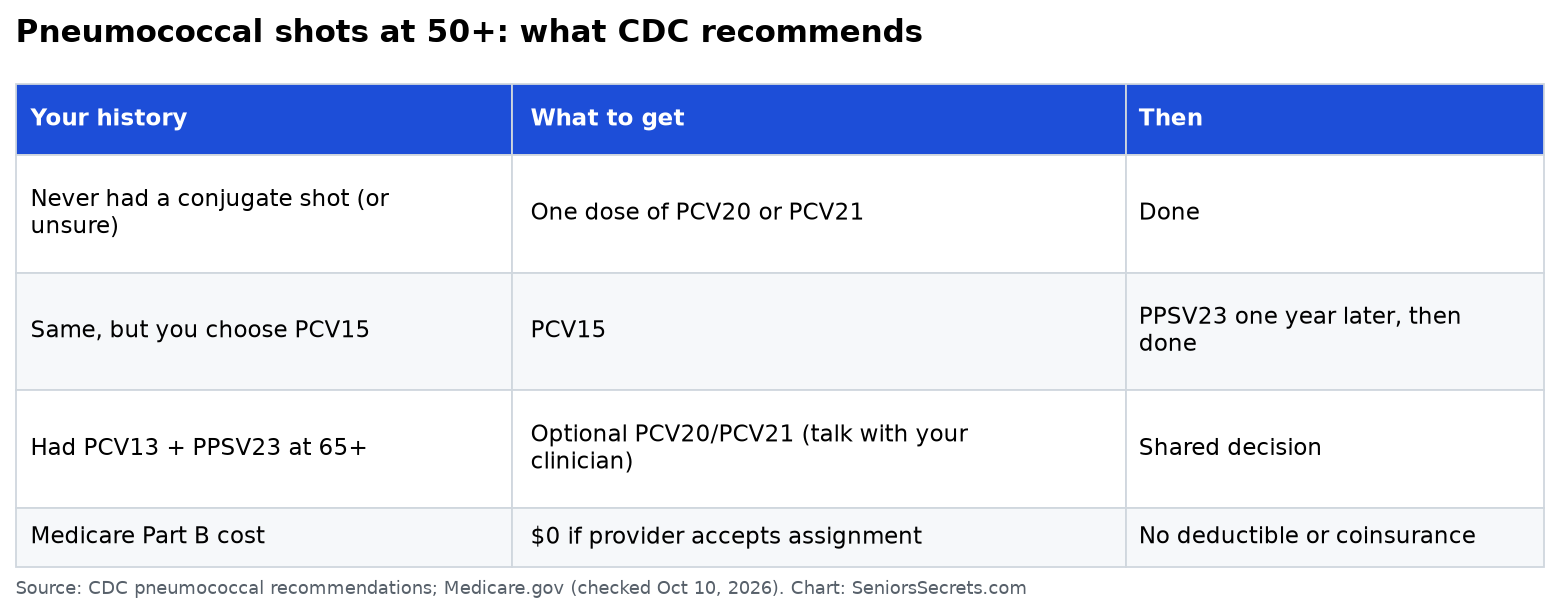
If you’re 50 or older and have never had a pneumococcal conjugate vaccine (or you can’t remember), CDC’s advice is simple: get one dose of PCV20 (Prevnar 20) or PCV21 (Capvaxive) and you’re done. If your pharmacy uses PCV15 (Vaxneuvance) instead, you need one PPSV23 (Pneumovax 23) shot a year later. Medicare Part B covers pneumococcal shots, and you pay nothing if the provider accepts assignment.
I checked CDC’s pneumococcal vaccine recommendations (updated February 25, 2026) and Medicare.gov’s pneumococcal coverage page on October 10, 2026. Below is what that means for someone on Medicare, including the confusing “I already had some pneumonia shots years ago” case.
I research Medicare and senior health topics for readers. I’m not a doctor or pharmacist, so use this to prepare for the conversation, not to replace it.
The short version
- Age cutoff is now 50, not 65. CDC recommends pneumococcal vaccination for all adults 50 or older, plus younger adults with certain health conditions.
- PCV20 or PCV21: one shot, no follow-up needed.
- PCV15: follow with one PPSV23 dose a year later (as soon as 8 weeks for people with a weakened immune system, a cochlear implant, or a spinal fluid leak).
- Already had PCV13 and PPSV23 at 65 or older? You’re considered covered, but you may add PCV20 or PCV21 after talking it through with your clinician.
- Cost on Original Medicare: $0 under Part B when the provider accepts assignment. No Part B deductible applies.
Why this shot matters more after 50
Pneumococcal bacteria live in the nose and throat. Most of the time they cause nothing worse than an ear or sinus infection, but they’re also a leading cause of bacterial pneumonia, and they can get into the blood or the lining of the brain. Risk climbs with age and with conditions common in later life: heart and lung disease, diabetes, kidney disease, smoking, and anything that weakens the immune system.
That’s the reason CDC moved routine vaccination down to age 50. It isn’t that 50-year-olds suddenly got sicker. It’s that a lot of people in their 50s and early 60s already have one of those risk conditions, and a single age rule is easier to follow than a list of diagnoses.
The four vaccines, in plain English
| Vaccine | Brand | Type | What it means for you |
|---|---|---|---|
| PCV20 | Prevnar 20 | Conjugate | One dose completes the series |
| PCV21 | Capvaxive | Conjugate | One dose completes the series; covers a different mix of strains common in adults |
| PCV15 | Vaxneuvance | Conjugate | Needs PPSV23 one year later |
| PPSV23 | Pneumovax 23 | Polysaccharide | Only used as the follow-up to PCV15 (or in some older schedules) |
“Conjugate” vaccines tend to produce a stronger, longer-lasting immune memory, which is why CDC built the adult schedule around them. PPSV23 still has a role after PCV15 because it covers extra strains.
You don’t usually get to pick the brand. Pharmacies stock one or two. If yours carries PCV20 or PCV21, you have the one-and-done option. If it only has PCV15, ask whether they’ll remind you about PPSV23 next year, or put it in your own calendar.
What if you already had pneumonia shots?
This is where most seniors get stuck, because the schedule changed several times. Here is how CDC handles the common histories:
| What you had before | What CDC says now |
|---|---|
| Nothing, or you’re not sure | One PCV20 or PCV21 (or PCV15 + PPSV23) |
| PPSV23 only (the old “pneumonia shot”) | You still need a conjugate shot. Ask your clinician about PCV20 or PCV21 |
| PCV13 only | A follow-up dose is still recommended. Ask about PCV20 or PCV21 |
| PCV13 at any age and PPSV23 at 65+ | Series complete. Optional PCV20 or PCV21 by shared decision |
| PCV20 or PCV21 | Done. No more pneumococcal shots |
If your records are a mess, you’re not alone. Your pharmacy can usually look you up in your state immunization registry, and CDC offers a free tool called PneumoRecs VaxAdvisor that clinicians use to sort out the timing. When in doubt, CDC’s own rule is to treat an unknown history as “never vaccinated.”
What Medicare covers, and where people get surprised
Pneumococcal shots fall under Part B preventive services. Medicare.gov is clear that you pay nothing if the doctor or pharmacist giving the shot accepts assignment. That’s true even if you haven’t met your Part B deductible ($283 in 2026).
A few practical points:
- Bring your red, white and blue Medicare card, not just your Part D card. Pharmacies sometimes run vaccines through Part D by habit; pneumococcal shots should be billed to Part B.
- Medicare Advantage plans must cover the same Part B preventive shots, and in-network pharmacies or doctors should charge $0. Use an in-network location.
- If you also want another service the same day (an office visit for a cough, for example), that visit can carry its own copay or coinsurance. The shot itself stays free.
For comparison, the other big vaccines seniors ask about are covered in different places: flu shots are Part B, while shingles and RSV vaccines are covered under Part D at $0 for recommended adult vaccines.
Side effects to expect
Most people notice a sore arm, sometimes with redness or swelling where the shot went in, and some feel tired or achy for a day or two. A mild fever is possible. Serious allergic reactions are rare, which is why pharmacies ask you to wait about 15 minutes after any vaccine.
You can get a pneumococcal shot at the same visit as a flu or COVID-19 vaccine. Many people do exactly that in the fall so they only make one trip.
Who should talk to a doctor first
Ask before you go if you:
- Had a severe allergic reaction to any earlier pneumococcal vaccine or a vaccine containing diphtheria toxoid.
- Are getting chemotherapy, take high-dose steroids or other drugs that suppress the immune system, or have had a transplant. Timing matters more for you.
- Are sick with a fever right now. Most clinicians will tell you to wait until you feel better.
My practical checklist
- Find your records. Ask your pharmacy to check the state immunization registry, or look through old patient portal messages.
- Ask which brand they stock. PCV20 or PCV21 means one visit. PCV15 means a second shot next year.
- Show your Medicare card so it’s billed to Part B.
- Pair it with your flu shot if both are due.
- Write down the brand and date. Future you, and future pharmacists, will thank you.
While you’re thinking about prevention, it’s worth looking at the full list of free Medicare preventive screenings as well. And if you’re comparing plans during Open Enrollment, check that your usual pharmacy is in-network; my Medicare Advantage 2027 guide walks through how to do that.
Common questions
Do seniors need a pneumonia shot every year?
No. Unlike the flu shot, pneumococcal vaccines aren’t yearly. Most adults need one PCV20 or PCV21 dose in their lifetime, or PCV15 followed by PPSV23.
Is Prevnar 20 free with Medicare?
Yes. Medicare Part B covers pneumococcal vaccines, and you pay nothing if the provider accepts assignment. Medicare Advantage plans cover it at $0 in network.
What’s the difference between Prevnar 20 and Capvaxive?
Both are conjugate vaccines that complete the series in one dose. They protect against somewhat different groups of pneumococcal strains; CDC accepts either one for adults 50 and older.
I got Pneumovax years ago. Am I covered?
Probably not fully. CDC recommends a conjugate vaccine (PCV20 or PCV21) for adults who had only PPSV23. Ask your clinician about timing.
Can I get the pneumonia shot and flu shot on the same day?
Yes. CDC allows them at the same visit, usually in different arms.
Written by Khasim Basha Shaik. I research Medicare coverage and senior health topics and compare official sources for readers. I’m not a doctor, pharmacist, or licensed insurance agent. This article summarizes CDC and Medicare.gov guidance and is not medical advice. Last reviewed October 10, 2026.
Related guides

Does Medicare Cover Mammograms? Screening, Diagnostic, and What You’ll Pay