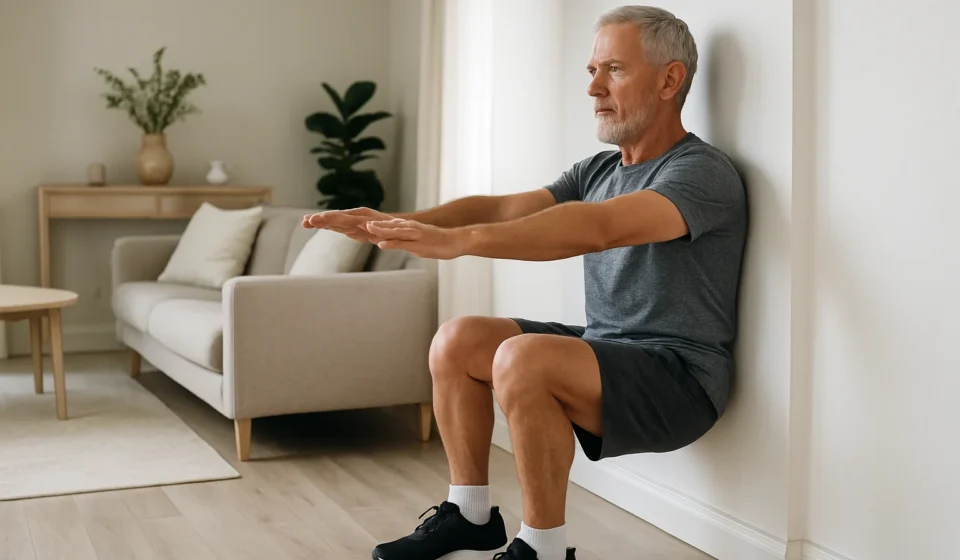

If you could do one type of exercise to lower high blood pressure, the latest science points to a surprising answer: holding still. Isometric exercises for seniors—moves like the wall sit, where a muscle contracts without the joint moving—produced the largest reductions in resting blood pressure of any exercise type in a landmark 2023 analysis. They are joint-friendly, require no equipment, and take just minutes a few days a week. This guide explains why isometrics work, the safest moves for older adults, and the one breathing rule you must never break.
Table of Contents
- What Isometric Exercise Is
- The Blood-Pressure Evidence
- Why Holding Still Lowers Blood Pressure
- 6 Safe Isometric Moves for Seniors
- How Often and How Long
- Tracking Your Progress
- Safety: The Breathing Rule & Who Should Be Careful
- Frequently Asked Questions
What Isometric Exercise Is
An isometric exercise is one in which your muscles generate force while their length—and the joint angle—stays the same. Instead of lifting and lowering a weight (a dynamic movement), you hold a position under tension: a wall sit, a plank, or simply pressing your palms together. Because the joints do not move through a range, isometrics put very little strain on arthritic knees, hips, and shoulders, which makes them especially appealing for older adults who find traditional weights or aerobics uncomfortable.
The Blood-Pressure Evidence
A 2023 systematic review and meta-analysis published in the British Journal of Sports Medicine pooled 270 randomized controlled trials with nearly 16,000 participants. It compared aerobic exercise, dynamic resistance training, high-intensity interval training, combined training, and isometric exercise. The result reshaped how researchers think about exercise and blood pressure: isometric training produced the biggest drops in resting blood pressure, averaging about 8.2 mmHg systolic and 4 mmHg diastolic—larger than aerobic exercise, resistance training, or HIIT.
| Exercise type | Average systolic drop | Average diastolic drop |
|---|---|---|
| Isometric training | ~8.2 mmHg | ~4.0 mmHg |
| Combined training | ~6.0 mmHg | ~2.5 mmHg |
| Dynamic resistance | ~4.6 mmHg | ~3.0 mmHg |
| Aerobic exercise | ~4.5 mmHg | ~2.5 mmHg |
| HIIT | ~4.1 mmHg | ~2.5 mmHg |
To put that in perspective, an 8 mmHg systolic reduction is in the same ballpark as some blood-pressure medications—a meaningful change for a senior trying to bring numbers down. Isometrics are not a replacement for prescribed medication, but they are a powerful, low-cost complement.
Why Holding Still Lowers Blood Pressure
The mechanism is a bit counterintuitive. During a sustained isometric hold, the contracting muscle squeezes the small blood vessels running through it, briefly restricting blood flow. When you relax at the end of the hold, blood rushes back into those vessels. Researchers believe this repeated squeeze-and-release trains the inner lining of your arteries—the endothelium—to release more nitric oxide, a molecule that relaxes and widens blood vessels. Over weeks, more flexible, responsive arteries translate into lower resting pressure. Isometric training also appears to calm an overactive sympathetic (“fight or flight”) nervous system and improve how the body regulates blood pressure moment to moment.
This is why the benefit builds gradually rather than appearing overnight, and why consistency outperforms intensity. It also explains the importance of the breathing rule discussed below: the goal is a controlled, sustained contraction, not a breath-held strain that spikes pressure in the moment.
6 Safe Isometric Moves for Seniors
- Wall sit: Slide your back down a wall until knees bend toward 90 degrees (go shallow if needed); hold.
- Wall press: Stand facing a wall and push your palms into it as if trying to move it; hold steady.
- Isometric leg extension: Sit in a chair, straighten one leg, and hold it parallel to the floor.
- Glute bridge hold: Lying on your back, lift your hips and hold the bridge position.
- Plank (modified on knees or against a counter): Hold a straight-body position bracing the core.
- Hand grip squeeze: Squeeze a soft ball or rolled towel—a classic isometric for blood pressure.
Begin with shorter holds and a sturdy chair or wall for support. If you are new to exercise or have balance concerns, pairing these with a wall-based routine can build confidence safely.
How Often and How Long
The protocol most used in the research is simple and time-efficient: four holds of about two minutes each, separated by short rests, performed three times a week. For seniors just starting out, that two-minute target is a goal to build toward, not a starting point. Begin with holds of 10–20 seconds, rest, and repeat. Gradually lengthen the holds as your strength and tolerance improve. Consistency—three sessions a week—matters more than pushing any single hold to failure.
One practical tip: anchor your three weekly sessions to something you already do, such as the kettle boiling for tea or the commercial break of a favorite show. Habit-stacking like this is far more reliable than willpower, and isometrics fit it perfectly because they need no change of clothes, no equipment, and no trip to a gym.
Tracking Your Progress
Because the blood-pressure benefit is gradual, the best way to stay motivated is to measure it. Keep a simple home log: check your blood pressure at the same time of day, in the same arm, after sitting quietly for five minutes, two or three mornings a week. Record the numbers alongside the days you trained. Over 8 to 12 weeks, a downward trend in your morning readings is the proof that the routine is working—and a far better guide than how any single session felt. Share that log with your doctor, who can see whether your medication needs adjusting as your numbers improve. Pairing isometrics with a lower-sodium diet, regular walking, good sleep, and stress management compounds the effect, since no single habit lowers blood pressure as much as several working together.
Safety: The Breathing Rule & Who Should Be Careful
The single most important rule of isometric training is: never hold your breath. Straining against a held position while holding your breath (the Valsalva maneuver) can cause a sharp, temporary spike in blood pressure—the opposite of what you want. Breathe slowly and steadily throughout every hold, and stop if you feel dizzy, short of breath, or feel chest pressure.
Talk to your doctor before starting if you have uncontrolled high blood pressure, a heart condition, a recent stroke, glaucoma, or an aneurysm, since the brief pressure responses during isometric holds warrant medical clearance. This article is educational and not a substitute for individualized medical advice (see our medical disclaimer).
Frequently Asked Questions
Are isometric exercises safe for seniors with high blood pressure?
For most people they are safe and may lower resting blood pressure over time, but you must breathe steadily and avoid straining. Anyone with uncontrolled hypertension or heart disease should get medical clearance before starting.
How quickly do isometric exercises lower blood pressure?
Most studies measured benefits after about 8 to 12 weeks of training three times a week. Results vary by person, and isometrics work best alongside a healthy diet, prescribed medication, and other activity—not as a replacement.
What is the best isometric exercise for blood pressure?
The wall sit is the most studied and effective for blood pressure, with hand-grip holds close behind. Choose whichever you can perform safely and consistently while breathing normally throughout.
Do I still need my blood pressure medication?
Never stop or change prescribed medication on your own. Isometric exercise is a complement that may help your numbers, but only your doctor can adjust your treatment based on your readings.
Related Articles You May Find Helpful
- High Blood Pressure in Seniors 2026: New Treatment Guidelines
- Best Blood Pressure Monitors for Seniors 2026
- Wall Pilates for Seniors 2026: Safe Core & Balance Moves
- Resistance Band Exercises for Seniors 2026: 8 Moves
- Senior Fitness & Exercise Guide 2026
Sources
- Edwards J et al., British Journal of Sports Medicine (2023) — Exercise training and resting blood pressure meta-analysis
- American Heart Association — Physical activity and blood pressure recommendations
- National Institutes of Health (NIH/NCBI) — Isometric resistance training and hypertension review