
Vitamin E for seniors sits at an unusual crossroads in nutrition science: it is a genuinely important fat-soluble antioxidant, yet it is also one of the few vitamins where taking too much in supplement form has been linked to real harm. For most older adults eating a varied diet, deficiency is rare—and the high-dose capsules sold for “heart health” or “memory” may do more harm than good. This evidence-based guide explains what vitamin E actually does, who truly needs more, the dose that crosses into risk, and why food beats pills for nearly everyone over 65.
Table of Contents
- What Vitamin E Does in the Body
- How Much Seniors Need—and the Safe Upper Limit
- What the Research Really Shows
- The Real Risks of High-Dose Supplements
- Who Should Actually Consider a Supplement
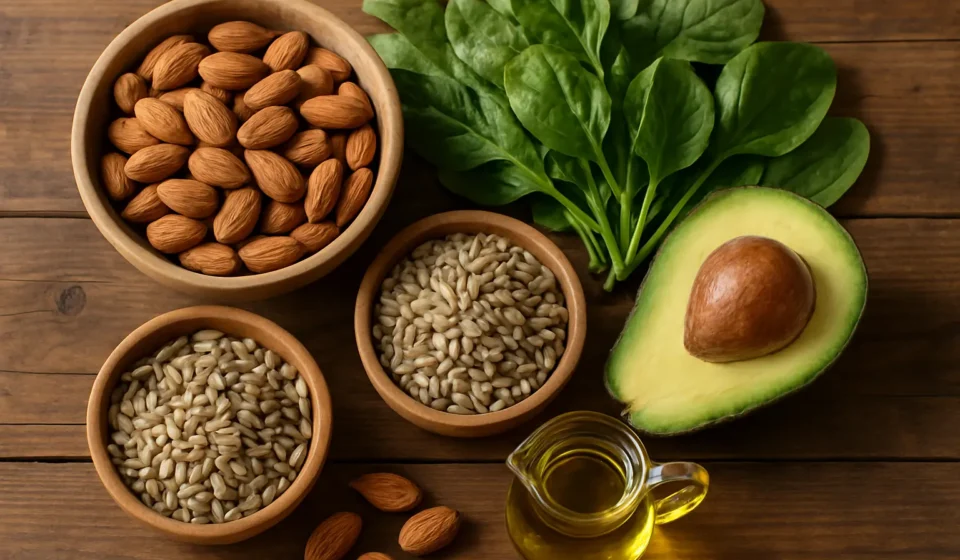
- Best Food Sources of Vitamin E
- Frequently Asked Questions
What Vitamin E Does in the Body
Vitamin E is the body’s main fat-soluble antioxidant. Its most active form, alpha-tocopherol, protects cell membranes—and the LDL cholesterol particles within your blood—from oxidative damage caused by free radicals. It also supports immune function, which naturally declines with age, and helps keep blood vessels healthy by limiting the oxidation of fats. These mechanisms are exactly why vitamin E was once marketed as a near-miracle heart and brain supplement. The reality, as the large trials below show, turned out to be far more nuanced.
How Much Seniors Need—and the Safe Upper Limit
The recommended dietary allowance (RDA) for adults is 15 mg (about 22.4 IU) of alpha-tocopherol per day, and this does not increase with age. The crucial number to remember is the tolerable upper intake level (UL): 1,000 mg/day (about 1,500 IU of natural or 1,100 IU of synthetic vitamin E). Many “high-potency” capsules contain 400 IU or more—well above what you need from supplements and, as research suggests, into a range where caution is warranted.
| Measure | Amount | What it means |
|---|---|---|
| RDA (adults, all ages) | 15 mg (~22.4 IU) | Easily met through diet |
| Typical “high-dose” capsule | 400 IU (~268 mg) | Far above need; linked to risk signals |
| Tolerable Upper Limit (UL) | 1,000 mg (~1,500 IU) | Bleeding risk rises above this |
| Deficiency | Below need + fat malabsorption | Rare; mainly in malabsorption disorders |
True deficiency is uncommon in healthy seniors. It is mostly seen in people with conditions that impair fat absorption—Crohn’s disease, cystic fibrosis, chronic pancreatitis, or after certain weight-loss surgeries—because vitamin E requires dietary fat to be absorbed.
What the Research Really Shows
Decades of large trials have tempered the early enthusiasm:
- Heart disease: Major randomized trials found that vitamin E supplements did not prevent heart attacks or strokes in older adults, despite the plausible antioxidant theory.
- All-cause mortality: A widely cited 2005 meta-analysis in the Annals of Internal Medicine found that high-dosage supplementation (400 IU/day or more) was associated with a small but significant increase in death from all causes.
- Eye health: Vitamin E at 400 IU is one ingredient in the AREDS2 formula shown to slow progression of intermediate age-related macular degeneration—but only as part of that specific combination, and it does not prevent the disease.
- Cognition: Evidence that vitamin E prevents dementia is weak and inconsistent; it is not recommended for preventing cognitive decline.
The take-home message: outside of specific medical situations like AREDS2-guided eye care, routine high-dose vitamin E offers little proven benefit for the average senior.
The Real Risks of High-Dose Supplements
Because vitamin E has a mild blood-thinning effect—it interferes with vitamin K–dependent clotting—high doses can meaningfully raise bleeding risk. This matters enormously for seniors, who are far more likely to take warfarin, aspirin, or other anticoagulants. Combining high-dose vitamin E with these medications can amplify bleeding, including the risk of hemorrhagic stroke. Anyone on a blood thinner, or scheduled for surgery, should not start a high-dose vitamin E supplement without talking to their doctor. This is general information, not a substitute for personalized medical advice (see our medical disclaimer).
Who Should Actually Consider a Supplement
There are legitimate reasons a clinician might recommend supplemental vitamin E, and they are specific. People with fat-malabsorption conditions—chronic pancreatitis, Crohn’s or celiac disease, cystic fibrosis, cholestatic liver disease, or a history of bariatric surgery—genuinely struggle to absorb the vitamin and may develop a measurable deficiency that causes nerve and muscle problems. In those cases supplementation is treating a real shortfall, often using special water-miscible forms, and should be monitored with blood levels. The other common scenario is an eye doctor prescribing the AREDS2 formula for intermediate macular degeneration, where the 400 IU dose is part of a tested combination rather than a standalone antioxidant.
What does not justify a high-dose capsule is the hope of preventing heart disease, cancer, or memory loss in an otherwise healthy senior—the large trials simply did not bear that out. If you do choose a supplement, look for a modest dose, prefer mixed tocopherols over high-dose synthetic alpha-tocopherol alone, and choose a product verified by NSF or USP for purity. Always tell your physician and pharmacist about it, especially before any surgery.
Best Food Sources of Vitamin E
Getting vitamin E from food delivers the nutrient with no risk of toxicity and alongside other beneficial compounds. Excellent sources include:
- Sunflower seeds and almonds (a small handful covers most of the day’s need)
- Vegetable oils—sunflower, safflower, and wheat germ oil
- Peanuts and peanut butter
- Leafy greens such as spinach and Swiss chard
- Avocado, and fortified cereals
For nearly all seniors, a Mediterranean-style diet rich in nuts, seeds, greens, and healthy oils provides ample vitamin E—no capsule required. If you suspect malabsorption or take a blood thinner, talk with your clinician before supplementing.
Frequently Asked Questions
Should seniors take a vitamin E supplement?
Most do not need one. Vitamin E deficiency is rare in people eating a normal diet, and high-dose supplements have been linked to bleeding risk and, at 400 IU or more, a small rise in all-cause mortality. Food sources are the safer choice for nearly everyone.
How much vitamin E is too much?
The tolerable upper limit is 1,000 mg (about 1,500 IU) per day from supplements. Bleeding risk rises above this, and many experts advise caution even at the common 400 IU dose—especially for those on blood thinners.
Does vitamin E interact with blood thinners?
Yes. Vitamin E has a mild anticoagulant effect and can increase bleeding when combined with warfarin, aspirin, or similar drugs. Always consult your doctor before starting a supplement if you take a blood thinner.
Is the vitamin E in AREDS2 eye vitamins safe?
The AREDS2 trials found no adverse effects from 400 IU vitamin E within that formula for intermediate macular degeneration. It should be used under an eye doctor’s guidance, and those on anticoagulants should discuss E-free versions.
Related Articles You May Find Helpful
- Selenium for Seniors 2026: Thyroid & Immune Benefits
- Vitamin K2 for Seniors 2026: Bone & Heart Nutrient
- Macular Degeneration in Seniors 2026: Prevention Guide
- Vitamin D for Seniors 2026: Optimal Levels & Dosage
- Senior Nutrition Guide 2026
Sources
- National Institutes of Health, Office of Dietary Supplements — Vitamin E Fact Sheet
- Miller ER et al., Annals of Internal Medicine (2005) — High-dosage vitamin E and all-cause mortality
- National Eye Institute — AREDS/AREDS2 study findings