Glaucoma After 60: Warning Signs, Who’s at Risk, Treatments and What Medicare Covers (2026)

Glaucoma damages the optic nerve, usually because pressure inside the eye is too high. The most common type has no symptoms at first. It slowly erodes your side (peripheral) vision, and by the time you notice, the damage is permanent. Treatment can’t restore lost vision, but it can slow or stop further loss. That’s why the only real defense is a dilated eye exam on a regular schedule.
Medicare Part B covers a glaucoma screening once every 12 months for people at high risk. It isn’t free: you pay 20% after the Part B deductible. Once you’re diagnosed, Part B covers exams, laser treatment and surgery, while your eye drops fall under Part D.
I’m a researcher, not an eye doctor. Medical information here comes from the National Eye Institute’s glaucoma page, and coverage rules come from Medicare.gov’s glaucoma screenings page. Your eye doctor is the right person to assess your risk and treatment.
The two main types
Open-angle glaucoma
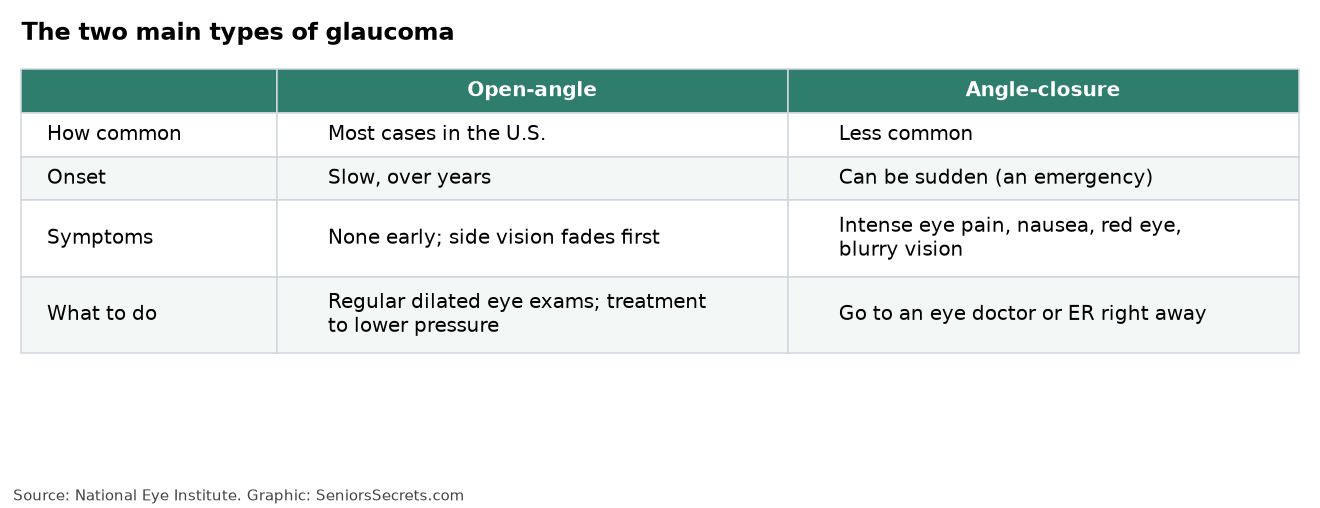
This is the most common type in the U.S. Fluid drains from the eye too slowly, pressure builds over years, and the optic nerve gradually suffers. There’s no pain and no early warning. Peripheral vision fades so slowly that your brain fills in the gaps.
Some people get glaucoma with normal eye pressure (normal-tension glaucoma), which is another reason pressure checks alone aren’t enough. A full exam looks at the optic nerve too.
Angle-closure glaucoma
Here, the drainage angle gets blocked, sometimes suddenly. According to the NEI, sudden angle-closure can cause:
- Intense eye pain
- Nausea or upset stomach
- A red eye
- Blurry vision
If you have these symptoms, go to an eye doctor or emergency room right away. Sudden angle-closure is a medical emergency that can cause blindness quickly without treatment.
Who’s at higher risk
According to the NEI, you’re at higher risk if you:
- Are over 60, especially if you’re Hispanic or Latino
- Are African American and over 40
- Have a family history of glaucoma
Other factors eye doctors watch include diabetes, high eye pressure, nearsightedness, long-term steroid use and past eye injuries.
The NEI says people at higher risk should get a comprehensive dilated eye exam every 1 to 2 years. Ask your eye doctor what schedule is right for you.
How glaucoma is diagnosed
A comprehensive exam usually includes:
- Tonometry: measures eye pressure, often with a quick puff of air or a gentle probe after numbing drops
- Dilated exam: drops widen your pupils so the doctor can examine the optic nerve
- Visual field test: checks your side vision by having you click when you see lights
- OCT imaging: scans the optic nerve and retinal nerve fiber layer
- Gonioscopy: checks whether the drainage angle is open or narrow
- Pachymetry: measures corneal thickness, which affects pressure readings
Treatment options
Every glaucoma treatment works by lowering eye pressure. None can restore vision that’s already lost.
Eye drops are the most common first step. Prostaglandin analogs, usually once a day at bedtime, are often prescribed first. Other drop types include beta blockers, alpha agonists, carbonic anhydrase inhibitors and rho kinase inhibitors. Drops only work if you use them every day. If you have trouble with the bottle, ask about drop aids, combination drops or laser.
Selective laser trabeculoplasty (SLT) is a quick in-office laser that improves drainage. A large UK trial, LiGHT, found SLT worked well as a first treatment for open-angle glaucoma, and many patients didn’t need drops for years afterward. The effect can wear off, but SLT can often be repeated.
Laser iridotomy creates a tiny opening in the iris. It treats or prevents angle-closure glaucoma.
Surgery comes in when drops and laser aren’t enough. Options include minimally invasive glaucoma surgery (MIGS), which is often done at the same time as cataract surgery, and traditional trabeculectomy or tube shunts for more advanced disease.
What Medicare covers
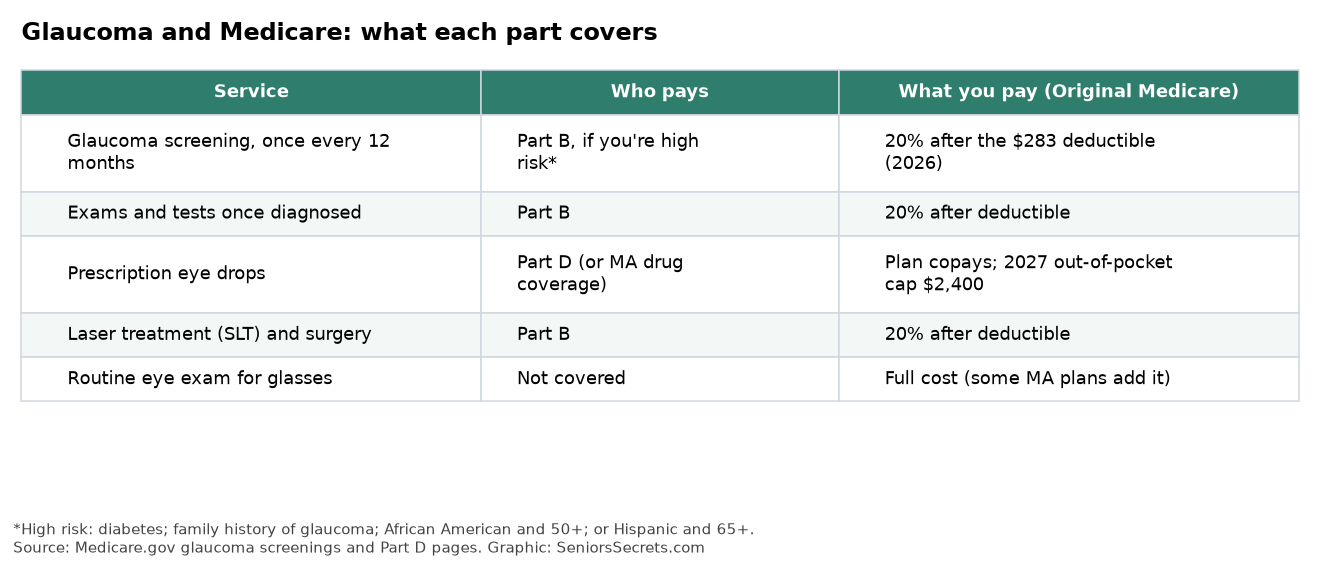
Glaucoma screening (Part B): once every 12 months if you’re high risk. Medicare counts you as high risk if you:
- Have diabetes
- Have a family history of glaucoma
- Are African American and 50 or older
- Are Hispanic and 65 or older
The screening must be done or supervised by an eye doctor who’s legally allowed to do it in your state. You pay 20% of the Medicare-approved amount after the Part B deductible ($283 in 2026).
After a diagnosis: Part B covers medically necessary exams, visual field tests and imaging, as well as laser procedures and surgery, with the usual 20% coinsurance. Medigap usually covers that 20%.
Eye drops: covered by your Part D plan or Medicare Advantage drug coverage. Check your plan’s formulary. Glaucoma drops vary widely in cost, and generics are often far cheaper. In 2027, Part D out-of-pocket costs are capped at $2,400 for the year. See my Part D 2027 guide.
Medicare Advantage plans cover all of the above, often with copays instead of coinsurance, and may require in-network eye doctors or prior authorization for surgery.
Routine eye exams for glasses aren’t covered by Original Medicare. For the full picture, see my guide to Medicare vision coverage.
Living with glaucoma
- Use drops exactly as prescribed. Set a phone alarm, or keep the bottle by your toothbrush. If you’re on more than one drop, wait about 5 minutes between them.
- Keep every follow-up visit. Glaucoma is monitored over years, and treatment is adjusted as needed.
- Tell all your doctors you have glaucoma. Some medications, including certain cold medicines and steroids, can affect eye pressure or angle-closure risk.
- Stay active. Regular exercise is generally good for eye health, but ask your doctor before doing head-down yoga poses.
- Protect your eyes from injury with safety glasses during yard work and home projects.
If glaucoma has already affected your vision, ask about low-vision services, and take extra steps to prevent falls. Lost side vision makes it easier to trip. For another major age-related eye disease, see my guide to macular degeneration.
FAQ
Can glaucoma be cured?
No, and lost vision can’t be restored. But treatment can usually slow or stop further damage, especially when glaucoma is caught early.
Does Medicare pay for glaucoma screening?
Yes, once every 12 months if you’re at high risk. That includes people with diabetes or a family history of glaucoma, African Americans 50 and older, and Hispanic adults 65 and older. You pay 20% after the Part B deductible.
What are the first signs of glaucoma?
Usually none. Open-angle glaucoma slowly reduces side vision without pain. Sudden eye pain, nausea, a red eye and blurry vision can signal angle-closure glaucoma, which is an emergency.
Is laser treatment better than drops?
For many people with open-angle glaucoma, SLT laser is a reasonable first choice, and some avoid daily drops for years. Your eye doctor will recommend what fits your type and stage.
How often should seniors get checked for glaucoma?
The NEI says people at higher risk should get a dilated eye exam every 1 to 2 years. Your eye doctor may recommend a different schedule.
Related guides