CSFP Senior Food Box: Who Qualifies for the Free Monthly USDA Groceries, 2026 Income Limits, and How to Apply

The Commodity Supplemental Food Program (CSFP) gives people 60 and older with limited income a free monthly package of USDA foods: things like milk, cheese, cereal, peanut butter, beans, canned meat and fish, and canned fruits and vegetables. It’s run by the U.S. Department of Agriculture through state agencies and local food banks. You can get it even if you already get SNAP.
The catch is that it isn’t available everywhere, and many areas have a set number of slots, so it’s worth applying as soon as you think you qualify. Here’s how it works, using USDA’s own CSFP fact sheet and 2026 income guidelines, checked October 13, 2026.
Who qualifies
- Age: at least 60.
- Where you live: a state or tribal area that runs CSFP. States can limit it to certain service areas, but they can’t require a minimum period of residency.
- Income: at or below the limit your state sets. Under current USDA rules, the state limit must be at or below 150% of the federal poverty guidelines. Some states use a lower cutoff, such as 130%, so check your own state’s number.
- Nutritional risk: some states also require that a doctor or local agency staff find you’re at nutritional risk.
There’s no work requirement, and getting the box doesn’t change your Social Security or Medicare benefits.
2026 income limits
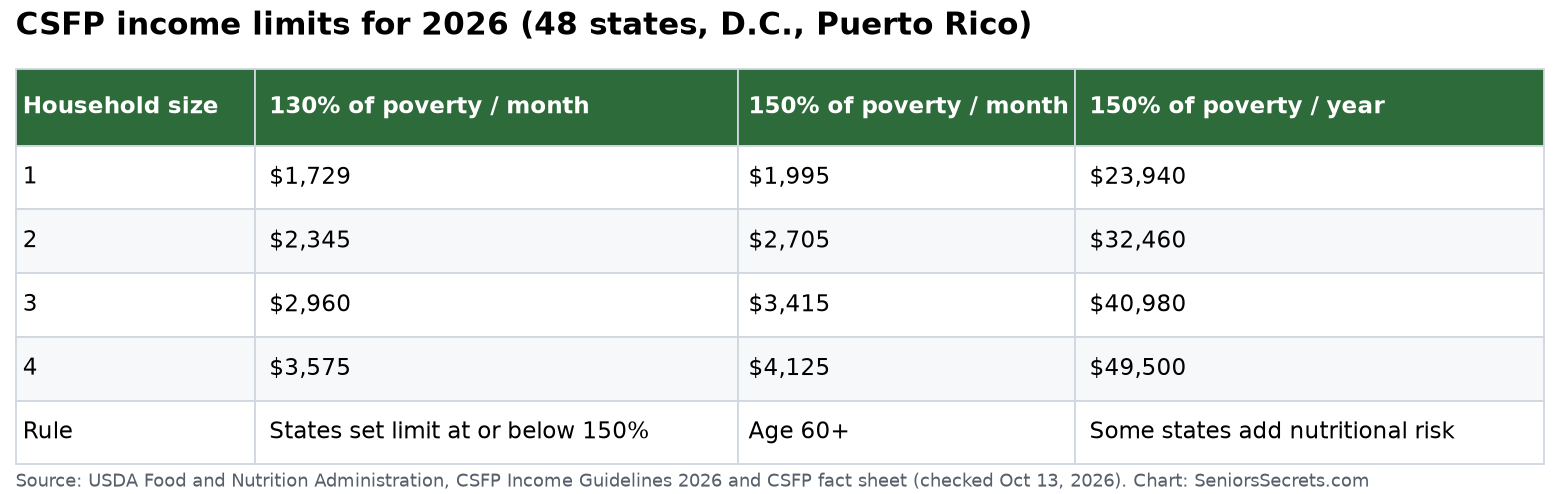
These are USDA’s 2026 figures for the 48 contiguous states, D.C. and Puerto Rico. Your state’s limit will be at or below the 150% column.
| Household size | 130% of poverty (monthly) | 150% of poverty (monthly) | 150% of poverty (yearly) |
|---|---|---|---|
| 1 | $1,729 | $1,995 | $23,940 |
| 2 | $2,345 | $2,705 | $32,460 |
| 3 | $2,960 | $3,415 | $40,980 |
| 4 | $3,575 | $4,125 | $49,500 |
Limits are higher in Alaska (one person: $2,162 a month at 130%, $2,494 at 150%) and Hawaii (one person: $1,989 at 130%, $2,295 at 150%). USDA posts the full tables, including larger households.
Most local agencies look at your household’s gross monthly income before deductions, including Social Security. If you’re close to the line, apply anyway and let the local agency decide.
What’s in the box
USDA says CSFP packages include foods like milk, cheese, juice, farina, oats, ready-to-eat cereal, rice, pasta, peanut butter, dry beans, canned meat, poultry or fish, and canned fruits and vegetables. The list changes with what’s available. USDA’s foods-available list for fiscal year 2027 includes items like unsweetened 100% juices, unsweetened applesauce, and fruit canned in extra-light syrup.
The package is meant to supplement your diet, not replace your groceries. USDA designs it to supply nutrients older adults often fall short on. In practice, that means shelf-stable protein, calcium and fiber.
A few ways to get more out of it:
- Pair it with fresh food. Add fresh produce, eggs or frozen vegetables when you can. The Senior Farmers’ Market Nutrition Program can help in season.
- Watch the sodium if you have high blood pressure or kidney disease. Rinsing canned beans and vegetables removes some salt.
- Use the peanut butter, beans, canned fish and milk to help you reach your daily protein. Here’s how much protein older adults need.
- Ask about swaps if you have allergies or can’t chew certain foods. Local agencies sometimes have options.
How to apply
- Find your state agency. USDA’s CSFP applicant page links to state contacts. Your state will tell you whether CSFP runs where you live. You can also call your local food bank or Area Agency on Aging. The Eldercare Locator (1-800-677-1116) can connect you.
- Contact the local agency (often a food bank, senior center or county office) and ask to apply.
- Bring proof of age, address, and household income. A Social Security benefit letter usually works for income.
- Ask how pickup works. Most programs have a monthly distribution day at a set site. Some deliver to homebound seniors, and many let a family member or friend pick up for you (“proxy”).
- If there’s a waitlist, ask to be added and how long it usually takes.
How CSFP fits with other food help
| Program | What you get | Can you get it with CSFP? |
|---|---|---|
| SNAP | Money on an EBT card for groceries | Yes |
| The Emergency Food Assistance Program (TEFAP) | Free food through food banks and pantries | Yes |
| Senior Farmers’ Market Nutrition Program | Coupons for fresh produce at farmers’ markets | Yes |
| Meals on Wheels / senior meal sites | Prepared meals | Yes |
USDA lists SNAP, TEFAP and the Senior Farmers’ Market Nutrition Program as other programs CSFP participants may qualify for. If you haven’t applied for SNAP, my SNAP for seniors guide covers the senior-friendly rules, including the medical expense deduction. And this roundup of government benefits seniors miss is worth a look while you’re at it.
How big the program is
CSFP runs in parts of all 50 states, D.C., Puerto Rico and on seven tribal reservations. For the 2024 caseload cycle, USDA allocated about 732,000 slots a month nationally, funded by a $389 million appropriation for fiscal 2024. That’s why some areas keep waitlists.
Common questions
What is the CSFP senior food box?
It’s a free monthly package of USDA foods for people 60 and older with limited income, given out through state agencies and local food banks under the Commodity Supplemental Food Program.
What is the income limit for CSFP in 2026?
States set the limit at or below 150% of the federal poverty guidelines. For one person in the 48 states that’s up to $1,995 a month; at 130% it’s $1,729. Check your state’s cutoff.
Can I get CSFP and SNAP at the same time?
Yes. CSFP and SNAP are separate programs, and you can get both if you qualify.
Is CSFP available everywhere?
No. It operates in parts of every state, but not every county, and many areas have limited slots. Your state agency can tell you whether it’s offered where you live.
Can someone pick up my box for me?
Many local agencies allow a proxy to pick up or offer delivery for homebound seniors. Ask when you apply.
Written by Khasim Basha Shaik. I research benefit programs for older adults using official USDA and other government sources. I’m not a benefits counselor or attorney, and rules vary by state. Confirm details with your state agency. Last reviewed October 13, 2026.
Related guides

2027 Social Security COLA Is 3.6%: What It Means for Your Check, SSI and Medicare

The $90 Medicare Part B Rebate: Who Gets It, When It Arrives, and What to Watch For

my Social Security Account in 2026: How to Sign In With Login.gov or ID.me, Fix Common Problems and Stay Safe