

Is Social Security Taxed in 2026? The Income Limits, the 85% Cap and 8 States

Social Security is taxed by the federal government only if your “combined income” is over $25,000 if you’re single, or $32,000 if you’re married filing jointly. Even then, no more than 85% of your benefit is taxable, so at least 15% is always tax-free (IRS Publication 915). Many retirees who live mostly on Social Security owe nothing.
The limits have never been raised for inflation. That’s why more retirees pay tax on benefits every year. Here’s how to tell if you will, and how to plan for it.
Step 1: Figure your combined income
The IRS compares your filing status’s “base amount” to this total:
- Half of your Social Security benefits for the year, plus
- All your other income, including pensions, IRA and 401(k) withdrawals, wages, interest, dividends and tax-exempt interest (like municipal bond interest)
SSA calls this “combined income.” The IRS worksheets call it “the total of one-half of your benefits and all your other income.” It’s the same idea (SSA).
Gotcha: Tax-free bond interest still counts here. People are often surprised by that.
Step 2: Compare it to the limits
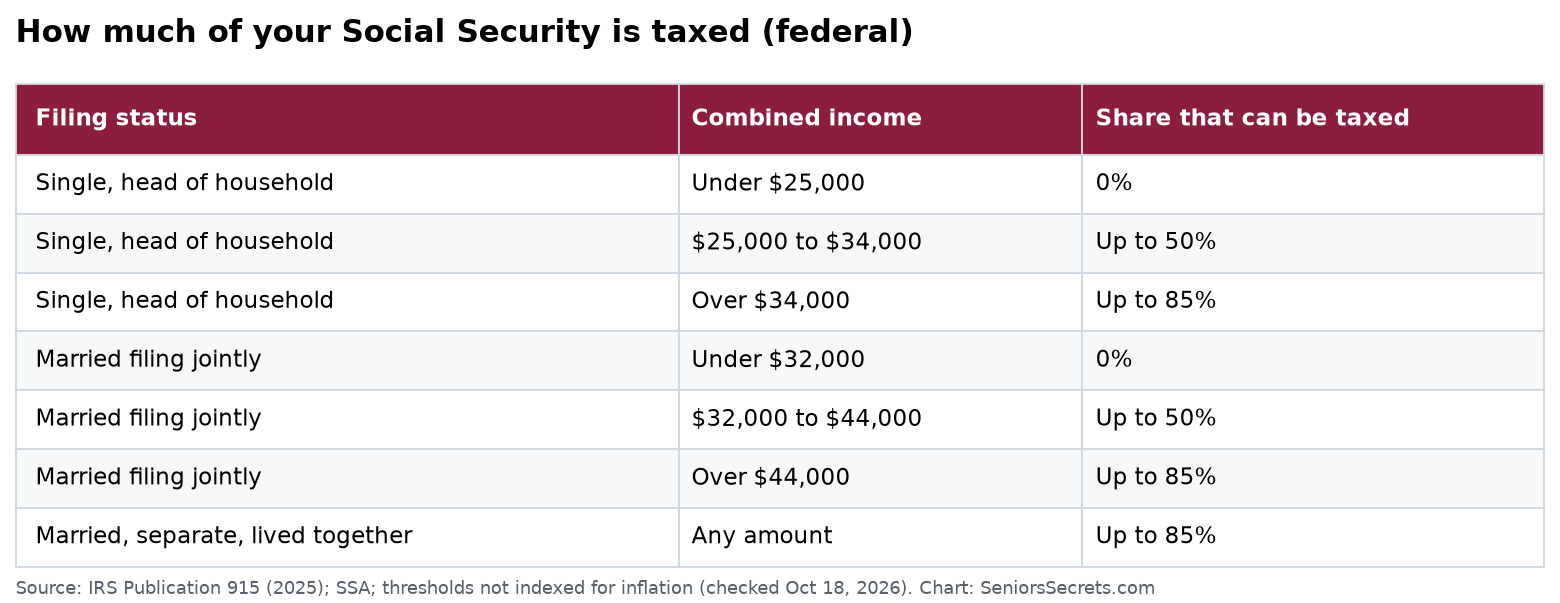
The rules from IRS Publication 915:
- Single, head of household or qualifying surviving spouse: Base amount is $25,000. Up to 50% can be taxed above that. Up to 85% can be taxed when combined income is over $34,000.
- Married filing jointly: Base amount is $32,000. Up to 85% can be taxed over $44,000.
- Married filing separately and lived together any time during the year: Base amount is $0. Up to 85% can be taxed.
“Up to 85% taxable” does not mean an 85% tax rate. It means up to 85% of your benefit gets added to your taxable income. Then your normal tax bracket applies.
A worked example
Say you’re single. You get $24,000 a year from Social Security and take $20,000 from your IRA.
- Half your benefit: $12,000
- Add other income: $12,000 + $20,000 = $32,000 combined income
- That’s $7,000 over the $25,000 base amount, but under $34,000
- Taxable benefits = the smaller of half the excess ($3,500) or half your benefits ($12,000)
So $3,500 of your $24,000 benefit is added to your taxable income. The other $20,500 is tax-free. Your tax on that $3,500 depends on your bracket and deductions.
If you pulled $30,000 from the IRA instead, more of your benefit would be taxed, up to the 85% cap. Every extra IRA dollar can make up to 85 more cents of Social Security taxable. Tax pros call this the “tax torpedo.”
The new $6,000 senior deduction helps
For tax years 2025 through 2028, people 65 and older can take an extra $6,000 deduction, or $12,000 for a married couple if both qualify. It phases out once modified adjusted gross income passes $75,000 for single filers or $150,000 for joint filers (IRS). You get it whether or not you itemize. It’s claimed on Schedule 1-A.
Be clear on what it does. It doesn’t change how much of your Social Security is taxable. It lowers your taxable income after that step. For many retirees, that’s enough to wipe out the tax on their benefits. Our $6,000 senior deduction guide has the details.
How to pay: withholding or estimated tax
If you’ll owe, you can avoid a big bill in April:
- Have tax withheld from your check. SSA lets you choose 7%, 10%, 12% or 22% of your monthly payment. You can set it up online in your my Social Security account, or file IRS Form W-4V (SSA).
- Pay quarterly estimated tax with Form 1040-ES.
- Raise withholding on a pension or IRA instead, if that’s easier.
Each January, SSA mails your Form SSA-1099. It shows the total benefits you got last year. You need it to do your taxes. If you lose it, you can download a copy from your my Social Security account.
Which states tax Social Security in 2026
Most states don’t. A July 2026 report from Connecticut’s Office of Legislative Research lists 8 states that tax benefits in some cases: Colorado, Connecticut, Minnesota, Montana, New Mexico, Rhode Island, Utah and Vermont (CT OLR).
Even in those states, most retirees pay little or nothing. Seven of them fully exempt benefits below certain income levels or ages. Montana is the main exception. It taxes the same part that’s federally taxable.
West Virginia dropped off the list. Starting with tax year 2026, it exempts 100% of taxable Social Security, at any income (WV Tax Division).
Smart ways to pay less tax on benefits
These are the moves I see in the IRS rules that actually work. Run your own numbers first, since each depends on your situation.
- Watch the timing of big IRA withdrawals. Spreading withdrawals over several years can keep you under a threshold.
- Use a Roth IRA. Qualified Roth withdrawals don’t count in combined income.
- Consider Roth conversions before you claim Social Security, in years with lower income. Conversions count as income in the year you do them.
- Give from your IRA if you’re charitable. A qualified charitable distribution (QCD), allowed from age 70½, goes straight to a charity and isn’t counted in your income.
- Don’t forget big one-time income. Selling a house or stock can push more of your benefit into the taxable zone that year.
Who should NOT do a Roth conversion just to save tax on benefits: people who need that cash soon, people already in a high bracket, and people who would pay the conversion tax out of the IRA itself. A conversion can also raise your Medicare premiums two years later.
Back pay and lump sums
If you got a big back payment for earlier years, the IRS lump-sum election may lower your tax. It lets you figure the tax as if the money came in the years it was owed. Form 1040 has a checkbox for it. This matters for many people who got back pay from the Social Security Fairness Act.
The 2027 raise and your taxes
Benefits rise 3.6% in January 2027 (our 2027 COLA guide). The $25,000 and $32,000 limits stay the same. So a raise can tip some people over a limit for the first time. Check your numbers early in 2027.

Common questions
At what age is Social Security no longer taxed?
There’s no age cutoff. Benefits can be taxed at any age if your combined income is over $25,000 single or $32,000 joint.
Is Social Security taxed at 85%?
No. Up to 85% of your benefit can be counted as taxable income. You then pay your normal tax rate on that part, not 85%.
Does the $6,000 senior deduction make Social Security tax-free?
Not directly. It lowers your taxable income for 2025 to 2028, which can erase the tax for many retirees, but it doesn’t change how much of your benefit is counted.
Which states tax Social Security benefits in 2026?
Colorado, Connecticut, Minnesota, Montana, New Mexico, Rhode Island, Utah and Vermont. Most give full or partial breaks based on income or age.
How do I have taxes taken out of my Social Security?
Sign in to your my Social Security account or file IRS Form W-4V. You can choose 7%, 10%, 12% or 22% withholding.
Written by Khasim Basha Shaik. I research Social Security and Medicare rules for readers. I am not a licensed tax professional or financial advisor. This article summarizes IRS, SSA and state materials and is not tax advice. Last reviewed October 18, 2026.
Related guides

2027 Social Security COLA Is 3.6%: What It Means for Your Check, SSI and Medicare

The $90 Medicare Part B Rebate: Who Gets It, When It Arrives, and What to Watch For

my Social Security Account in 2026: How to Sign In With Login.gov or ID.me, Fix Common Problems and Stay Safe


