
Every fall I hear the same story: someone discovers a free yearly Wellness visit, Extra Help with drug costs, or a Medicare Savings Program years after they could have used it. The benefits were sitting there. Nobody had named them in plain English.
This guide is that plain-English list. I pulled each item from Medicare.gov or CMS, and I link the source under every section. Use it as a checklist before Open Enrollment for 2027 coverage (October 15 to December 7, 2026).
I’m a researcher, not a licensed insurance agent or a doctor. This is education, not advice for your specific situation. For free one-on-one help, contact your State Health Insurance Assistance Program (SHIP).
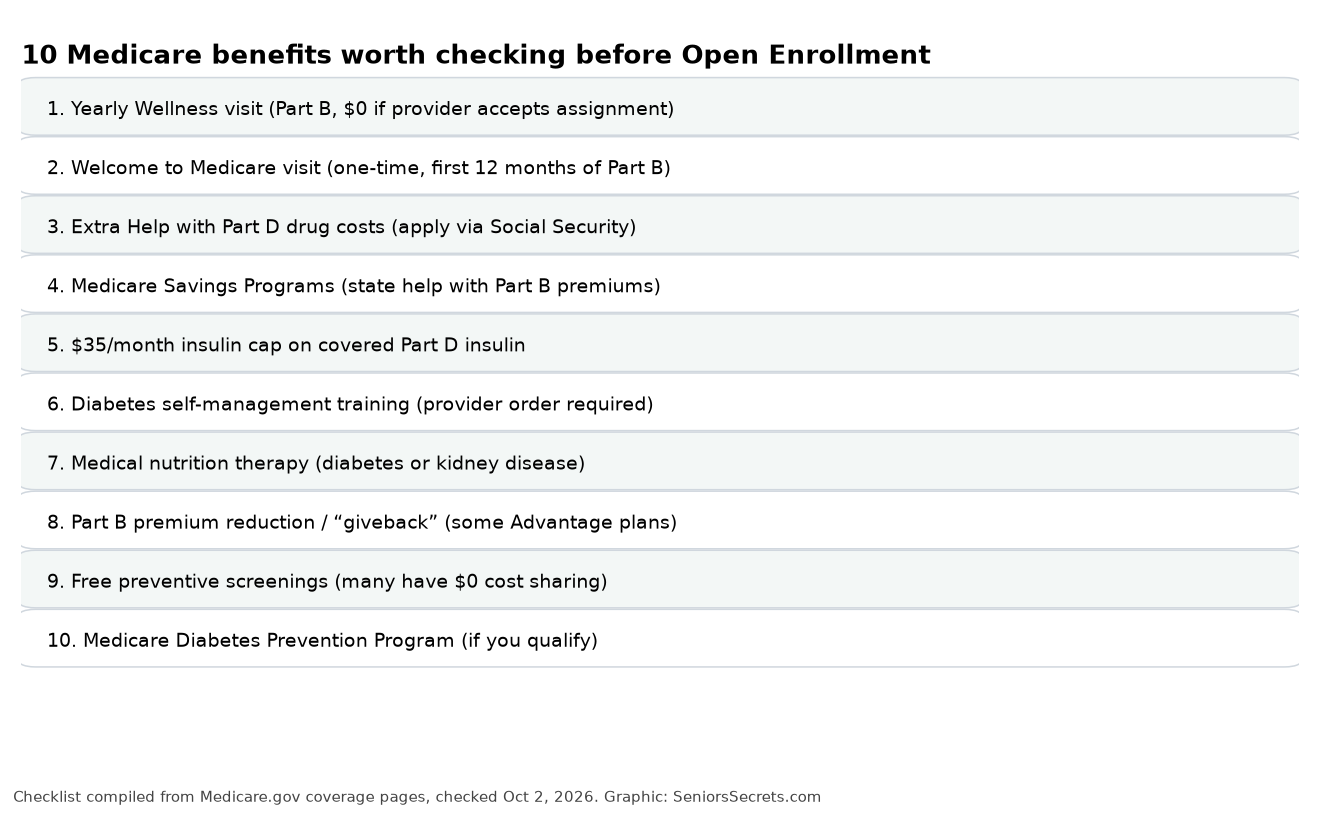
1. Your yearly “Wellness” visit (often free)
Medicare Part B covers a yearly “Wellness” visit once every 12 months. It is a prevention-planning visit, not a head-to-toe physical. If your provider accepts assignment, you pay nothing for the visit itself, and the Part B deductible does not apply.
Ask for a “Medicare yearly Wellness visit” or “Annual Wellness Visit.” If you ask only for a “physical,” the visit may be billed as a regular office visit with cost sharing.
If you are new to Part B, also ask about the one-time “Welcome to Medicare” preventive visit, available in your first 12 months of Part B. I’ve compared the two visits in Medicare Annual Wellness Visit vs. a physical.
2. Extra Help with Part D drug costs
Extra Help (the Low-Income Subsidy) can pay Part D premiums, deductibles, and most of your prescription cost sharing. For 2026, Medicare.gov lists these income and resource limits in most states:
| Income limit | Resource limit | |
|---|---|---|
| Individual | $23,940 | $18,090 |
| Married couple | $32,460 | $36,100 |
If you qualify for Extra Help in 2027, Medicare.gov says you generally pay a $0 plan premium and $0 deductible in many plans, and up to $5.80 for each generic and $14.40 for each brand-name covered drug. Once total drug costs reach the $2,400 Part D out-of-pocket cap, you pay $0 for covered drugs for the rest of the year.
You get Extra Help automatically if you have full Medicaid, SSI, or a Medicare Savings Program that pays your Part B premium. Otherwise apply through Social Security at ssa.gov/medicare/part-d-extra-help or call 1-800-772-1213 (TTY 1-800-325-0778). Step-by-step: How to get Extra Help.
3. Medicare Savings Programs (help with Part B premiums)
Medicare Savings Programs are run by your state. Depending on the program, they can pay your Part B premium and, for Qualified Medicare Beneficiary (QMB), also Medicare deductibles, coinsurance, and copays for covered services.
Federal monthly income limits for 2026 (48 contiguous states; Alaska and Hawaii are higher; some states use more generous rules):
| Program | Helps pay | Individual monthly income | Couple monthly income | Resources (indiv. / couple) |
|---|---|---|---|---|
| QMB | Part A/B premiums and Medicare cost sharing | $1,350 | $1,824 | $9,950 / $14,910 |
| SLMB | Part B premium | $1,616 | $2,184 | $9,950 / $14,910 |
| QI | Part B premium | $1,816 | $2,455 | $9,950 / $14,910 |
QI is first-come, first-served in many states and must be renewed each year. Apply through your state Medicaid office even if you think you are slightly over the limit. More detail: Medicare Savings Programs that can eliminate premiums.
4. The $35 monthly insulin cap
For covered insulin products under Part D, Medicare and CMS describe a $35 monthly cost-sharing cap per covered insulin, and the Part D deductible does not apply to that insulin. Ask your pharmacist: “Is this insulin under the Medicare $35 cap?” If you are paying more, call your plan.
Extra Help can lower insulin costs further. People with full Medicaid in the QMB program have separate, lower drug caps listed on Medicare.gov.

5. Diabetes self-management training (DSMT)
If you have diabetes and a provider order, Part B covers diabetes self-management training: up to 10 hours of initial training (typically 1 hour individual and 9 hours group), then up to 2 hours of follow-up each calendar year after the year you completed the initial training. After you meet the Part B deductible, you pay 20% of the Medicare-approved amount.
6. Medical nutrition therapy
If you have diabetes or kidney disease, or you had a kidney transplant in the last 36 months, and a doctor refers you, Part B covers medical nutrition therapy from a registered dietitian or qualifying nutrition professional. Medicare.gov says you pay nothing if you qualify: 3 hours in the first calendar year, then up to 2 hours of follow-up in later years (with more hours possible if your doctor documents a change in condition).
7. Part B premium reduction (“giveback”) on some Advantage plans
Some Medicare Advantage plans reduce the Part B premium you pay to Social Security. The amount varies by plan and county. It is not a cash rebate you request from Medicare; it is a plan benefit you choose during enrollment.
For 2026, the standard Part B premium is $202.90 a month and the Part B deductible is $283. As of October 2, 2026, CMS has not announced the 2027 Part B premium or deductible. I’ll update related posts when those numbers land. How givebacks work: Medicare Giveback Benefit. Compare plans on Medicare Plan Finder.

8. Preventive screenings with $0 cost sharing (when rules are met)
Part B covers a long list of preventive and screening services. Many have no copay and no Part B deductible when you use a provider who accepts assignment and the service is billed as preventive. Common ones people skip:
- Screening mammograms
- Colorectal cancer screening (several test options; rules depend on age and risk)
- Lung cancer screening with low-dose CT if you meet age and smoking-history criteria
- Bone mass measurement when you are at risk for osteoporosis
- Cardiovascular and diabetes screenings
- Flu, pneumococcal, hepatitis B, and COVID-19 vaccines under the preventive vaccine rules
A diagnostic test ordered because of symptoms can have cost sharing even if the same test is free when it is preventive. Say “preventive screening” when you schedule. Full list: Free Medicare preventive screenings.
9. Medicare Diabetes Prevention Program
If you have prediabetes and meet the program rules, Medicare covers the Medicare Diabetes Prevention Program. Sessions can be in person or virtual. Ask your doctor whether you qualify and how to find a supplier in your area.
10. Help appealing a coverage denial
If Medicare or your plan denies a claim or service you believe should be covered, you have appeal rights. Start with the instructions on your denial notice or Medicare Summary Notice. Deadlines are short. SHIP counselors help with appeals at no charge. Call 1-800-MEDICARE (1-800-633-4227; TTY 1-877-486-2048) for your local SHIP number, or use shiphelp.org.
I am not going to invent a “win rate” for appeals. Outcomes depend on the facts of the claim. What is true: many people never appeal, and the process exists for a reason.
How to use this list during Open Enrollment
- Pull your Annual Notice of Change and mark anything that changed for 2027. Line-by-line help: Your ANOC for 2027.
- Schedule the Wellness visit if you are due, using the exact name above.
- Screen for Extra Help and Savings Programs if income is tight. Apply even if you are unsure.
- Check insulin and other high-cost drugs in Plan Finder with your real list.
- Ask about DSMT or nutrition therapy at your next diabetes or kidney visit if you have never used them.
For the bigger 2027 picture (Part D cap, negotiated drugs, telehealth), see Medicare changes for 2027.
FAQ
Are these benefits only on Medicare Advantage?
No. Wellness visits, Welcome to Medicare, Extra Help, Savings Programs, DSMT, medical nutrition therapy, many preventive screenings, and the Diabetes Prevention Program are Original Medicare (Part B) or federal/state assistance benefits. The Part B giveback and some dental/vision/hearing extras are Advantage-plan features. The insulin cap applies through Part D coverage (stand-alone or Advantage with drugs).
Will claiming Extra Help or a Savings Program hurt my Social Security?
These programs reduce what you pay for Medicare. They are not a loan. Eligibility is based on income and resources under the rules Medicare and your state publish. Ask SHIP or your state Medicaid office if you have a special situation (working, supporting a dependent, Alaska/Hawaii).
What about dental, vision, and hearing?
Original Medicare generally does not cover routine dental, eyeglasses, or hearing aids. Some Medicare Advantage plans add allowances. Those amounts change every year, so treat them as plan extras to compare in Plan Finder, not as guaranteed Medicare benefits.
Bottom line
The most expensive benefit is the one you never use because nobody told you the right name for it. Start with the Wellness visit, Extra Help, and Savings Programs, then work down the list with your ANOC in hand before December 7.