

To enroll in Medicare for the first time, sign up for Part A and Part B through Social Security during your 7-month Initial Enrollment Period: the 3 months before the month you turn 65, your birthday month, and the 3 months after. If you already collect Social Security (or Railroad Retirement) benefits at least 4 months before 65, you don’t need to do anything; you’re enrolled automatically and your card arrives about 3 months before your birthday. Everyone else should apply online at ssa.gov, ideally 1 to 3 months before the birthday month so coverage starts on time.
The one big exception: if you or your spouse are still working and have group health insurance from an employer with 20 or more employees, you can usually delay Part B without a penalty.
I put this guide together from Medicare.gov’s sign-up pages, its late enrollment penalty rules, and the CMS 2026 premium fact sheet, all checked October 10, 2026. I research and compare Medicare options for readers; I’m not a licensed insurance agent, and I don’t sell plans.
Step 1: Check if you’re enrolled automatically
| Your situation | What happens |
|---|---|
| Getting Social Security or RRB benefits at least 4 months before 65 | Enrolled in Parts A and B automatically; card mailed about 3 months before your birthday month |
| Not yet collecting Social Security | You must sign up yourself |
| Under 65 with disability benefits | Enrolled automatically after 24 months of disability benefits |
| ALS | Enrolled automatically when disability benefits start |
| Living in Puerto Rico | Part A automatic; you must sign up for Part B yourself |
If you’re enrolled automatically and want to delay Part B because you have qualifying job-based coverage, follow the instructions with your card to turn Part B down. Don’t just ignore it, or you’ll be billed.
Step 2: Know your deadlines
Your Initial Enrollment Period (IEP) is 7 months long. When you sign up inside that window decides when your Part B starts:
| If you sign up… | Part B coverage starts |
|---|---|
| 1-3 months before your birthday month | The 1st of your birthday month |
| During your birthday month | The 1st of the next month |
| 1-3 months after your birthday month | The 1st of the month after you sign up |
Premium-free Part A starts the month you turn 65. One quirk: if your birthday falls on the 1st, Medicare treats you as turning 65 the month before, so everything shifts a month earlier.
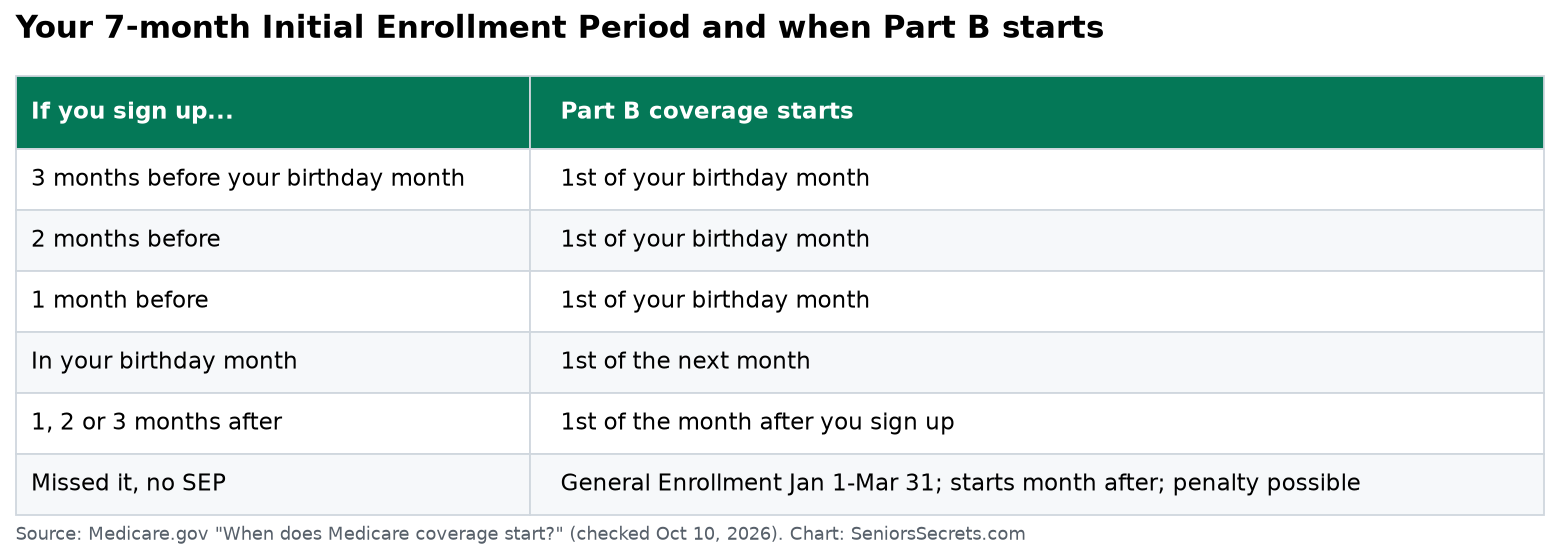
If you miss your IEP and don’t qualify for a Special Enrollment Period, you wait for the General Enrollment Period (January 1 to March 31). Coverage starts the month after you sign up, and a late penalty may apply. More in my General Enrollment Period guide.
Step 3: Decide whether to delay Part B
Part A is free for most people (you or your spouse paid Medicare taxes for about 10 years), so nearly everyone takes it at 65. Part B costs $202.90 a month in 2026 for most people, with a $283 annual deductible. Higher earners pay more through IRMAA. 2027 amounts haven’t been announced yet.
You can usually delay Part B without a penalty if:
- You or your spouse are still working, and
- You’re covered by that employer’s group health plan, and
- The employer has 20 or more employees.
When the job or the coverage ends (whichever comes first), you get an 8-month Special Enrollment Period to sign up for Part B. COBRA and retiree coverage don’t count as current employment coverage, so the 8-month clock starts when the job ends even if you’re on COBRA. My Special Enrollment Period guide covers the paperwork (forms CMS-40B and CMS-L564).
Small employer (under 20 employees)? Medicare usually pays first, so you generally need Part B at 65. Ask the plan in writing.
Health Savings Account? You can’t contribute to an HSA once any part of Medicare starts, and Part A can be backdated up to 6 months when you sign up late. Many people stop HSA contributions 6 months before they plan to enroll to avoid a tax penalty.
Marketplace (ACA) coverage? It doesn’t let you delay Part B penalty-free. Sign up during your IEP.
Step 4: Apply
You have three ways to apply through Social Security:
- Online at ssa.gov. This is fastest for most people; you’ll need a my Social Security account.
- By phone at 1-800-772-1213 (TTY 1-800-325-0778).
- At a local Social Security office. Call ahead for an appointment.
Have these ready: Social Security number, birth certificate or other proof of age, proof of citizenship or lawful residence, and, if you’re signing up after a delay, proof of employer coverage (form CMS-L564 completed by the employer).

Step 5: Choose how you’ll get your coverage
Once you have Parts A and B, you choose between two main paths:
- Original Medicare + a Medigap plan + a Part D drug plan. You can see any doctor who takes Medicare. Your best time to buy Medigap is your 6-month Medigap Open Enrollment Period, which starts the month you’re 65 or older and enrolled in Part B. During that window insurers can’t turn you down or charge more for health conditions. See my best Medigap plans guide.
- Medicare Advantage (Part C). A private plan that replaces Original Medicare for most purposes, usually with drug coverage built in and a network. My Medicare Advantage vs. Original Medicare comparison walks through the trade-offs.
Don’t forget drug coverage. If you go 63 days or more without Part D or other creditable drug coverage after your IEP, you’ll owe a Part D penalty for as long as you have it.
The penalties, with real numbers
Late penalties aren’t one-time fees. They’re added to your premium, usually for life.
| Penalty | How it works | 2026 example from Medicare.gov |
|---|---|---|
| Part B | +10% for each full 12 months you could have had Part B but didn’t | 2 years late: $202.90 + 20% = about $243.50 a month |
| Part D | +1% of the national base premium for each month without creditable coverage | 14 months: 14% x $38.99 = about $5.50 a month added |
| Part A (only if you buy Part A) | +10%, for twice the number of years you delayed | Rare; most people get Part A free |
You won’t owe a Part B penalty if you qualify for a Special Enrollment Period or enroll in a Medicare Savings Program, and Extra Help removes the Part D penalty.
Mistakes I see most often
- Assuming Social Security will sign you up when you haven’t started benefits. If you’re not collecting yet, you must apply.
- Treating COBRA or retiree coverage as a reason to delay Part B. It isn’t. Penalties and gaps follow.
- Waiting until your birthday month and starting coverage a month late.
- Skipping Medigap during the 6-month window, then failing medical underwriting years later.
- Forgetting drug coverage because you take no medications today.
Common questions
When should I sign up for Medicare if I turn 65 soon?
Apply 1 to 3 months before your birthday month so Part A and Part B start on the 1st of the month you turn 65.
Do I have to sign up for Medicare if I’m still working?
You can delay Part B without a penalty if you have group coverage from your or your spouse’s current job at an employer with 20 or more employees. Most people still take premium-free Part A at 65 unless they contribute to an HSA.
Can I enroll in Medicare online?
Yes. You can apply for Medicare Parts A and B on the Social Security website. You can also apply by phone or at a local office.
What happens if I miss my Initial Enrollment Period?
You can sign up during the General Enrollment Period from January 1 to March 31, with coverage starting the next month, and you may owe a lifetime Part B penalty unless you qualify for a Special Enrollment Period.
Is Medicare enrollment automatic at 65?
Only if you already receive Social Security or Railroad Retirement benefits at least 4 months before turning 65. Otherwise, you need to apply.
Written by Khasim Basha Shaik. I research and compare Medicare plans and rules for readers. I’m not a licensed insurance agent and don’t sell plans. This article summarizes Medicare.gov, Social Security, and CMS information and is not legal or financial advice. Last reviewed October 10, 2026.