Shoulder Exercises for Seniors: 8 Gentle Moves for Stiffness and Pain (With a Weekly Plan)

If reaching a high shelf, fastening a bra or seatbelt, or pulling on a coat has started to hurt, you’re far from alone. The shoulder is the most mobile joint in the body. It gives up some stability for that range, and it loses flexibility quickly when we stop using it fully.
The good news is that gentle, regular exercise is the main treatment for most everyday shoulder stiffness. Below are eight moves, how many reps to do, how often to do them, and the warning signs that mean you should stop and get checked.
I’m a researcher, not a physical therapist. The reps and frequencies here come from the American Academy of Orthopaedic Surgeons’ rotator cuff and shoulder conditioning program. The AAOS recommends doing that program with your doctor’s or physical therapist’s guidance. If you’ve had a recent injury, surgery or shoulder replacement, get cleared first.
Why shoulders stiffen and hurt with age
Four small muscles, the rotator cuff, hold the ball of the upper arm in its shallow socket. Over the years, their tendons lose some elasticity and blood supply. Common problems in older adults include:
- Rotator cuff tendinitis or tears: pain when lifting the arm out to the side or overhead, often worse at night. See my guide to rotator cuff tears.
- Frozen shoulder (adhesive capsulitis): the joint capsule thickens and tightens, and motion becomes very limited. It’s more common in people with diabetes. See frozen shoulder in seniors.
- Osteoarthritis: wear of the joint cartilage, which causes aching and grinding.
- Bursitis: inflammation of the fluid sac that cushions the joint.
Each problem responds a little differently, but most share one thing: careful movement usually helps more than resting the arm completely. Rounded, forward-slumped posture also crowds the shoulder joint, which is why several of these moves work the upper back. My posture exercises pair well with them.
Before you start: the ground rules
- Warm up for 5 to 10 minutes. The AAOS suggests low-impact activity like walking or a stationary bike. A warm shower also helps loosen stiff tissue.
- Stretch first, then strengthen, then stretch again to finish.
- Respect pain. The AAOS says you shouldn’t feel pain during an exercise. A mild stretch or muscle tiredness is fine. Sharp, catching or increasing pain means stop.
- Move slowly, about two seconds in each direction, and breathe out on the effort.
- Gear: a sturdy chair or table, a wall, a doorway and a light resistance band.
The 8 moves
1. Pendulum swings (mobility)
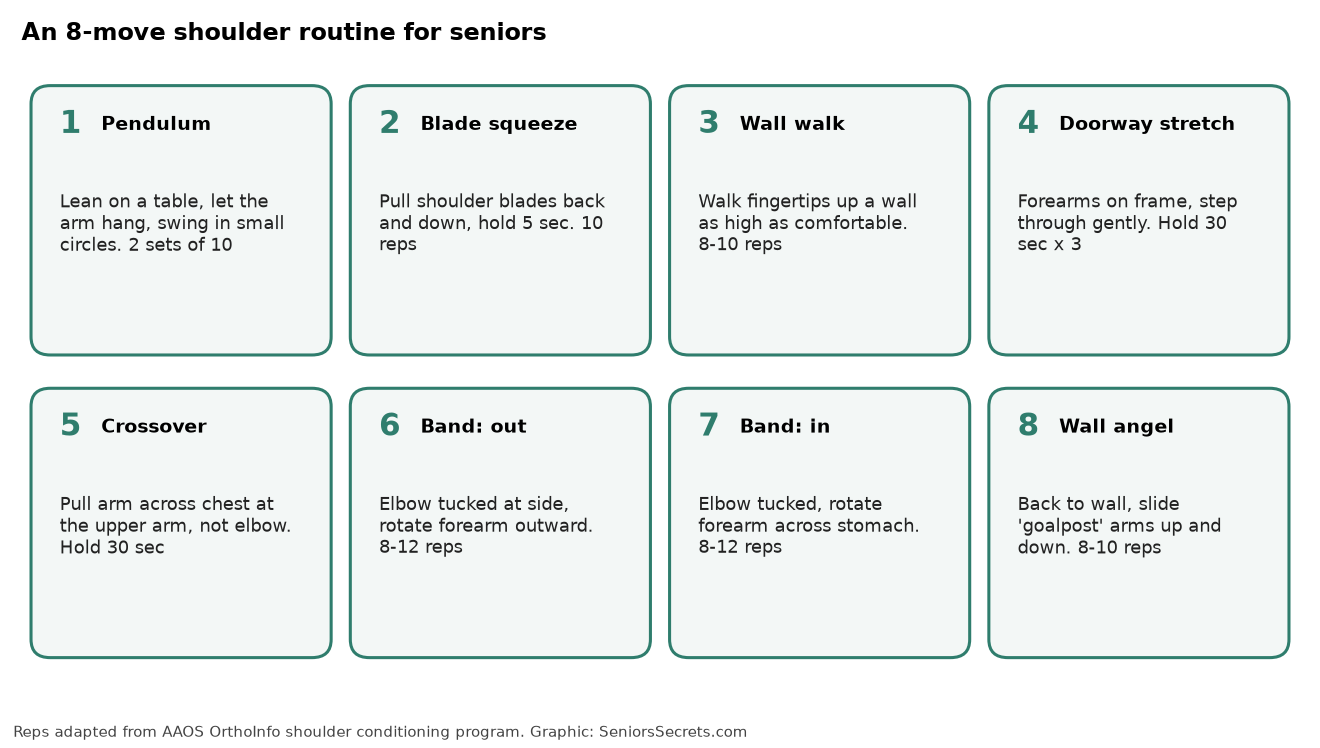
Lean forward and rest one hand on a table or counter. Let the other arm hang loose. Gently swing it forward and back, then side to side, then in small circles, letting your body’s rocking do the work. The AAOS suggests 2 sets of 10, 5 to 6 days a week. Don’t round your back or lock your knees. This is a good first move on a painful day.
2. Shoulder blade squeezes (posture and stability)
Sit or stand tall. Draw your shoulder blades back and down, as if pinching a pencil between them. Hold 5 seconds, then release. Do 10 reps. You can do these anytime, even in the car or at your desk. Don’t shrug toward your ears.
3. Wall walks (range of motion)
Face a wall and put your fingertips on it at chest height. Slowly “walk” them upward as far as is comfortable, then walk them back down. Do 8 to 10 reps. The wall supports the weight of your arm, so you can regain overhead reach a little at a time. Put a small sticker at your high point to track your progress.
4. Doorway chest stretch (flexibility)
Stand in a doorway with your forearms on the frame, elbows at about shoulder height. Step one foot through until you feel a gentle stretch across your chest and the front of your shoulders. Hold 30 seconds, and repeat 3 times. Tight chest muscles pull the shoulders forward, so this helps posture too.
5. Crossover arm stretch (flexibility)
Relax your shoulders. Gently pull one arm across your chest, holding it at the upper arm, not the elbow. Hold 30 seconds, relax 30 seconds. The AAOS suggests 4 per side. You should feel this in the back of the shoulder.
6. Outward rotation with a band (rotator cuff)
Tie a light band to a doorknob at waist height. Stand with your elbow bent 90 degrees and tucked against your side. Keeping the elbow in, slowly rotate your forearm outward, then return. The AAOS starts at 3 sets of 8, building to 3 sets of 12, 3 days a week. This strengthens the muscles at the back of the cuff that hold the joint steady.
7. Inward rotation with a band (rotator cuff)
Turn around so the band pulls your hand outward. Keep the elbow pressed into your side, and bring your forearm across your stomach. Use the same reps as move 6. Doing both keeps the muscles around the joint balanced.
8. Wall angels (mobility and posture)
Stand with your back against a wall, feet a few inches out. Bend your arms into a “goalpost” shape against the wall. Slowly slide them up and down, keeping as much contact as you comfortably can. Do 8 to 10 reps. Don’t force your arms flat; contact will improve over the weeks.
Optional ninth move, standing rows: Loop the band around a doorknob. With your elbow at your side, pull it straight back while squeezing your shoulder blades together. The AAOS suggests 3 sets of 8. My resistance band guide explains how to choose a band strength.
If you’re having a painful day
Stick to pendulums, shoulder blade squeezes and gentle arm circles. For circles, hold both arms out to the sides and make 10 small, slow circles forward, then 10 backward. Make the circles bigger only as comfort allows. Skip the band moves until the flare calms down.
Can you do these seated?
Yes. Shoulder blade squeezes, crossover stretches, arm circles and both band rotations work well in a sturdy armless chair. That’s useful if standing or balance is a concern. For a full seated routine, see chair yoga for seniors.
How often to do them
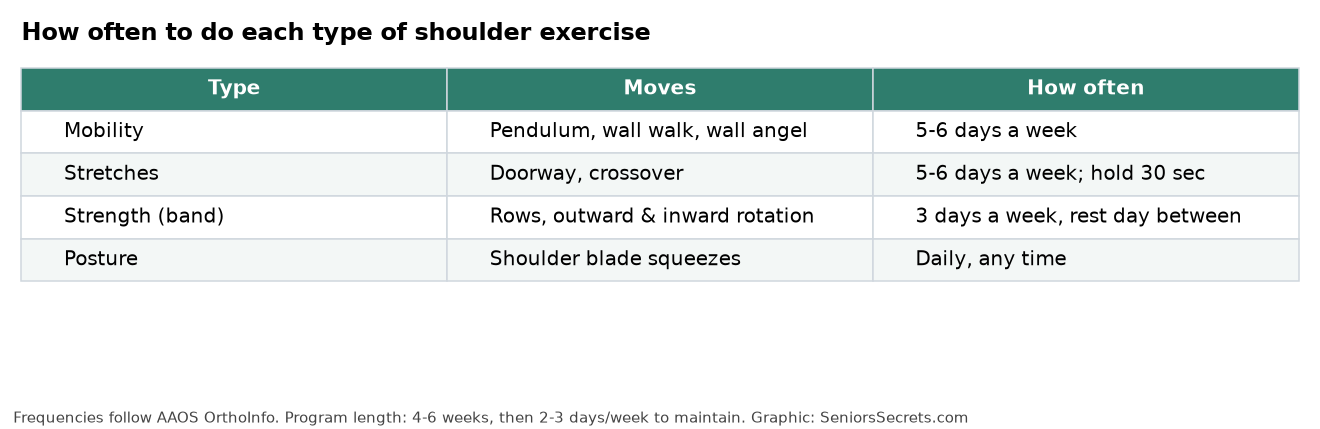
The AAOS program runs 4 to 6 weeks. After that, doing the exercises 2 to 3 days a week helps maintain strength and range of motion. A 10-minute routine most days does more good than an occasional long session. Many people notice easier movement within a few weeks, but frozen shoulder and cuff tears can take much longer and usually need a therapist’s guidance.
Heat or ice? Warmth before exercise loosens stiff tissue. An ice pack wrapped in a cloth for 15 to 20 minutes afterward can calm soreness. Use whichever helps.
Common mistakes
- Skipping the warm-up. Stretching cold tissue invites a strain.
- Shrugging. Hiking your shoulders toward your ears shifts the work to your neck.
- Using too heavy a band. The rotator cuff muscles are small. A light band with more reps is safer.
- Swinging with momentum. Slow, controlled reps build stability.
- Only stretching. Flexibility without strength leaves the joint loose. Do both.
- Ignoring the good side. Working both shoulders keeps your posture balanced.
Stop and get checked if…
- You can’t lift your arm, or it suddenly feels weak, especially after a fall.
- You have numbness or tingling running down the arm.
- The pain is severe, wakes you most nights, or is getting worse.
- You have swelling, redness, warmth or fever.
- There’s no improvement after 4 to 6 weeks of consistent home exercise.
Shoulder pain with chest pressure, shortness of breath, sweating or jaw pain can be a heart attack. Call 911.
A physical therapist can tailor a program to your diagnosis. Medicare Part B covers outpatient physical therapy when it’s medically necessary. You typically pay 20% after the Part B deductible ($283 in 2026). My guide to Medicare physical therapy coverage has the details.

FAQ
How long until stiff shoulders improve?
Many people feel looser within a few weeks of consistent, gentle exercise. The AAOS conditioning program runs 4 to 6 weeks. Frozen shoulder can take many months.
Are these exercises safe with a rotator cuff tear?
Gentle mobility moves are often fine. Ask your doctor or physical therapist before doing band strengthening if you have a known tear, and stop anything that causes sharp pain.
Should exercise hurt?
No. Mild stretching or muscle tiredness is normal. The AAOS says you shouldn’t feel pain during the exercises. If you do, stop and talk to your doctor or therapist.
Does Medicare pay for physical therapy for shoulder pain?
Yes. Part B covers medically necessary outpatient physical therapy. You usually pay 20% of the approved amount after the deductible.
What’s the best single shoulder exercise for seniors?
There isn’t one. Pendulums are the gentlest starting point, and band rotations build the most stability. A balanced routine of mobility, stretching and strengthening works best. For whole-body ideas, see my senior fitness guide.
Related guides