
Folate for seniors—vitamin B9—is one of the most important nutrients for the aging brain, heart, and blood, and also one of the easiest to get wrong. Get too little and you risk anemia, fatigue, and elevated homocysteine. Take high-dose folic acid supplements carelessly and you can mask a dangerous vitamin B12 deficiency until nerve damage is permanent. This guide explains how much folate older adults actually need, where to get it, and the one supplement rule every senior should follow.
I am Margaret Collins. Folate sits at the center of a subtle but serious interaction in senior nutrition, and the nuance is exactly where most generic advice falls short. Let us get it right.
Table of Contents
- What Folate Does in the Body
- How Much Folate Seniors Need
- The B12 Masking Trap
- What the Research Shows
- Best Food Sources and Supplements
- Frequently Asked Questions
What Folate Does in the Body
Folate is a water-soluble B vitamin essential for making DNA and red blood cells and for processing the amino acid homocysteine. “Folate” refers to the natural form found in food; folic acid is the synthetic form used in supplements and in fortified grains. Without enough folate, cells that divide rapidly—like those in bone marrow—cannot mature properly, producing large, immature red blood cells. The result is megaloblastic anemia, with fatigue, weakness, pallor, and shortness of breath.
Folate also helps keep homocysteine in check. Elevated homocysteine is associated with higher cardiovascular and cognitive risk, and folate, B12, and B6 together drive its breakdown. This is why the three B vitamins are so often discussed as a team.
How Much Folate Seniors Need
The recommended dietary allowance does not drop with age. Here are the key numbers, measured in micrograms of dietary folate equivalents (mcg DFE):
| Measure | Amount | Note |
|---|---|---|
| RDA, adults 51+ | 400 mcg DFE/day | Same for men and women |
| Tolerable upper limit (folic acid) | 1,000 mcg/day | Applies to synthetic folic acid, not food folate |
| Typical multivitamin | 200–400 mcg | Usually enough to fill gaps |
Because the United States has fortified enriched grains with folic acid since 1998, outright folate-deficiency anemia is now uncommon in healthy seniors. The people most at risk are those with poor diets, heavy alcohol use, malabsorption conditions (celiac, Crohn’s, bariatric surgery), or who take folate-depleting medications such as methotrexate, certain anti-seizure drugs (phenytoin), or sulfasalazine. If that is you, talk with your doctor about monitoring.
Signs your folate may be low
Deficiency builds slowly and is easy to blame on “just aging.” Watch for persistent fatigue, weakness, and breathlessness on exertion; a sore, smooth, or beefy-red tongue (glossitis); mouth ulcers; pale skin; irritability; and difficulty concentrating. Because these overlap with B12 deficiency, depression, and thyroid problems, a simple blood test—serum folate plus a complete blood count and B12—is the only way to know for sure. Do not self-diagnose from symptoms alone.
The B12 Masking Trap
This is the single most important thing for older adults to understand about folate. Folate and vitamin B12 deficiency cause the same megaloblastic anemia on a blood test. If you take a high dose of folic acid, it can correct the anemia—making the blood count look normal—while a coexisting B12 deficiency continues to silently damage the nervous system. The anemia is “masked,” but the neurological injury (numbness, balance loss, memory trouble) keeps progressing and can become irreversible.
This matters enormously in seniors, who are far more prone to B12 deficiency because stomach acid declines with age and common drugs like metformin and acid reducers lower B12 absorption. The practical rule: never take high-dose folic acid on your own without first confirming your B12 status. Anyone supplementing folate should have B12 checked too. For the full picture, see our guide to vitamin B12 deficiency in seniors.
What the Research Shows
Folate’s evidence is a story of correcting deficiency rather than mega-dosing for benefit:
Brain and cognition
The Dutch FACIT trial found that 800 mcg of daily folic acid for three years improved memory and information-processing speed in older adults who had elevated homocysteine and low-normal folate. Benefits are clearest in people who start out deficient; in folate-replete seniors, supplements have not reliably boosted cognition. Lowering homocysteine with B vitamins has slowed brain atrophy in some trials of people with mild cognitive impairment, but it is not a proven dementia cure.
Heart and stroke
Folic acid reliably lowers homocysteine, but large trials show it does not cut heart-attack risk much. It may modestly reduce stroke risk, particularly in populations without grain fortification. The bottom line: folate is necessary, but it is not a stand-alone heart drug.
A note on excess
Routinely exceeding the 1,000 mcg upper limit of folic acid offers no proven benefit and may carry risks, including the B12 masking described above and “unmetabolized folic acid” in the blood whose long-term effects are still debated. More is not better here.
Best Food Sources and Supplements
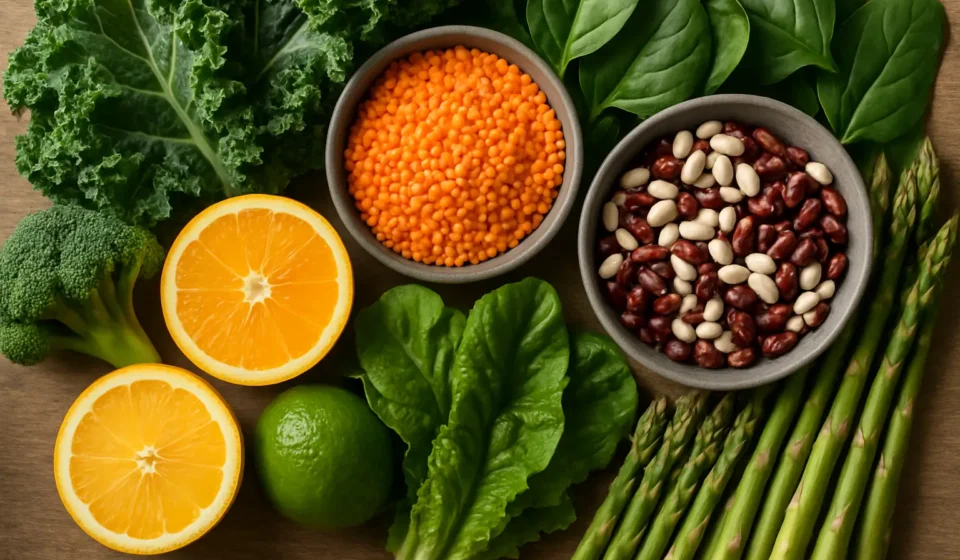
The word folate comes from the Latin folium (leaf)—and leafy greens are still the best source. Top choices include cooked lentils (about 180 mcg per half cup), spinach, asparagus, broccoli, avocado, oranges, beans, and fortified breakfast cereals (often 100–400 mcg per serving). A “food first” diet rich in vegetables and legumes will meet most seniors’ needs without any pill, and it delivers fiber and potassium as a bonus. Our MIND diet guide is built around exactly these brain-friendly foods.
If you do supplement, a standard multivitamin with 400 mcg is plenty for most people. Choose products verified by USP or NSF, avoid combining several folic-acid–heavy supplements at once, and remember that folate works best as part of a balanced approach to senior nutrition—see our Senior Nutrition Guide for how the B vitamins fit together.
Frequently Asked Questions
What is the difference between folate and folic acid?
Folate is the natural form found in foods like greens and beans; folic acid is the synthetic form added to supplements and fortified grains. Folic acid is absorbed more efficiently, which is why supplement and food-fortification amounts are measured in dietary folate equivalents.
Should seniors take a folic acid supplement?
Most seniors who eat a varied diet do not need one because fortified grains and vegetables supply enough. Supplements help those with poor intake, malabsorption, alcohol use, or certain medications—but always confirm your B12 status first.
Can too much folic acid be harmful?
Yes. Exceeding 1,000 mcg of folic acid per day can mask a vitamin B12 deficiency and allow nerve damage to progress undetected. It offers no proven extra benefit, so stay within the upper limit unless a doctor directs otherwise.
Does folate help prevent dementia?
Correcting a folate deficiency can improve cognition, and lowering homocysteine has slowed brain shrinkage in some trials of mild cognitive impairment. But for seniors who already have enough folate, supplements have not been shown to prevent dementia.
Related Articles You May Find Helpful
- Senior Nutrition Guide 2026
- Vitamin B12 Deficiency in Seniors 2026
- MIND Diet for Seniors 2026
- Zinc Deficiency in Seniors 2026
- Selenium for Seniors 2026
Sources
- NIH Office of Dietary Supplements — Folate Fact Sheet
- FACIT Trial (Durga et al., The Lancet) — Folic acid and cognitive function
- NIH / NIA — B vitamins, homocysteine, and brain health
This article is educational and not a substitute for professional medical advice. See our Medical Disclaimer and Editorial Guidelines.