
The best exercise plan after 75 looks different from the one that worked at 65. Muscle loss speeds up. Fall risk rises. Recovery takes longer. The good news is that the official guidance is clear, and you do not need a gym membership to follow it.
I checked the CDC’s physical activity guidelines for adults 65 and older, Medicare’s coverage pages for fitness-related benefits, and the practical moves that show up again and again in fall-prevention programs. This page is the over-75 version: what to do each week, eight concrete exercises, what to skip, and how Medicare can help pay for support.
I’m a researcher, not a doctor or physical therapist. If you have heart disease, severe osteoporosis, recent surgery, or dizziness on standing, get a clinician’s OK before you change your routine.
The short version
According to the CDC’s older-adult activity guidelines, adults 65 and older need each week:
- At least 150 minutes of moderate aerobic activity (for example, 30 minutes on 5 days), or 75 minutes of vigorous activity, or a mix
- At least 2 days of muscle-strengthening work for all major muscle groups
- Balance activities each week
- If you can’t hit the targets, be as active as your abilities allow – some activity still beats none
After 75, I treat those as the ceiling to build toward, not a pass/fail test. Consistency beats intensity.

Why the plan changes after 75
Without regular activity, adults over 75 tend to lose muscle faster, walk more slowly, and fall more often than adults in their late 60s. That does not mean exercise is off the table. It means the mix matters:
| Goal | Why it matters after 75 | Practical options |
|---|---|---|
| Aerobic | Heart fitness, stamina, mood | Brisk walking, water walking, cycling on a stable bike |
| Strength | Counters sarcopenia; helps chair rises and stairs | Sit-to-stands, resistance bands, light weights |
| Balance | Directly targets fall risk | Tai chi, single-leg stands near a counter, heel-to-toe walking |
| Flexibility | Keeps daily tasks comfortable | Chair yoga, gentle stretching after walks |
If diabetes is part of your picture, pair this with our guide to exercise with diabetes after 60. For step targets, see how many steps seniors actually need.
Eight practical exercises for adults over 75
1. Sit-to-stand (functional strength)
From a sturdy chair, rise slowly without using your hands if you can, stand tall, then lower with control. Start with 6–8 reps, twice a day. This trains the same muscles you use to get off the toilet, out of a car, and up from the couch.
2. Tai chi (balance and fall prevention)
Slow, controlled weight shifts train balance and leg strength at the same time. Community classes and SilverSneakers-style programs often offer beginner forms. Our tai chi guide for seniors walks through why it shows up so often in fall-prevention research.

3. Water walking or aquatic exercise (low-impact cardio)
Water supports a large share of your body weight, which is kinder to arthritic knees and hips. Twenty to 30 minutes, three days a week, is a solid aerobic block for many people.
4. Resistance bands (strength without heavy iron)
Seated rows, band pulls, gentle presses, and seated leg work. Aim for 2 sets of 8–12 controlled reps, on 2 non-consecutive days. Bands travel well and fail safely if you lose your grip.

5. Walking with purpose (aerobic base)
Level sidewalks, mall walking, or a treadmill with a rail nearby. Use supportive shoes. Trekking poles or a rollator are tools, not failures, if balance is a concern.
6. Single-leg balance (daily fall insurance)
Stand near a kitchen counter. Hold one foot up for 10 seconds, then switch. Build toward 20–30 seconds. Keep a hand ready on the counter. More balance progressions are in our balance exercises for seniors over 70 guide.
7. Chair yoga (flexibility without floor work)
Fifteen to 20 minutes, most days, keeps shoulders, hips and spine moving without the hassle of getting up off a mat.
8. Diaphragmatic breathing (recovery tool)
Sit tall. Inhale through the nose for about 4 counts; exhale slowly through pursed lips for 6–8. Five minutes at the end of a session helps people with COPD or anxiety settle their breathing.
A sample week that meets the CDC targets
This is a template, not a prescription. Shrink every block if you are restarting after a long layoff.
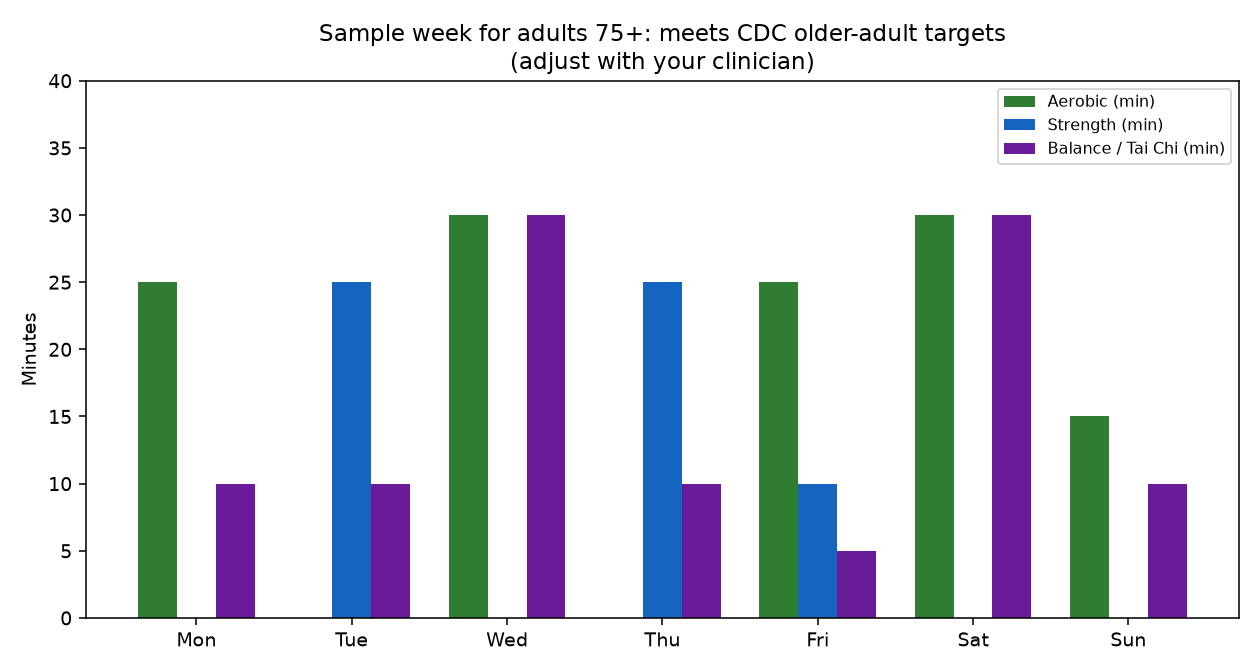
| Day | Plan | About how long |
|---|---|---|
| Monday | Walk + single-leg balance | 25 min + 10 min |
| Tuesday | Resistance bands + chair yoga | 25 min + 15 min |
| Wednesday | Tai chi or aquatic class | 30 min |
| Thursday | Resistance bands + balance | 25 min + 10 min |
| Friday | Sit-to-stands + walk | 10 min + 25 min |
| Saturday | Aquatic exercise or longer walk | 30 min |
| Sunday | Easy stroll + breathing | 15 min + 5 min |
What to approach carefully after 75
- High-impact jumping or running if you are new to it and have osteoporosis risk
- Heavy free weights without supervision when balance is shaky
- Hot yoga or outdoor hard efforts on very hot, humid days
- Floor exercises if getting up from the floor is already hard – use a chair instead
Stop and get help for chest pain, sudden severe shortness of breath, new neurological symptoms, or a fall with head injury.
Medicare benefits that can support exercise after 75
- SilverSneakers and similar fitness extras come through many Medicare Advantage (and some Medigap) plans, not through Original Medicare. Details are in our Medicare gym and SilverSneakers guide. Open Enrollment runs October 15 to December 7, 2026, for coverage that starts January 1, 2027 – a good time to check whether your plan keeps a fitness benefit.
- Physical therapy (Part B) can address balance, gait and strength when medically necessary.
- Cardiac or pulmonary rehab (Part B) offers supervised sessions after qualifying heart or lung events.
- Annual Wellness Visit (Part B) is a natural place to ask for a safe activity plan.
Original Medicare does not pay for ordinary gym memberships. Confirm any fitness perk in your plan’s Evidence of Coverage.
Feed the muscle, too
Exercise is only half of fighting age-related muscle loss (doctors call it sarcopenia). Muscles need protein to rebuild, and many older adults eat less of it as appetite drops.
The official recommended dietary allowance for adults is 0.8 grams of protein per kilogram of body weight a day. An international expert group (the PROT-AGE study group, 2013) suggested healthy adults over 65 aim higher, about 1.0 to 1.2 g/kg, and more for people who exercise or are recovering from illness. For a 150-pound (68 kg) person, that’s roughly 68 to 82 grams a day.
Practical ways to get there:
- Spread protein across meals instead of loading it all at dinner. An egg breakfast, a tuna or bean lunch and fish or chicken at dinner covers most of it.
- Have a protein snack after your strength days: Greek yogurt, cottage cheese, milk, or a handful of nuts.
- If chewing is a problem, soft options like eggs, yogurt, tofu, soups with beans or lentils, and smoothies made with milk work well.
Important exception: if you have chronic kidney disease, don’t raise protein on your own. Too much can strain the kidneys, so ask your doctor or a dietitian for your target. My kidney disease diet guide explains why the advice differs by stage.
Common questions
How many days a week should a 75-year-old exercise?
Build toward the CDC pattern: aerobic activity most days to reach 150 moderate minutes a week, strength on 2 days that aren’t back to back, and balance work each week. If you are starting from zero, three short walks a week is a legitimate first step.
What is the single best fall-prevention exercise?
No single move covers every risk factor. Tai chi has a strong track record as a balance program, and it works best alongside strength work (sit-to-stands, bands) and simple daily balance practice.
Is it safe to start exercising at 75 with no history of workouts?
Often yes, if you start easy and progress slowly. A pre-exercise check with your clinician is smart if you have multiple chronic conditions, chest symptoms, or recent falls.
Should I prioritize strength or cardio after 75?
Both. Cardio protects the heart and stamina; strength protects independence. Skipping strength is how chair rises and grocery bags get harder.
Does Medicare pay for a personal trainer?
Not as a routine benefit. Medically necessary physical therapy is different. Fitness memberships, when covered, usually come through Medicare Advantage extras.
Written by Khasim Basha Shaik. I research senior health topics and compare official guidance for readers. I’m not a doctor, physical therapist, or fitness professional. This article summarizes public CDC and Medicare.gov guidance and is not medical advice. Last reviewed October 9, 2026.
Related guides